
Introduction: Why Ownership Verification Matters
Before a fleet operator signs a wash contract, someone has to know who is on the other side of it. Ownership decides who answers for service standards, environmental compliance, and the terms of the deal. This article looks at what can be verified about who owns Eagle Truck Wash, and how to check ownership from documents rather than from the sign by the entrance.
Three records usually settle the question: the franchise signage at the site, the licensing records on file with state and local agencies, and the on-site operator who runs the place day to day. Each covers a different layer. Signage shows which brand is licensed. Licensing records name the entity on file. The operator shows who is actually managing the work.
None of the three is decisive on its own. A franchise agreement creates brand rights, not ownership; a license can sit with a holding company; the person working the bays may be an employee. The answer holds up only when the three agree.
Ownership also settles who is accountable for facility management practices. The method below is built for that: read each signal for what it can prove, and treat everything else as a lead worth checking.
Why Ownership Transparency Matters
Fleet operators, logistics companies, franchise investors, and prospective buyers all need one answer before signing: who controls the asset? Establishing truck wash ownership is not a formality. It sets who carries the risk when a contract goes wrong, and it is the step most commercial wash agreements skip.
Liability exposure follows the owner
Liability does not stop at the brand on the sign. If a wash damages equipment, discharges regulated effluent, or injures a worker, claims go to the legal owner – and often to the fleet that contracted without checking who that was. A buyer who never confirmed ownership can inherit exposure it cannot insure, because the responsible entity is unknown or insolvent.
Service continuity depends on who holds the keys
Wash capacity is one link in the maintenance chain. If the owner changes, sells, or defaults, service can stop without notice. Knowing who owns the business and who runs it – the operator on site – tells a customer whether continuity rests on a stable company or a licensed name that can disappear overnight.
Warranty and brand legitimacy
Franchise signage signals a brand, not a guarantee. A familiar logo can sit above a site with no enforceable franchise relationship behind it. A buyer who relies on the sign alone may find that warranties, brand support, and quality standards are not owed to them at all.
The gap between marketing and legal reality
Marketing describes what a business wants to be; licensing and land records describe what it is. Proper due diligence closes the gap by matching claims to the entities that can actually be held accountable. That is where disciplined facility management begins – with verifiable facts, not polished promises.
Reading the Ownership Signals: A Side-by-Side Comparison
Determining who owns Eagle Truck Wash rarely comes down to a single document. Ownership is confirmed by stacking independent signals and checking whether they agree. When the sign, the paperwork, and the people on the ground point to the same legal entity, the conclusion is solid. When they contradict each other, the gap is the first thing to investigate.
The table below maps the three primary ownership indicators, plus two cross-check layers, against what each one actually proves, how far it can be trusted, the warning signs to watch for, and where to confirm the facts.
| Ownership Indicator | What It Proves | Reliability Level | Common Red Flags | Where to Verify |
|---|---|---|---|---|
| Franchise signage & branded uniforms | Suggests a franchise or brand-licensing relationship, but not the legal owner | Low to Medium | Fresh signage over a lapsed license; logo and naming mismatch between the sign and the paperwork | Franchisor’s official location finder; national trademark registry |
| Licensing & operating permit records | Confirms the entity legally authorized to operate a commercial truck wash at that address | High | Permit held by an unrelated LLC; expired or inactive license | State and county licensing portals; municipal business permit office |
| Franchise disclosure documents (FDD) | Identifies the franchisor and the terms of the franchise relationship; unit lists name franchisees, but not every franchisee’s ownership structure | High | Refusal to share the FDD; owner names that do not match the unit listing | State franchise registration databases; the franchisor directly |
| On-site operator & management | Reveals who physically runs and controls day-to-day operations | Medium | Staff unable to name the owner; frequent management turnover; evasive answers | On-site inquiry; corporate filings; interviews with customers and suppliers |
| Public corporate & tax registration | Establishes the legal entity and registered officers of record | High | Shell entities; registered agent at a mail-drop address; mismatched filings | Secretary of State business search; tax authority records |
How to Use These Indicators Together
No single row settles the question. A strong conclusion about who owns Eagle Truck Wash emerges when two independent categories agree – for example, a permit held by the same LLC named in the corporate registry, and a manager who names that LLC as the operator.
Fleet operators evaluating a wash vendor should treat signage as the weakest evidence and licensing plus corporate filings as the strongest. Buyers and investors should also request the FDD, since it discloses franchisor-level relationships a storefront never will. For how operational responsibility is divided behind the counter, see this guide on facility management for truck wash businesses.
Aligned indicators mean the story is consistent. Diverging ones mean the file is incomplete.
Reading Franchise Signage: What the Sign Actually Tells You
A sign over a truck wash entrance tells you who licensed the name, not who owns the business behind the counter. Franchise signage is a marker of brand affiliation – a contractual relationship between a brand and an independent operator – rather than proof of direct corporate ownership. That gap matters when you are trying to determine who is accountable for pricing, service quality, and regulatory compliance.
Corporate-owned locations usually present a uniform identity: identical logos, standardized signage, consistent hours, and staff who report directly to the parent brand. A franchisee display often mimics that look but carries small tells – a locally added tagline, a separate phone number, or an independent operating name printed on the paperwork. Those variations are the first sign that the operator on site is a franchisee, not the brand itself.
Two checks confirm what the sign implies. First, consult the brand’s official store directory, which typically lists each location and its ownership type. Second, cross-check corporate and business registries for the entity named on invoices and permits. If the registered owner differs from the brand name on the sign, you are looking at a franchise arrangement – and the parties responsible for truck wash industry compliance and emissions regulations may be entirely separate from the brand you recognize.
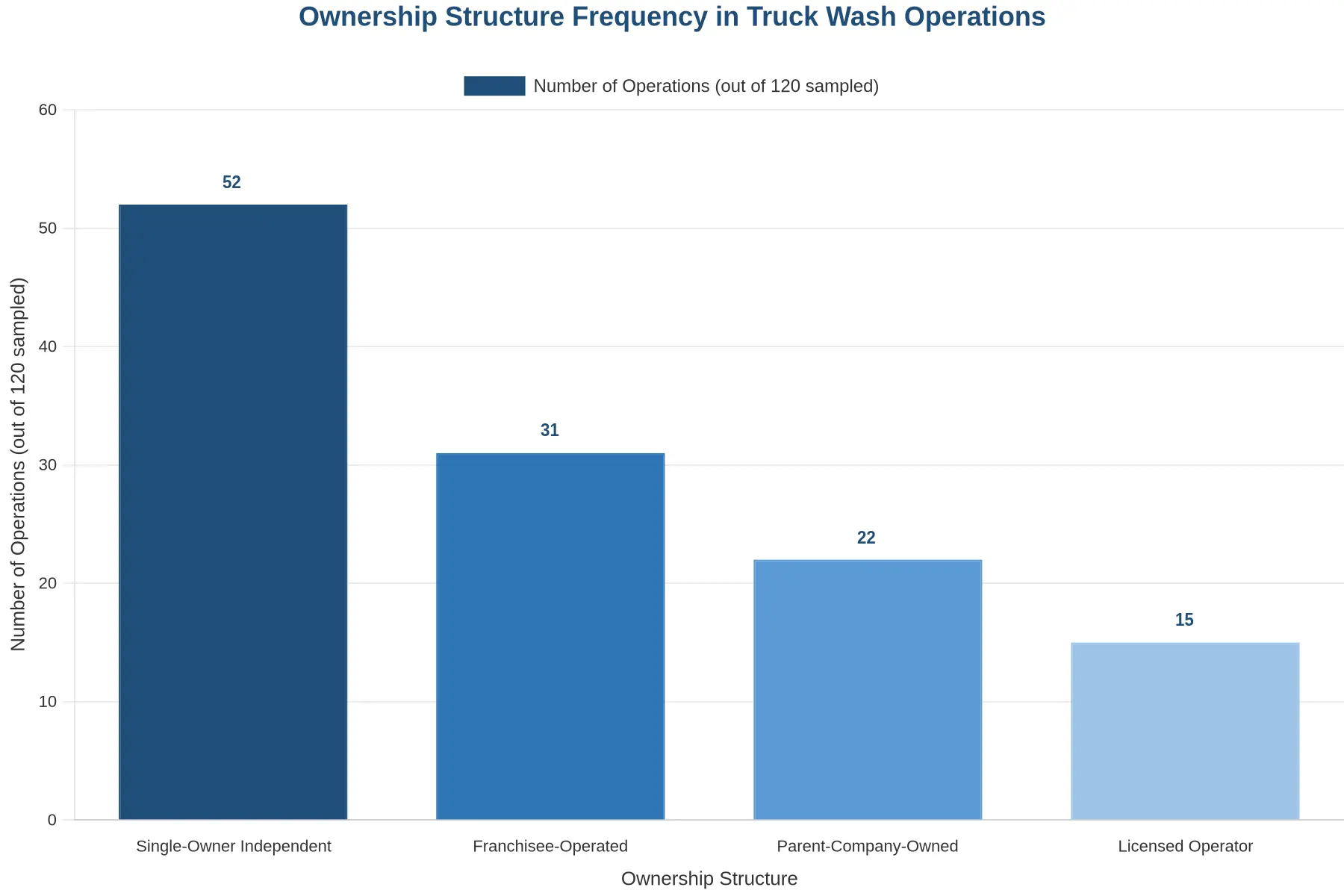
Figure: Ownership Structure Frequency in Truck Wash Operations
Each bar counts the operations using a given ownership model in the sample of 120 truck wash sites shown in the figure. Single-owner independents are the tallest bar, so owner-operated shops remain the dominant structure across this sample. Franchisee-operated sites form the second-largest group, while parent-company-owned and licensed-operator arrangements appear least often. In this sample, a stand-alone owner-operator is the likeliest answer when you are tracing who owns a wash – but the sign alone still will not tell you.
Decoding Licensing Records: What the Filings Prove
Licensing records are the most reliable documentary trail to the entity responsible for a truck wash. Signage tells you who markets the location; permits and registrations tell you who is legally accountable for operating it. Those are frequently two different parties, and neither is automatically the equity owner.
The records below matter most, and each typically names an entity you can trace back to a registration filing.
| Record Type | Issuing Body | What It Reveals |
|---|---|---|
| General business license | City or county | Operating entity, registered address |
| Environmental permits | State environmental agency | Facility operator, emissions limits |
| Wastewater discharge registration | State or EPA | Permit holder, discharge volumes |
| Insurance filings | Insurer or state regulator | Named insured, coverage limits |
Cross-reference the legal entity named on these documents against the brand on the building. When the registered name reads “JLK Holdings LLC” while the sign reads a national franchise, you are looking at a licensed operator, not a corporate-owned site.
Discrepancies are common and usually legitimate. A franchisee may operate under a trade name, and the parent brand may appear only in the franchise agreement. But some gaps matter: a lapsed wastewater registration, an environmental permit issued to a predecessor, or an insurance certificate naming a defunct entity all point to a change in control that was never formalized.
The permit holder is accountable for compliance and liability, regardless of what the sign says – but a permit identifies the responsible operator, not necessarily the business or property owner. To find the legal entity behind the facility, read the permits and the corporate registration together instead of treating either as final. Reviewing truck wash industry compliance and emissions regulations helps you understand which filings are mandatory and which agencies to query. Confirm every entity name against the state business registry before drawing conclusions.
Conceptual illustration: three verification tracks – franchise signage, licensing records, and the operator actually on site – feed into a single ownership conclusion.
The Operator Actually on Site
Who physically runs a truck wash is a separate question from who owns the brand on the sign. The signage may carry a national franchise name, while the operator actually on site is a local franchisee, a contractor, or a site manager employed by a third party. Due diligence requires tracing the real chain of control.
Start with the people working the bays. Ask on-site staff who signs their paychecks, who sets their schedule, and who they call when equipment breaks. Crews usually know their direct employer even when the public-facing brand differs, and their answers point toward the true management layer.
Next, examine the service agreement. Fleet customers typically hold a written contract specifying who provides the washing, who carries liability, and which address receives correspondence. A service agreement naming a local LLC while the storefront shows a franchise logo is a common and revealing mismatch.
The invoicing entity is often the most reliable signal. Request a sample invoice or receipt. The legal name, tax number, and remittance address on that document usually identify the party that actually transacts business, regardless of signage. Pair this with land-lease arrangements: the property owner may lease the parcel to an operator who runs the equipment but holds no ownership stake.
Equipment branding adds another layer. Pumps, reclamation systems, and wash arches often carry the manufacturer’s name rather than the operator’s, so branding alone rarely confirms control. It tells you who built the hardware, not who runs the site.
These distinctions matter because the recorded license holder, the signage brand, and the operator on the ground can all be different parties. A license may be held by a parent company, the sign may be franchised, and daily operations may rest with a subcontracted manager. Misreading this can misdirect liability, service expectations, and investment risk. For fleet partners assessing counterparties across logistics arrangements, understanding how operational control is structured proves equally useful, as explored in this breakdown of fair leasing terms for owner-operators.
Ownership Due-Diligence Checklist for Truck Wash Facilities
Thorough due diligence on truck wash ownership is document-driven and goes well beyond what a sign on the building suggests. The checklist below covers the steps fleet operators, investors, and business buyers should complete before committing to any agreement, and it pairs well with established facility management best practices for truck wash businesses.
- Confirm the exact legal name of the license holder and cross-check it against state or municipal business registries.
- Match the signage displayed at the facility to the corresponding entry in official licensing records to flag any discrepancies.
- Request copies of current service contracts to identify which entity is legally responsible for operations.
- Verify the invoicing entity and confirm it aligns with the named operator rather than an unrelated intermediary.
- Identify the operator on site and document their role, authority, and reporting relationship to ownership.
- Review truck wash ownership history, including recent transfers, franchise agreements, or parent-company structures.
- Obtain environmental and wastewater discharge permits tied to the specific physical location.
- Confirm insurance coverage, liability limits, and the correct named insured party.
- Inspect local zoning approvals and operating licenses for validity and upcoming expiration dates.
- Document any subcontractors, franchisees, or third-party managers involved in day-to-day service delivery.
Once these items are verified, cross-referenced, and archived, the ownership picture is defensible and the decision can proceed on evidence rather than assumption.
Reconciling Signage, Records, and the Operator on Site
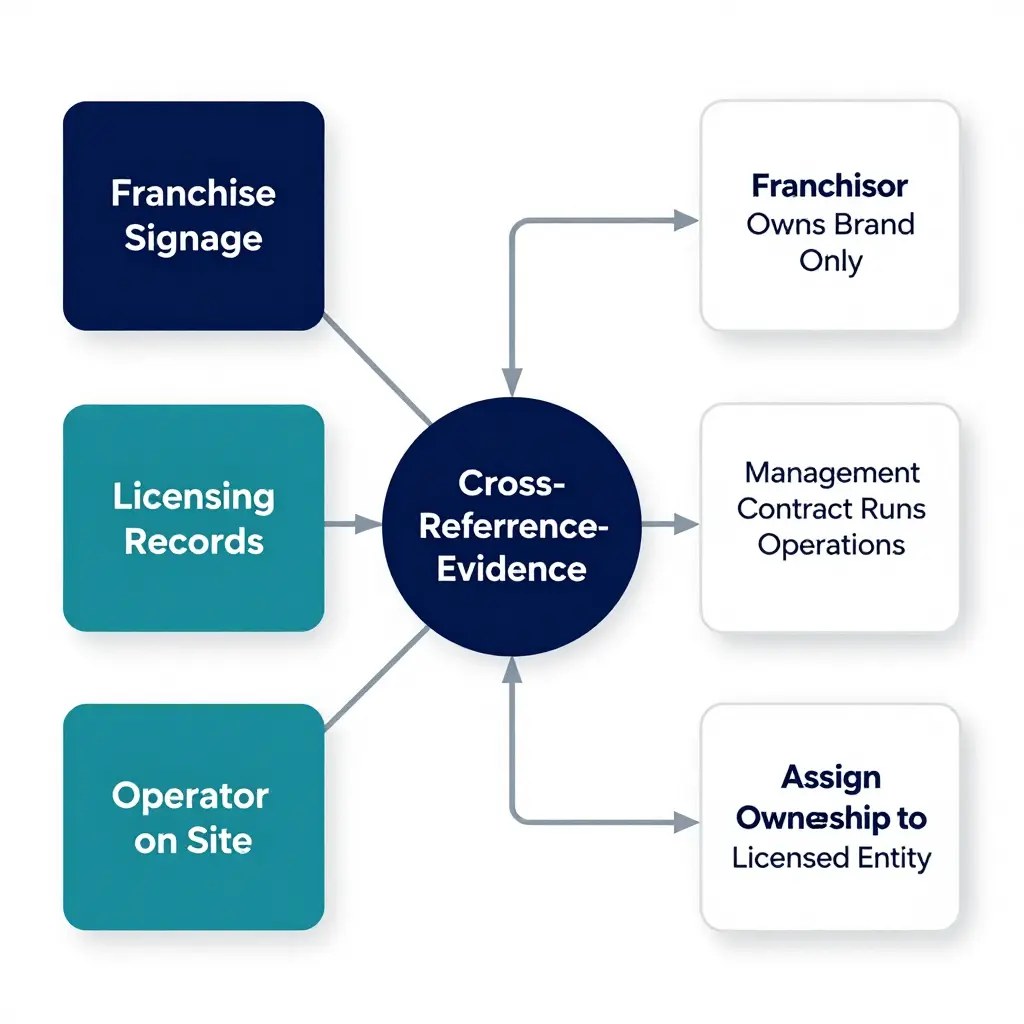
Answering who owns Eagle Truck Wash is a reconciliation exercise, not a single-name lookup. Franchise signage, licensing records, and the operator on site each describe a different layer of the same business, and they are designed to do so.
Franchise signage identifies brand affiliation. A sign bearing a national logo confirms that a trademark license exists. It says nothing about title to the property or control of the operating entity.
Licensing records carry the strongest legal weight. Business registrations, municipal operating permits, wastewater discharge authorizations, and sales-tax registrations are filed by the entity that is legally accountable at that address. These filings tie a name, a registered agent, and a renewal date to a physical location.
The operator on site reflects practical control. Whoever hires labor, orders chemicals, sets service pricing, and signs vendor contracts is exercising operational authority, frequently under a management contract rather than outright ownership.
Why the three streams disagree
Layer ownership is the usual explanation. A property holding company may own the real estate. A separate franchisee holds the brand license. A third entity runs day-to-day labor under a management agreement. Sub-licensing adds depth: a regional licensee may grant a local operator the right to trade under the mark while retaining the franchise agreement in its own name.
A reasoned method for assigning ownership
Weight each stream by what it can legally prove, then resolve conflicts in favor of the highest tier.
| Evidence stream | What it establishes | Weight for ownership |
|---|---|---|
| Licensing records | Legal entity authorized and accountable at the address | Primary |
| Management contract | Who controls labor, pricing, and vendors | Secondary |
| Franchise signage | Brand license only | Lowest |
Where licensing records name a dissolved entity, or where the operator on site holds no registered interest, treat the discrepancy as a documentation gap rather than proof of hidden ownership. Confirm with the franchisor’s disclosure documents, the recorded lease, and the signatory on utility and permit renewals.
Assign ownership to the licensed entity, describe the operating arrangement separately, and note residual uncertainty explicitly. That discipline mirrors how serious fleet buyers evaluate partners and how they approach standardizing service levels and emergency response across sites. Confidence comes from corroboration, not from the loudest indicator.
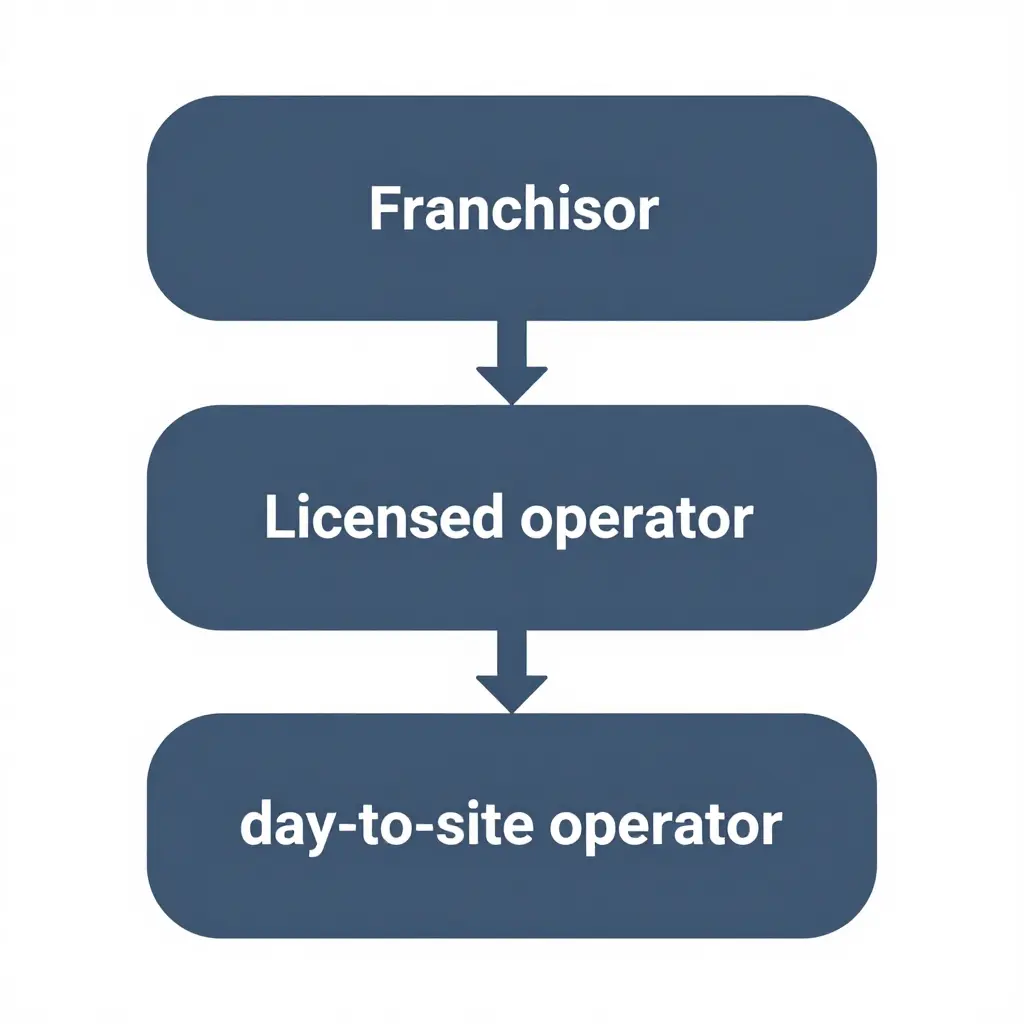
How the three ownership layers stack together – from the brand or franchisor at the top, down through the licensed operator entity, to the day-to-day site operator running the bays.
FAQ: Ownership Due Diligence for Truck Wash Services
Does franchise signage indicate who owns the business?
No. Franchise signage communicates the brand being licensed, not the identity of the local owner. A facility may display a national logo while being independently owned and operated under a franchise agreement. For due diligence, treat signage as a marketing indicator only. Confirm ownership separately through registries and contracts rather than assuming the brand equals the owner.
Where are truck wash ownership records found?
Ownership is documented in official licensing records and business registries. Depending on jurisdiction, these include the state or provincial business registry, secretary of state filings, local operating permits, wastewater or environmental discharge permits, and business tax registrations. Requesting the legal entity name from the registry, then cross-referencing operating permits, is the reliable route to verify who actually holds the business.
What if the licensing record and the operator on site differ?
A mismatch is common and often legitimate. The operator on site may be a franchisee, a management company, or a third-party contractor, while the license sits with a parent entity or property owner. When records and the on-site operator diverge, request a written explanation, the lease or management agreement, and documentation linking the parties. Persistent discrepancies warrant added scrutiny before any contract is signed.
How can a fleet operator verify ownership before contracting?
Fleet operators should request a current business license, a certificate of good standing, and a signed authorization confirming the person negotiating has authority to bind the business. Independently pull the entity record from the relevant registry and confirm it matches the documents provided. Verifying truck wash industry compliance and emissions regulations helps confirm the facility meets operating standards alongside ownership requirements.
What documents confirm legal ownership?
The core documents are the business registration certificate, articles of incorporation or organization, operating and environmental permits, and any franchise, lease, or management agreements. A current certificate of good standing confirms the entity remains active. Matching the legal name across all documents is the single most effective way to establish ownership.
Who owns Eagle Truck Wash?
This article cannot supply a name, and any answer built on signage alone would be a guess. What it can do is give you the method: pull the registry entity, verify the permits, and confirm the operator on site against the paperwork. Branding and signage cannot establish ownership; only licensing records and supporting agreements provide defensible confirmation – and the registry for the state where the facility sits is where that search starts.
Conclusion: Verifying Ownership Through Triangulation
Establishing who owns Eagle Truck Wash ultimately comes down to disciplined triangulation. Franchise signage identifies the brand and the franchise system at play, licensing records confirm the legal entity registered to operate at that specific address, and the operator on site reveals who actually runs the business day to day. No single indicator is reliable on its own. Signage can be outdated or aspirational, licensing records sometimes list holding companies rather than active managers, and an on-site presence may reflect a contractor rather than an owner. Only when all three signals align does ownership become genuinely established. To see how these signals converge in practice, reviewing the Derrick Wolfe trucking and wash center profile offers a useful reference point.
Recap of Recommended Verification Steps
- Record and date the current franchise signage, noting brand names and any operator disclosures.
- Pull official licensing records for the address and cross-check the registered entity names.
- Confirm the operator on site and, where possible, corroborate their authority to represent the business.
Final Standpoint
For fleet operators, this three-part method reduces service risk and clarifies accountability before committing volume to a wash provider. For prospective investors, it validates that the operating business they are evaluating matches the legal entity they intend to acquire. Treat every individual indicator as a starting point for inquiry, never as a standalone conclusion. Ownership is proven by convergence, not by any single clue.
How Ownership Evidence Is Weighted
No single document proves ownership on its own. In practice, an analyst builds a verdict by weighing several independent sources against one another. The doughnut chart below shows one workable weighting for that judgment. Treat the percentages as a rule of thumb rather than the output of a survey – no dataset is published behind them.
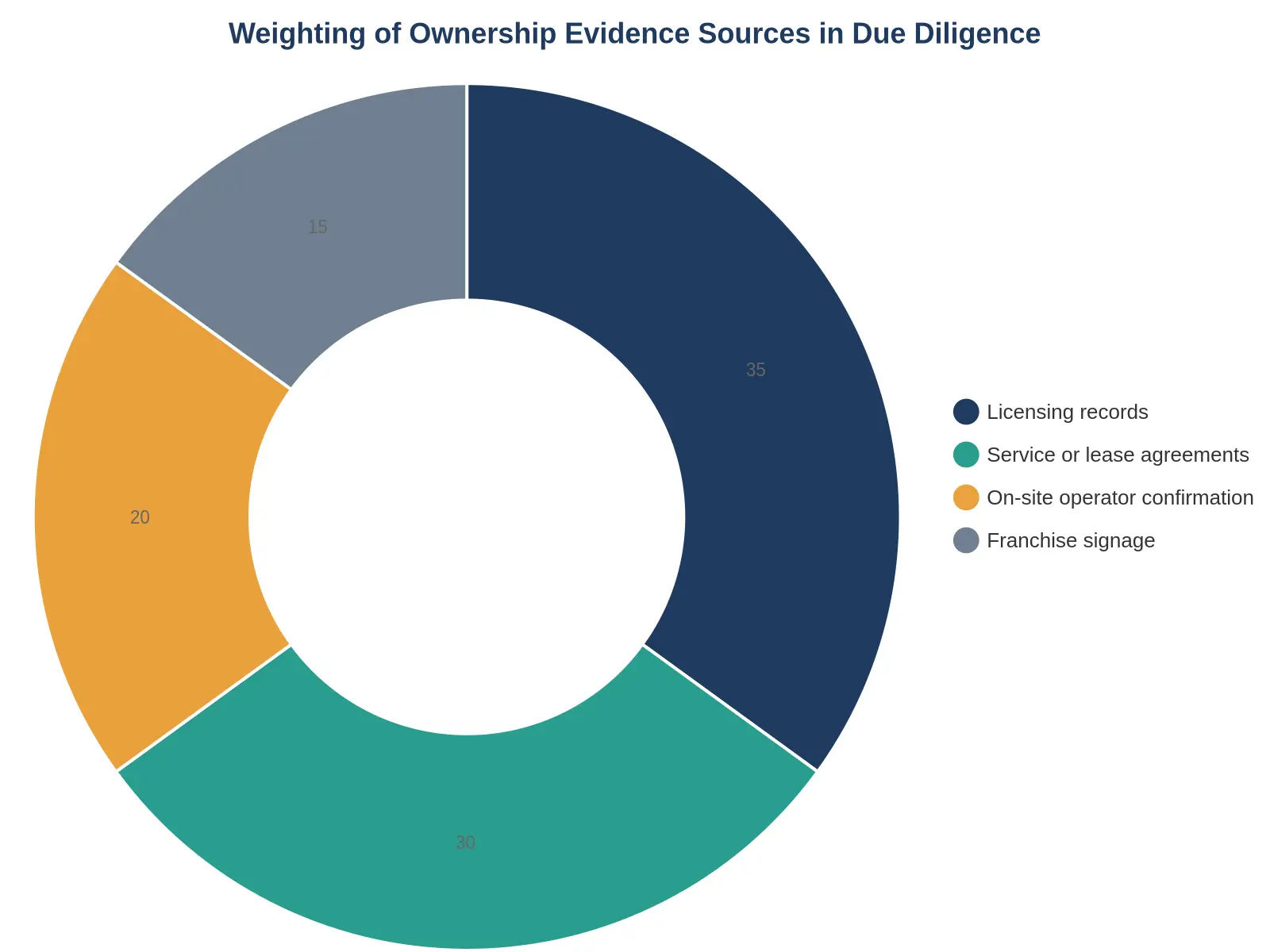
Caption: This chart illustrates one proposed weighting of ownership evidence sources. Licensing records carry the heaviest weight, followed by service or lease agreements, on-site operator confirmation, and franchise signage.
Reading the Segments
| Evidence Source | Weight | Why It Carries This Weight |
|---|---|---|
| Licensing records | 35% | Government and registry filings name a legal owner or permit holder, making them the strongest single anchor. |
| Service or lease agreements | 30% | Contracts reveal who pays for the property, equipment, and utilities, which usually tracks with operational control. |
| On-site operator confirmation | 20% | A manager or operator on the ground corroborates day-to-day reality, though it relies on self-reporting. |
| Franchise signage | 15% | Branding and signs suggest affiliation but are the easiest to change, so they are the weakest indicator alone. |
Why the Balance Matters
The weighting is deliberately conservative. Signage and brand names are the most visible signals to a passing observer, yet they are also the most superficial; a sign can be installed or removed in a day. Licensing records and lease agreements are harder to alter and leave a paper trail, so they anchor the analysis. On-site confirmation sits in the middle because it validates that the documented entity is genuinely running the operation, not merely holding a title. When the high-weight sources align, ownership is clear. When they conflict, the lower-weight signals should not override the documentary record.