
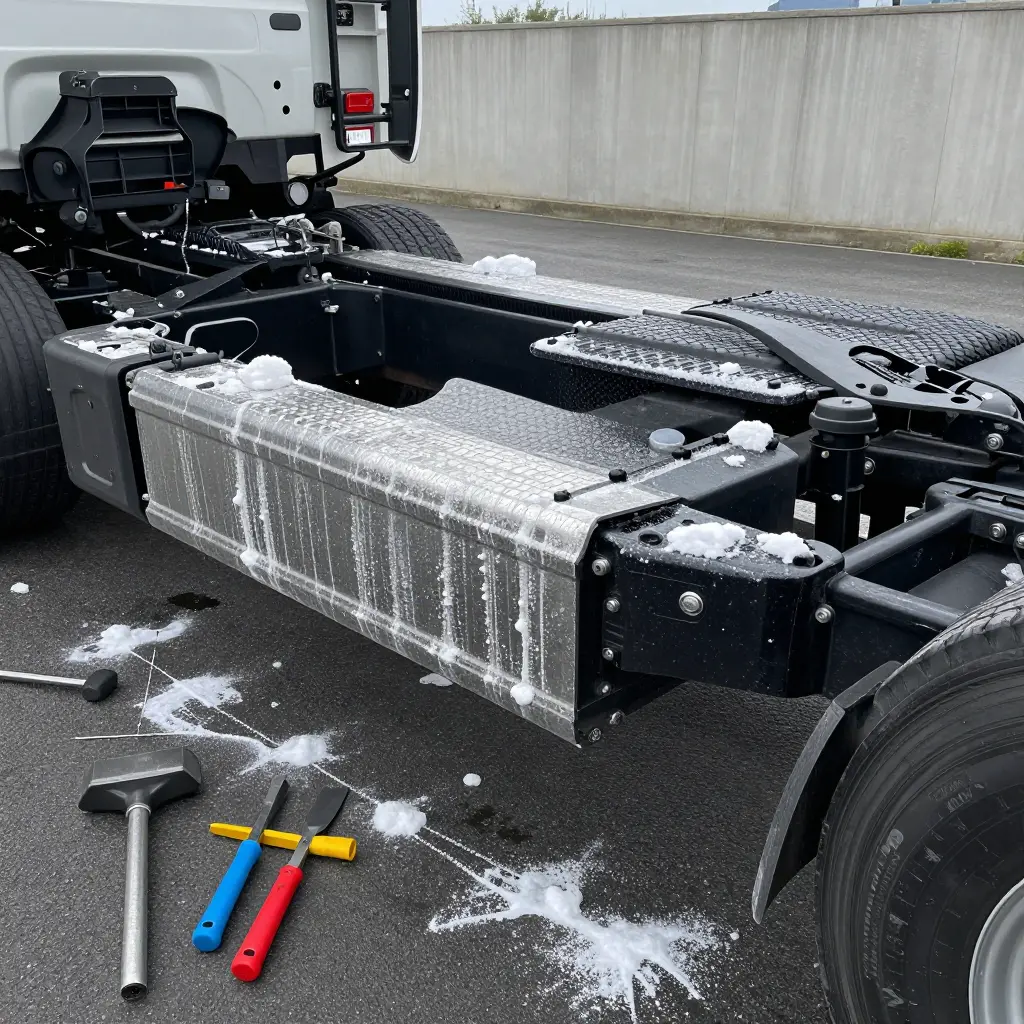
Why Road Salt Threatens the Truck Undercarriage
Road salt is a de-icing compound, usually sodium chloride or a calcium chloride blend, spread on highways in winter to lower the freezing point of water and keep traffic moving. The trouble starts after the plow passes. Salt does not sit only on mirrors, mudflaps, or the rear bumper. It dissolves into brine, sprays upward, and works its way into hidden undercarriage zones such as frame rails, crossmembers, and boxed sections, where it keeps eating metal long after the exterior looks clean.
Truck undercarriage washing means rinsing that contaminated brine off the underside of a vehicle, including the frame, suspension, axles, and concealed cavities. It is not the same as a standard top-side wash. The point is not appearance; it is neutralizing and removing salt before it attacks structural steel.
Truck owners, fleet managers, and maintenance professionals can head off most of that hidden corrosion by understanding three things:
- Salt migration mechanics — how brine travels, clings to concealed metal, and stays active.
- Why frame rails trap salt — the geometry that turns ordinary channels into corrosion reservoirs.
- Where pressure rinsing makes rust worse — how the wrong technique drives salt deeper instead of removing it.
None of this is exotic. It is the same discipline behind something as familiar as regular trailer maintenance, and it is the baseline for any preventive program worth running.
How Road Salt Reaches and Clings to Undercarriage Components
Road salt never coats the undercarriage evenly. It arrives as a moving slurry of brine, and where it ends up is decided by fluid dynamics, not by where the tires throw it. That is why undercarriage corrosion clusters in specific places while large flat panels stay comparatively clean.
Splash and Spray Patterns
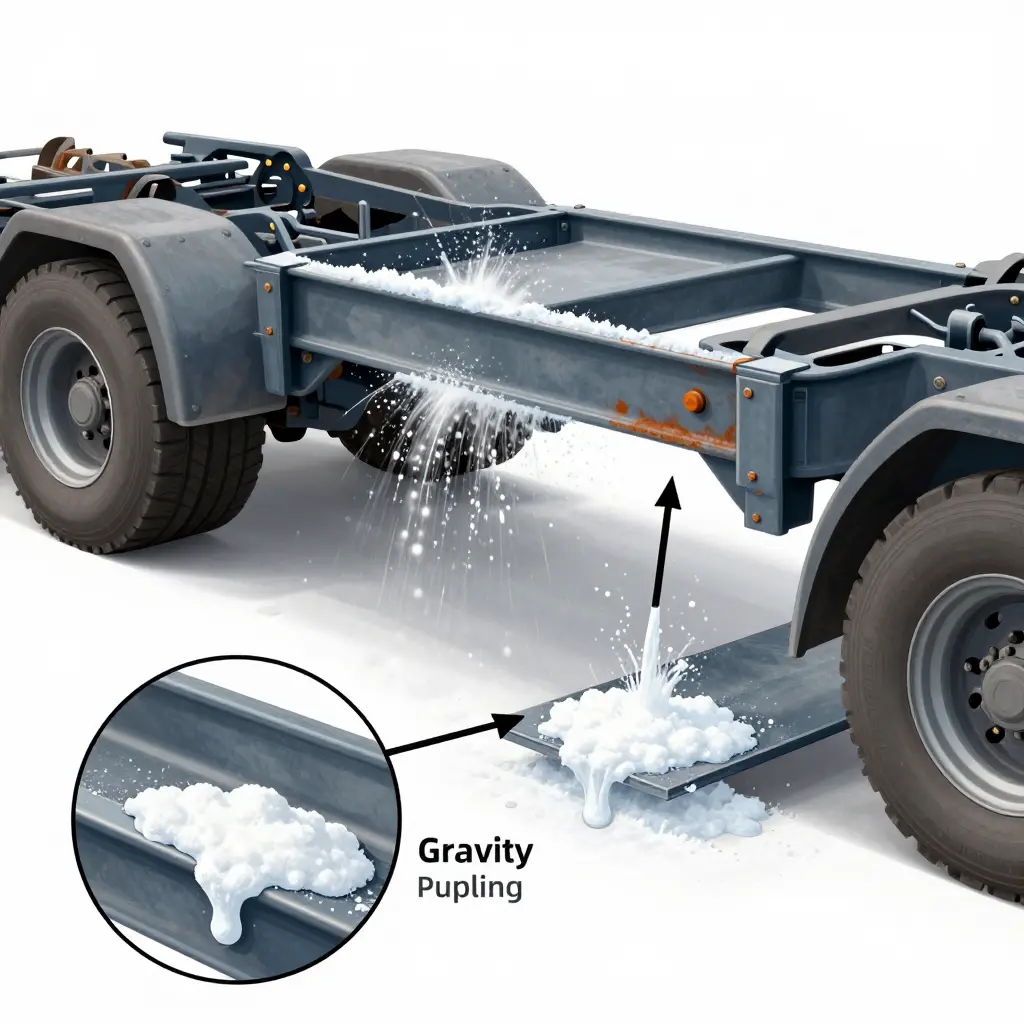
At speed, tires continuously displace the brine standing on the road. The tread channels eject a high-velocity spray backward and outward, and this mist wraps the underside of the vehicle. Turbulence behind the axles keeps fine droplets suspended, so they settle onto downward-facing and sheltered surfaces: frame rails, crossmembers, brackets, fuel-tank straps.
Capillary Action
The heaviest salt loads accumulate where spray cannot easily escape. Frame rails, overlapping plates, and bolted joints form narrow gaps a fraction of a millimeter wide. Capillary action pulls liquid into these spaces, drawing brine sideways and upward against gravity, well past the initial spray contact point. Once the brine is inside, airflow cannot reach it, and it drains only slowly.
Gravity-Driven Pooling
Brine that does not enter a crevice flows downward until it reaches a horizontal surface. Flat ledges, the tops of crossmembers, recessed brackets, and floor pockets act as collection trays. Pools remain there long after the road has dried, holding steel in continuous contact with a concentrated salt solution.
How Brine Films Remain After Drying
When the bulk of the spray evaporates, the dissolved salts do not leave with it. Sodium chloride and, especially, calcium chloride are hygroscopic: they absorb atmospheric moisture and hold residual brine on the surface. A visually dry undercarriage can therefore still carry a thin, conductive film that re-wets each time humidity rises.
Why Chloride Brines Attack Steel
Both sodium chloride and calcium chloride brines are aggressive because they combine an electrolyte with chloride ions. The chloride accelerates the electrochemical corrosion reaction: it penetrates and breaks down the thin passive oxide layer that would otherwise slow oxidation, and it forms soluble iron-chloride complexes that carry metal away from the surface. That keeps the protective layer from re-forming and sustains the anodic and cathodic half-reactions. Calcium chloride is the more damaging of the two, because its deliquescent nature keeps the surface wet at lower relative humidity, extending the window in which undercarriage corrosion can proceed. For operators, routine removal of stubborn road deposits is ultimately about interrupting that wet, chloride-rich environment.
Salt-Attachment Pathways at a Glance
- Splash and spray: tire-driven droplets coat sheltered and downward-facing surfaces.
- Capillary action: brine wicks into narrow frame-rail and joint gaps against gravity.
- Gravity pooling: liquid collects and rests on flat ledges and brackets.
- Hygroscopic brine film: residual salts hold moisture on steel after visible spray dries.
Every one of those pathways puts road salt where drainage and airflow are weakest, which is where chloride ions do the most damage.
Why Frame Rails Function as Salt Traps
Truck frame rails are the longitudinal structural members that carry the payload, the suspension, and the fifth wheel. Their cross-sectional geometry, however, also makes them highly effective salt traps. Road salt, brine, and salt-laden grit thrown up by the tires enter the frame rails and remain there long after the road surface itself has dried.
Cross-Sectional Geometry: C-Channel versus Boxed Rails
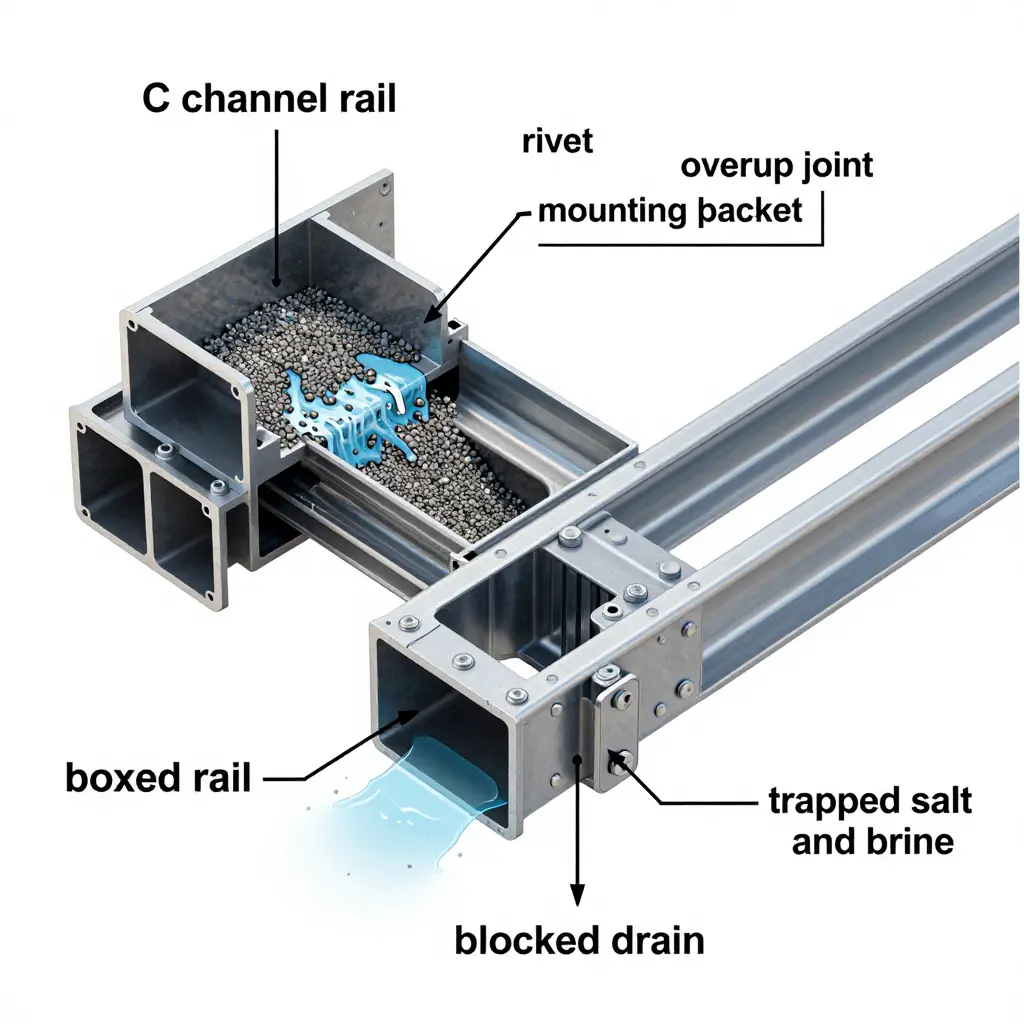
Most trucks use either a C-channel (open) or a boxed (fully enclosed) frame rail. A C-channel rail has an open top and bottom flange connected to a central web. Debris drops straight into the channel, but the inboard face and lower flange form a shelf where wet grit settles. A boxed rail welds a cover plate over the channel, creating a sealed structural section with a large internal cavity. The closed geometry delivers superior torsional stiffness, but it also forms a reservoir that is nearly impossible to inspect or flush by hand.
Overlapping Joints, Rivets, and Mounting Brackets
Frame rails are rarely a single continuous beam. Manufacturers join sections with overlapping reinforcements, secured by rivets or high-tensile bolts. Each overlap creates a capillary gap between two steel surfaces. Brine wicks into those gaps and stays, and the resulting crevice becomes oxygen-starved, which accelerates corrosion. Rivet heads and bolted mounting brackets for the fuel tank, battery box, air tanks, and suspension hangers add dozens of additional crevices that hold moisture against the frame.
Poor Drainage and Open-Ended Rails
Most frame rails are open-ended or fitted with only small, easily clogged drain holes. Mud, salt, and debris bridge across those openings, sealing the rail so liquid cannot escape. Water enters freely through the open ends, yet internal baffles, cross-members, and gusset plates obstruct the path to any outlet, so the rail effectively holds a pooled brine solution.
Reduced Airflow and Prolonged Wet Contact Time
Inside a rail, airflow is minimal. Convection cannot move air through the enclosed cavity, so moisture evaporates far more slowly than on exterior surfaces. That extended wet contact time keeps salt in solution against bare or lightly coated steel for hours, or even days, after a storm. The result is hidden frame rail corrosion, commonly called undercarriage rust, which typically appears first as surface pitting near overlaps and rivets.
Why Normal Washing Misses the Interior
Standard spray patterns and drive-through systems reach exterior surfaces but rarely penetrate enclosed cavities. Even truck undercarriage washing aimed at the frame can drive slurry deeper into the rail, and forced pressure rinsing risks pushing brine past overlap joints into areas no drainage path can clear. Routine trailer maintenance that includes inspection and controlled flushing of frame cavities is what keeps these salt traps from becoming structural failures.
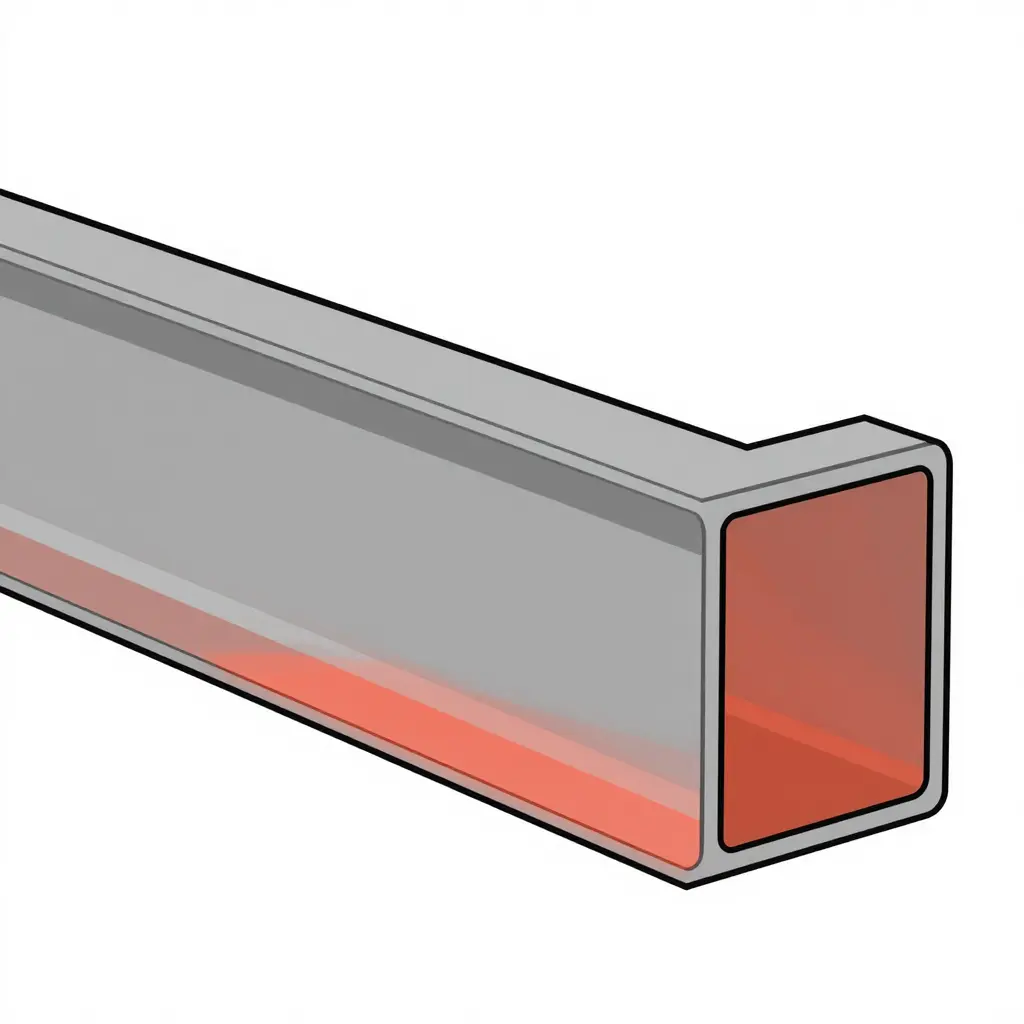
This schematic shows why a frame rail keeps corroding even after a thorough surface wash. The steel profile is clean on the outside, but the shaded regions mark the places brine actually settles and stays: the lower inner flange, where gravity pulls meltwater; the enclosed internal cavity, which no spray nozzle can enter; and the joint overlap seams, where capillary action wicks saltwater into gaps too tight for a pressure stream to flush. The brine creeps into these hidden pockets, then dries, crystallizes, and re-wets with every thaw — holding moisture against bare steel long after the visible surfaces are dry. Rinsing what you can see is only half the job.
The Electrochemistry of Road Salt and Rust on Truck Steel
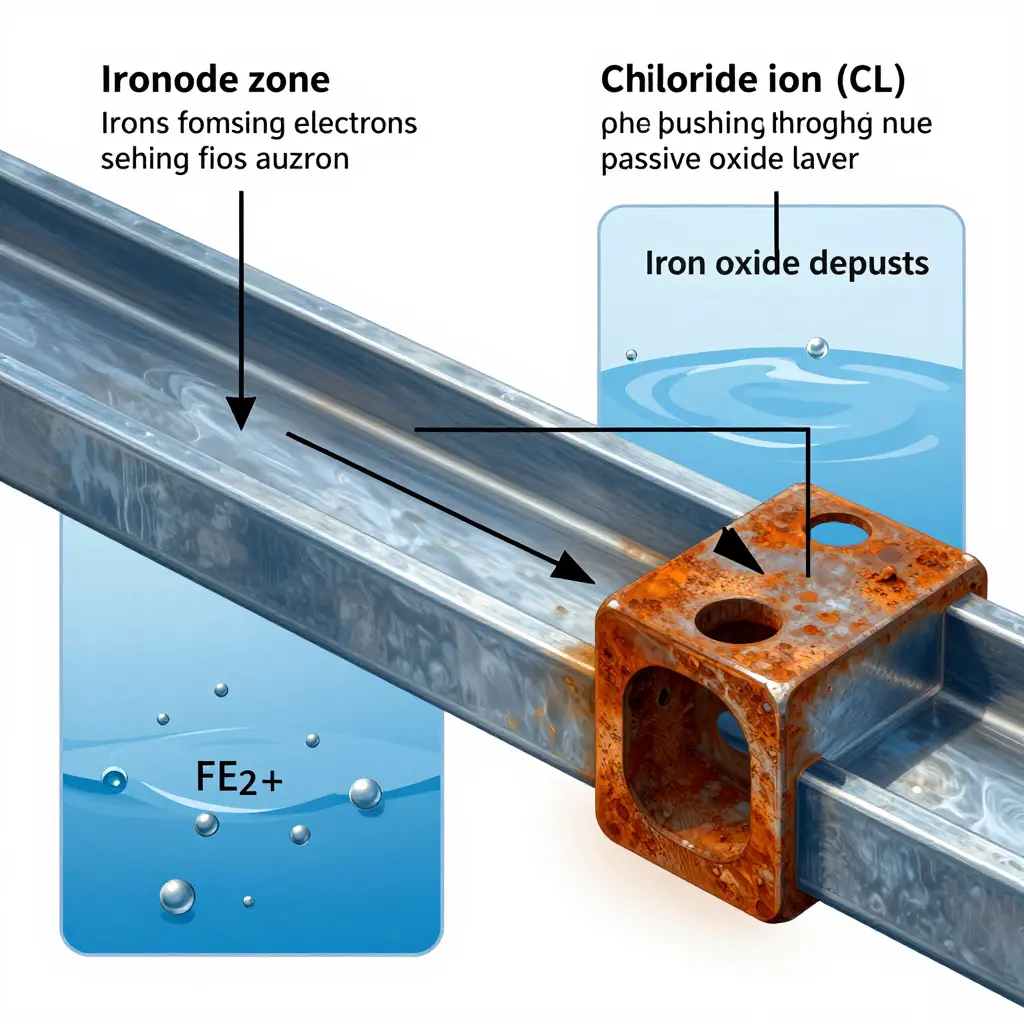
Rust is an electrochemical process, not a simple surface stain. For steel to corrode, three conditions must exist at the same point on the metal: an electrolyte (water), dissolved oxygen, and an exposed conductive surface. A truck’s frame, crossmembers, and undercarriage hardware provide the steel. Winter road spray provides the water and oxygen. Road salt provides the chloride that transforms a slow reaction into an aggressive one.
The Basic Corrosion Cell: Water, Oxygen, and Iron
A thin film of water on steel acts as an electrolyte, allowing ions and electrons to move. Two reactions then occur simultaneously at different points on the same piece of metal:
- Anode (oxidation): Fe -> Fe2+ + 2e-
- Cathode (reduction): O2 + 2H2O + 4e- -> 4OH-
Iron ions and hydroxide combine into hydrated iron oxide — the flaky reddish-brown rust:
4Fe + 3O2 + 6H2O -> 4Fe(OH)3
Steel is lost at the anode while oxygen is consumed at the cathode, so both sites must stay wet and oxygenated for corrosion to continue. That is why a wet, aerated undercarriage is close to ideal for rust.
Why Chloride Ions Drive a Regenerative Corrosion Cycle
Unprotected steel naturally forms a thin passive oxide film that slows further oxidation. Chloride ions destroy that protection. Chloride is small, highly mobile, and aggressively displaces the oxygen that maintains the passive layer. Once the film breaks down locally, that spot becomes a pit, and the pit cannot repassivate while chloride remains on the surface.
The defining feature of road salt is that chloride is not consumed by the reaction. It acts as a catalyst: it penetrates the passive layer, accelerates iron dissolution, and moves on to attack the next site. This is the corrosion cycle — chloride breaches the film, fresh iron is exposed, more rust forms, and new chloride renews the attack. Salts also lower the freezing point of water, keeping a conductive brine film in contact with steel below 0 degrees Celsius, well after pure water would dry or freeze.
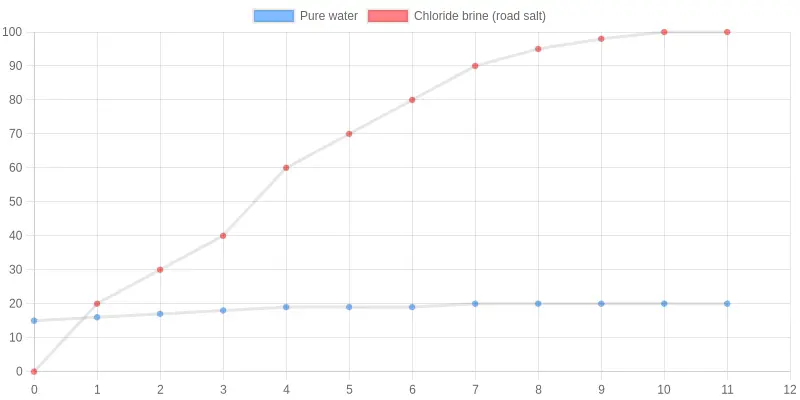
Pure Water vs. Chloride Brine: The Rate Difference
The chemistry explains a large gap in real-world corrosion rates between clean water exposure and road-salt brine exposure.
| Exposure medium | Passive layer behavior | Corrosion rate | Typical outcome |
|---|---|---|---|
| Pure water | Mostly intact, slowly reforms | Low and roughly linear | Surface staining, gradual oxide growth |
| Road-salt brine | Repeatedly broken down | High, accelerates over time | Pitting, section loss, structural fatigue |
Why Enclosed Frame Rail Cavities Make Rust Worse
Frame rails are boxed or C-channel structures with overlapping metal, hidden pockets, and drain paths that clog with mud and salt. These enclosed cavities change the chemistry in two ways.
First, they retain moisture. Brine splashes into the cavity during winter driving and then lingers, because airflow is limited and drainage is often blocked. A trapped brine film keeps the corrosion cell active for days or weeks instead of hours.
Second, they sustain the regenerative cycle without interruption. With chloride and oxygen sealed against bare interior steel, the passive layer never gets a chance to heal. Corrosion progresses from the inside out, so serious section loss is frequently invisible until a frame is inspected closely. Because these reactions are continuous, prevention depends on removing the salt itself — which is why structured, regular trailer and undercarriage maintenance matters more than any single treatment.
For fleets, the practical point is this: chloride is catalytic and persistent, water is the transport medium, and oxygen completes the cell. Break any one of the three and rust stalls — but only if road salt is physically flushed from the places where moisture lingers.
How Much Rust Survives Each Washing Strategy?
The chart compares how corrosion progresses on truck undercarriage steel across four exposure and treatment scenarios. The y-axis is a Relative Corrosion Index, where the untreated salt-exposed baseline equals 100. Values are illustrative estimates normalized to that baseline, so they reflect proportional differences rather than a specific mileage or timeframe.
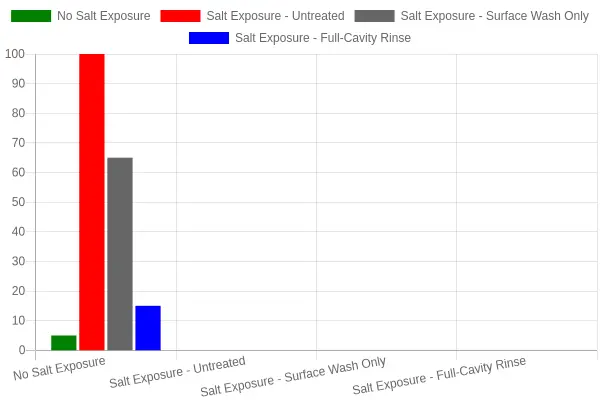
| Condition | Relative Corrosion Index | What It Tells Us |
|---|---|---|
| No salt exposure | 5 | Minimal baseline weathering on the frame rails |
| Salt exposure (untreated) | 100 | Reference point — full brine attack with no intervention |
| Salt exposure (surface-only wash) | 65 | Looks clean, but trapped brine keeps rust spreading inside the cavities |
| Salt exposure (full-cavity rinse) | 15 | Controlled, low-level progression when trapped salt is actually flushed out |
Caption: Surface-only washing removes the visible salt film but leaves roughly two-thirds of the corrosion progression intact — the hidden salt trapped inside frame rails keeps doing damage long after the wash. For broader preventive maintenance workflows that pair flushing with scheduled inspections, see proven maintenance best practices for trailers.
Where Pressure Rinsing Makes Rust Worse
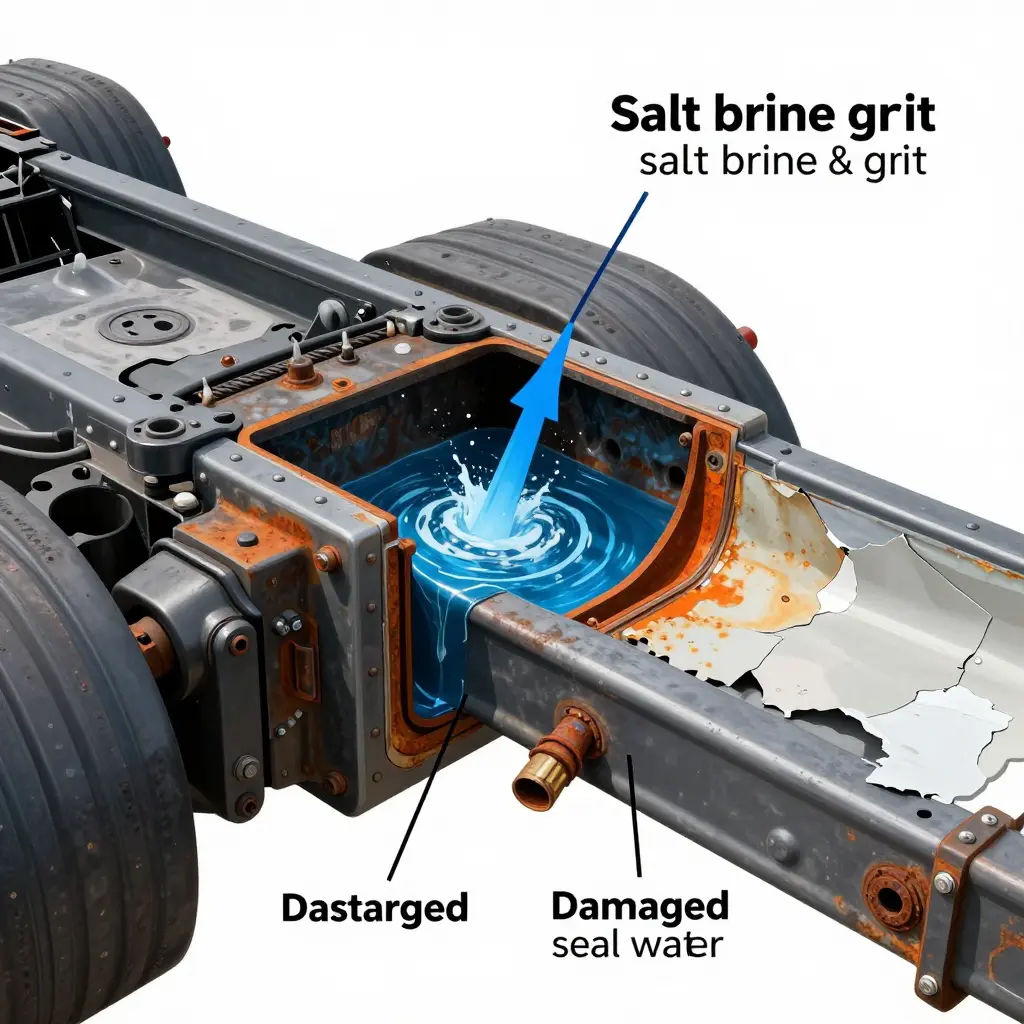
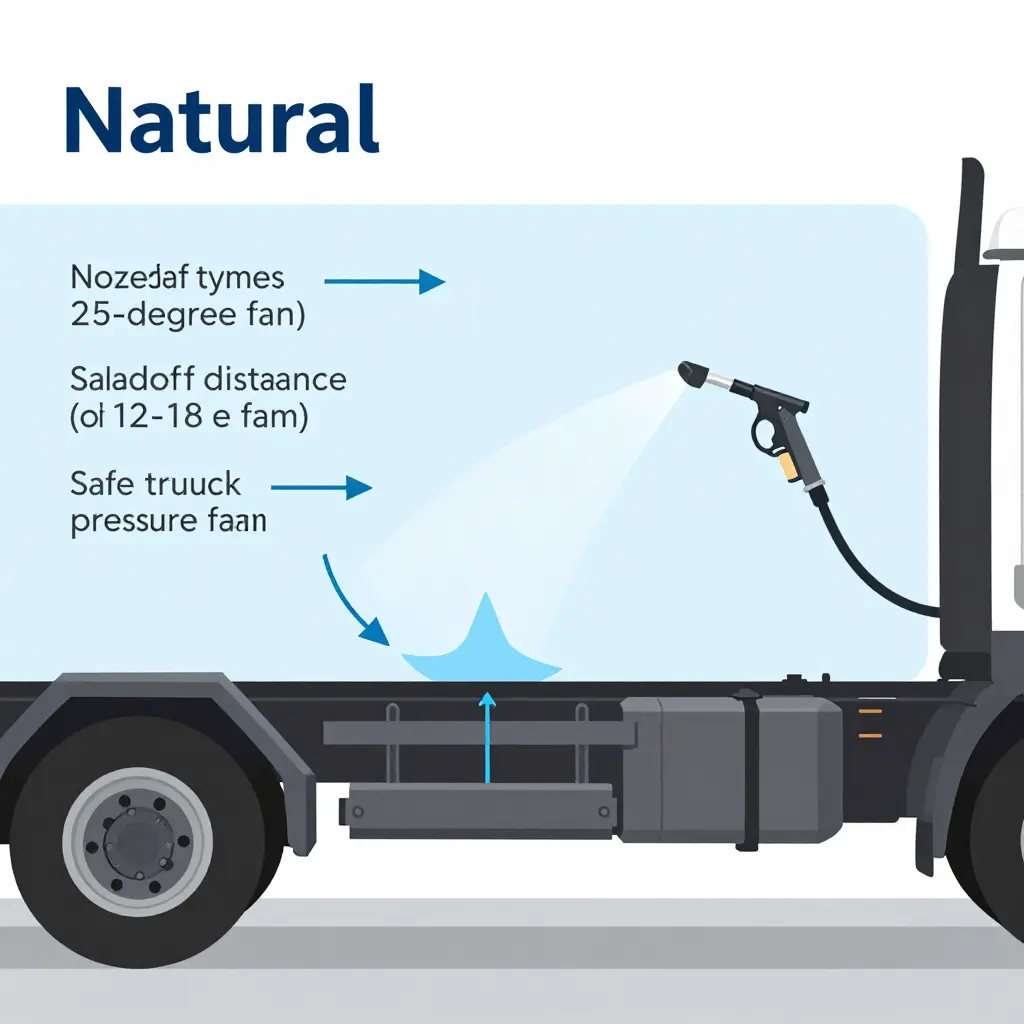
Pressure rinsing is one of the most effective ways to remove road salt from a truck’s underside, but it is a precision tool, not a blunt one. When nozzle pressure is too high or the spray is aimed carelessly, the same stream that flushes salt out can drive it deeper into the structure, turning a cosmetic surface problem into a structural one.
Forcing Brine Deeper Into Cavities
Frame rails are boxed or C-channel structures built with enclosed cavities, overlapping seams, riveted joints, and small drain holes. At high pressure, a directed stream pushes salty water and brine through those seams instead of washing them away. Once inside, the fluid sits against bare, uncoated steel for days. The cavity cannot drain or dry efficiently, so this is where most hidden undercarriage rust begins.
Stripping Protective Coatings
Excessive pressure does not distinguish between the salt you want gone and the factory protection you need to keep. It can blast away e-coat, undercoating, seam sealer, and paint, exposing raw steel to every subsequent spray of winter brine. That damage compounds quickly, which is why routine, correctly performed washing matters to the broader case for regular trailer maintenance.
Damaging Seals and Connectors
Seals, wiring grommets, and electrical connectors are not designed to resist a focused high-pressure jet. When seals fail, water and salt enter joints and harnesses that were meant to stay dry. The result is corrosion, electrical faults, and moisture trapped where it cannot drain or evaporate.
Risky Pressure-Rinsing Practices to Avoid
- Using a zero-degree tip at close range on frame rails and seams
- Exceeding the washer’s or manufacturer’s recommended nozzle pressure
- Holding the wand inches from seals, grommets, and connectors
- Spraying directly into drain holes, forcing debris and brine inward
- Re-rinsing without allowing the undercarriage to fully dry
Misdirected pressure rinsing converts a surface irritant into a structural liability. Match pressure to the surface, keep the nozzle at a safe distance, and always rinse to flush salt out rather than pound it in.
Comparing Undercarriage Washing and Rinsing Methods
Not every undercarriage cleaning method removes road salt equally well, and the wrong choice can push brine further into the frame rails, where rust takes hold. The table below breaks down the four methods most commonly used in commercial truck care, weighing how each performs against the specific challenge of hidden-zone salt removal and the risk of driving that salt deeper.
| Method | Typical pressure range | Salt-removal effectiveness in hidden zones | Risk of forcing salt deeper | Coating-damage risk | Best-fit use case |
|---|---|---|---|---|---|
| Low-pressure deluge rinsing | 30-100 psi | Moderate — floods open channels but leaves enclosed cavities | Low — volume, not velocity, does the work | Low | Routine post-winter flush of frame rails and open underbody areas |
| High-pressure surface washing | 1,000-3,500 psi | Low in hidden zones — reaches exposed panels only | High when aimed close to seams and seals | Moderate to high on undercoating and seam sealer | Removing caked mud and salt film from accessible outer surfaces |
| High-pressure cavity rinsing | 400-1,200 psi with a flexible cavity lance | High — directed spray reaches inside rails and crossmembers | Moderate — depends on nozzle angle and standoff distance | Moderate | Targeted cleaning of frame rail interiors using a flexible lance |
| Manual hand rinsing | 40-90 psi | Low to moderate — limited by reach and time | Low | Low | Spot treatment, delicate components, and final inspection passes |
Reading the Table: Why Pressure Alone Isn’t the Answer
Low-pressure methods are the safest, but they can struggle inside the boxed sections of a frame rail. High-pressure surface washing reaches the outer panels with real force, and that same force shoves salt-laden water into seams and around fasteners. High-pressure cavity rinsing sits in the sweet spot only when the pressure is dialed back and the lance is guided deliberately. For a deeper look at keeping the whole rig roadworthy between washes, see our guide to essential trailer maintenance practices.
For fleet managers and wash operators, match the method to the zone, not to habit. Protect the frame rails with controlled low-pressure flooding, reserve aggressive pressure for genuinely exposed surfaces, and never assume that a stronger blast equals a cleaner — or safer — undercarriage.
Hidden Undercarriage Zones Where Road Salt Accumulates
Road salt does not stay where it lands. Once it dissolves into slush, it migrates upward and outward through the chassis, settling into low points, enclosed pockets, and bolted joints. During truck undercarriage washing, spray reaches the outer faces of components but seldom the recessed zones where salt ponds and dries into a corrosive film. Over a season, these neglected pockets keep feeding rust long after the visible surfaces look clean. Where appropriate, targeted cleaning methods for stubborn deposits complement a proper undercarriage rinse. The list below names the specific hidden zones where road salt accumulates and persists, along with the reason each one defies routine washing.
- Frame rails and rail cavities. C-channel frame rails form a long, downward-facing trough that holds salt-laden water against the inner web and flange. Because the opening faces away from the spray, rinse water never fully contacts the inner surface, so the brine simply re-wets with the next storm.
- Crossmembers. These span between rails and create overlapping seams and riveted joints where salt slurry collects. Routine washing glances off the outer edge, leaving the trapped moisture in the crevices to corrode unchecked.
- Under-bed and cab floor channels. Floor ribs and under-bed supports create shallow cavities that stay damp for days. Spray from below rarely reaches the top surface of these channels, so salt eats the thin floor metal from underneath.
- Suspension and axle housings. Housing contours, air-bag seats, and axle tubes have curved surfaces that pool water. Their tucked position behind springs and wheels shields them from direct spray, letting salt residue persist.
- Brake and air system brackets. Small bolt-on brackets and air-valve mounts trap grit and brine against flat mating faces. The tight geometry blocks rinse flow, and the trapped moisture attacks both the bracket and the fastener.
- Spring hangers. These sit deep in the suspension pocket, surrounded by leaf packs and hardware that block the spray pattern. Salt accumulates in the pivot area and corrodes the hanger and its pins from the inside.
- Fuel tank straps and shields. Straps wrap the tank tightly, leaving a thin gap where salt water wicks in and sits against the metal. Routine washing cannot flush this gap, so corrosion forms under the strap where it is hardest to see and fix.
- Electrical and connector housings. Connector bodies, harness loom, and junction boxes have sealed shapes that hold moisture. Salt enters through small openings and remains, corroding terminals and pins that routine washing never reaches.
Direction of the rinse decides where the salt goes
The schematic below illustrates the single most important difference between a rinse that protects your frame rails and one that makes rust worse. On the left, a pressure wand fires straight into the rail cavity, driving brine deeper into the closed channel, where it sits against the steel and eats away at it from the inside. On the right, the same water is angled so it flushes along and out of the rail toward its drainage points, carrying dissolved salt out of the structure instead of wallowing it into the corners.
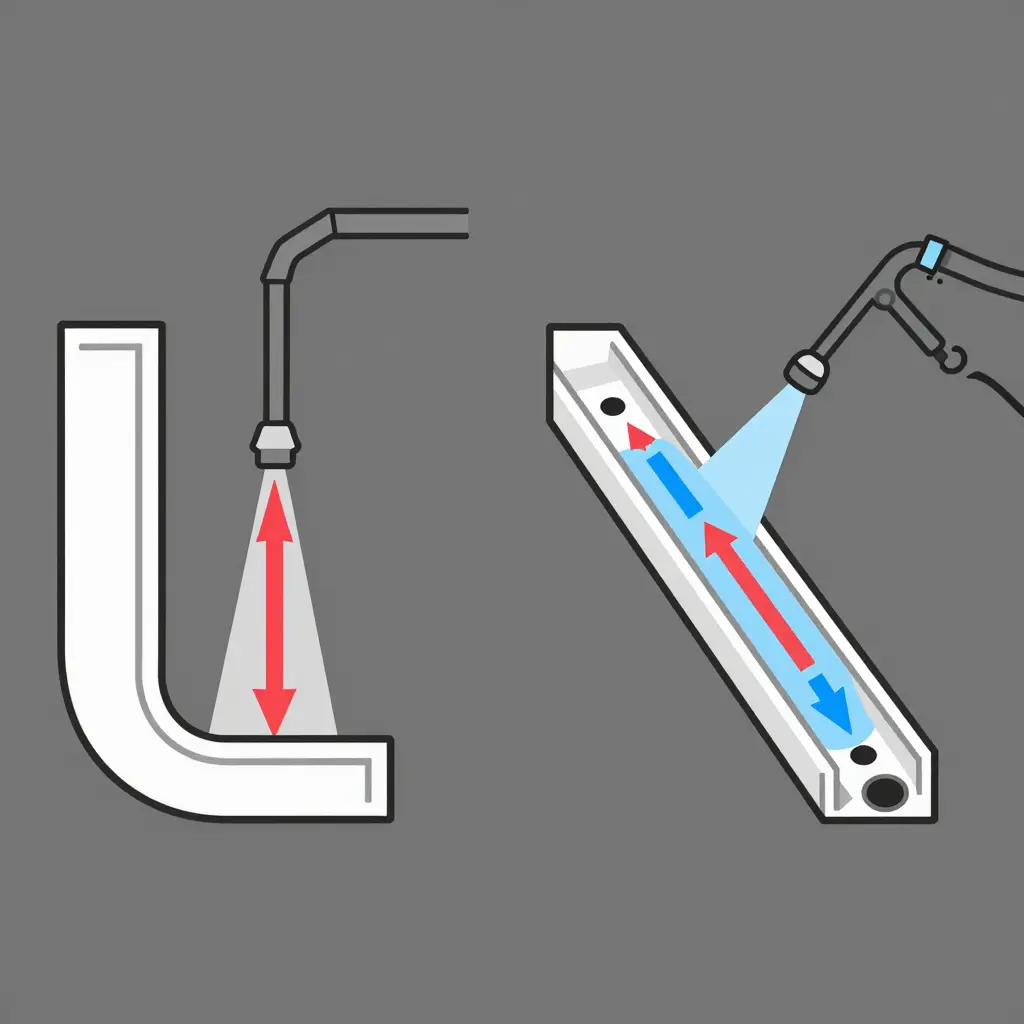
Same nozzle, same pressure, opposite result. Aim with the flow path of the rail, not against it — see how the right cleaning technique keeps hardware in service longer.
Where Road Salt Actually Hides: A Zone-by-Zone Breakdown
Knowing that road salt hides in the undercarriage is one thing; knowing where it concentrates is what turns a generic rinse into a targeted one. The pie chart below estimates how retained salt and moisture typically distribute across the major undercarriage zones of a working truck.
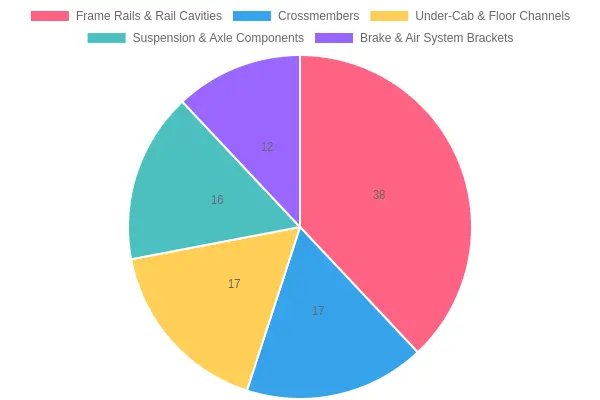
Figure: Estimated proportional share of retained salt and moisture across truck undercarriage zones. Frame rails and enclosed cavities account for the single largest share at 38% — more than any other zone — which is exactly why sweeping, generalized rinsing rarely reaches the deposits that matter most.
Frame rails and rail cavities alone hold roughly 38% of retained salt, nearly double the next-largest zone. Those C-channel recesses, boxed sections, and factory drain gaps trap brine, road spray, and silt long after the visible surfaces look clean. Because the contaminant sits in an enclosed geometry rather than on an open surface, it stays wet, keeps reacting with the steel, and moves from surface flash-rust to deep pitting.
A targeted approach makes the difference here, not a broad high-pressure blast. A well-aimed rinse focused on the cavities, drain paths, and rail interiors flushes out the salt where it actually accumulates, while indiscriminate pressure directed at the wrong angle can drive moisture deeper into the same enclosures and accelerate the very corrosion you are trying to stop. Pairing this zone awareness with sound cleaning strategies for stubborn road grime helps ensure your wash routine spends its effort where the data says it counts.
Fleet Operations, Compliance, and Maintenance Integration
Road salt does not stay where the plow leaves it. It migrates into frame rails, cross members, wiring harnesses, and brake hardware, then corrodes whatever it touches. For fleet managers, that hidden damage is not a cosmetic concern. It is an operational and regulatory one that shows up in shop schedules, inspection outcomes, and warranty disputes.
Undercarriage Corrosion as a Maintenance Trigger
Corrosion rarely announces itself. It surfaces as seized fasteners, chafed air lines, or a failed brake component discovered during a roadside inspection. By the time the damage is visible, it has usually spread well beyond the original point of contact.
Proactive undercarriage washing belongs in the preventive maintenance schedule, not the cosmetic care column. Treating a salt rinse as a fixed-interval task — tied to winter mileage, storm cycles, or road-treatment events — turns it into a predictable, budgetable line item instead of an emergency repair. This is where the importance of regular trailer maintenance connects directly to fleet reliability: tractors and trailers share the same exposure profile, and a consistent wash routine protects both.
The Cost of Ignoring Hidden Salt
Deferred undercarriage care compounds. A small rust pocket becomes a structural repair; a corroded connector becomes a roadside breakdown. Each stage costs more than the last, and downtime adds a second bill on top of the parts invoice. The table below shows representative cost escalation for a single commercial tractor when salt exposure is left unmanaged.
| Corrosion Stage | Typical Repair Cost (USD) | Operational Impact |
|---|---|---|
| Surface rust on frame rails | 150–400 | Cosmetic; early warning sign |
| Seized fasteners and brake hardware | 600–1,500 | Unplanned shop time |
| Corroded air and electrical lines | 1,200–3,000 | Roadside breakdown risk |
| Structural frame repair or replacement | 4,000–12,000+ | Extended downtime; possible out-of-service |
These ranges are illustrative, but the pattern holds across fleets: the cost of a scheduled rinse is trivial next to the cost of a corrosion-driven repair. Managers who track repair orders by cause consistently find that undercarriage failures cluster in vehicles that miss wash intervals.
Wash Practices and Environmental Compliance
How a truck is washed matters as much as how often. Wash facilities operate under wastewater discharge rules, runoff controls, and in some jurisdictions emissions-related permits covering equipment and detergents. Mishandling salt-laden runoff creates compliance exposure for both the wash site and the operator who chooses it.
Fleets that understand truck wash industry compliance and emissions regulations can select vendors and design on-site programs that keep contaminated water out of storm drains and within permit limits. The same discipline that prevents corrosion also prevents regulatory findings — a rare case where asset protection and compliance point in the same direction.
Building an Integrated Program
An effective program combines three elements:
- A scheduled undercarriage rinse cadence tied to weather and road-treatment data.
- Correct technique — controlled pressure and full coverage rather than high-pressure blasting that drives salt deeper into seams.
- Documentation of wash intervals and inspection findings as part of the maintenance record.
When these pieces align, undercarriage washing stops being a seasonal chore and becomes a compliance and reliability tool. Fleets that treat it that way protect their assets, their budgets, and their operating authority at the same time.
Key Takeaways for Fleet Managers
- Salt hiding in frame rails and seams drives both repair costs and inspection failures.
- Fixed wash intervals convert corrosion risk into a predictable budget line.
- Wash-site environmental and emissions compliance is part of a complete fleet maintenance strategy.
- Documentation turns routine rinses into a defensible maintenance record.
FAQ: Truck Undercarriage Washing and Road Salt
How often should I rinse the undercarriage during winter?
When road salt is in active use, rinse frequently — ideally every 1 to 3 days during heavy applications, and always after a storm. Salt needs moisture and oxygen to accelerate corrosion, so removing it before it dries and bonds is the single most effective defense against rust. A quick, low-volume flush of the wheel wells, axles, and frame rails beats a rare, aggressive washdown. Consistency matters far more than intensity.
Is high pressure ever appropriate for frame rails?
Rarely, and never at close range. Frame rails are typically C-channel or boxed sections with seams, rivets, and drain holes where salt collects. High-pressure rinsing can force water and brine deeper into enclosed cavities and strip away factory coatings, actually worsening rust. Use low-to-moderate pressure, keep the nozzle at a distance, and let volume and dwell time do the work rather than force. Pressure rinsing is best reserved for open, painted surfaces that drain freely.
How can I tell if salt is trapped in the frame rails?
Look for white or rusty streaks weeping from drain holes and rivet seams, flaking paint along the rail edges, and a gritty residue on the inner web. Probe gently with a screwdriver or tap the rail with a hammer; a dull, soft sound can indicate thinning metal. If debris flows out when you flush a drain hole, salt and sediment had accumulated inside. Catching this early prevents hidden rust from festering where you cannot see it.
Does undercoating actually help?
Yes, when applied correctly and kept intact. A quality undercoating or cavity wax creates a barrier that keeps road salt and moisture off bare metal. The catch is maintenance: chips, cracks, and worn spots let brine underneath, where it traps moisture and rust spreads unseen. Inspect and touch up coatings annually, and never undercoat over existing rust — you will only seal the problem in.
How should I dry and protect the undercarriage after washing?
Drying is as important as washing. Trapped water recreates the wet environment salt needs, so flush cavities with clean water, let them drain fully through the frame rails’ designed holes, and use forced air to push residual moisture out of seams and brackets. Follow with a rust-inhibiting spray or cavity wax on bare metal, and check drain holes to confirm they are clear. Pairing undercarriage care with broader regular trailer maintenance keeps the whole vehicle protected through salt season.
Can I skip washing if I park indoors?
No. Road salt that is already clinging to the frame continues to pull moisture from humid air and slowly corrode metal even in a dry bay overnight. Indoor parking slows the process but does not stop it. Wash and dry before storage, not after, so brine never sits on the truck for days at a time.
Key Takeaways: Getting Undercarriage Washing Right
The corrosion that shortens a truck’s life rarely starts where you can see it. Road salt settles into frame rails, boxed sections, and enclosed undercarriage cavities, and it stays there long after the exterior looks spotless. Cleaning the visible surfaces is not enough, and aggressive rinsing done incorrectly can make the damage worse. What matters most:
- Road salt hides in the places you cannot see, particularly inside frame rails, crossmembers, and enclosed undercarriage cavities where brine pools and lingers.
- Surface washing misses the problem entirely. Wiping down visible panels leaves trapped salt undisturbed, so corrosion keeps working from the inside out.
- Misapplied pressure rinsing makes rust worse. The wrong angle or excessive pressure drives brine deeper into crevices and strips away the factory and aftermarket coatings that shield bare metal.
- Controlled, correctly directed rinsing is what works. Low-angle, moderate-pressure streams flush contaminants out instead of forcing them further in.
- Drying and protective coatings finish the job. Removing residual moisture and reapplying a coating restores the barrier that keeps rust from getting a foothold.
- Discipline beats intensity. Routine undercarriage washing, not the occasional deep clean, is what genuinely extends frame and component life.
None of this requires exotic equipment or heroic effort, but it does demand consistency. Treat undercarriage washing the same way you treat any other part of a regular trailer maintenance schedule: a predictable, recurring step rather than an afterthought. Develop a routine that reaches the hidden cavities, uses correctly aimed and calibrated pressure, dries thoroughly, and reapplies protective coatings where they belong. Done this way, washing is not just about appearance, it is one of the most cost-effective defenses you have against rust. Build it into your maintenance discipline now, and your frames, components, and budget will thank you over thousands of miles to come.