
Why Murphy Oil Soap Leaves Residue in a Truck Wash Bucket
Murphy Oil Soap is a plant-oil soap built for sealed wood indoors. It lifts kitchen grease off a finished floor and leaves a thin oily film that makes the wood look fed rather than stripped, which is the product doing its job. Nothing in the formula was chosen with road film, diesel soot, brake dust, or the mineral load of a wash-bay water supply in mind, and that mismatch is what shows up on the truck.
A purpose-built truck soap carries surfactants sized for heavy soil, chelators that hold calcium and magnesium in suspension, and rinse aids that let water sheet off a panel before it dries. A wood soap brings a soap base, glycerin, and fragrance. It also brings an oil film, because that film is the point. If the soil you are chasing is grease or tar, start with a detergent class that can actually dissolve it instead of a household substitute.
What is left on the panel afterwards is a dried soap film, and it reads differently on each surface. On cured paint it dries into irregular streaks and a grey haze that looks like a bad rinse or a failing clearcoat. On aluminum trim – mirror covers, fuel tank straps, bumper faces, wheel surrounds – the same film meets surface oxidation and hard-water minerals and dries into white spotting that plain water will not move.
Prevention and removal are separate problems. Prevention is settled before the truck gets wet, when someone decides what goes in the bucket. Removal is a question of chemistry and dwell time after the damage is already visible. Operators who keep Murphy Oil Soap around as a cheap pre-soak tend to learn the difference on a white trailer panel in direct sun.
What Murphy Oil Soap Is Formulated to Do – and What It Was Never Formulated For
Murphy Oil Soap is a good cleaner that gets blamed for the place it was used. It was built to lift greasy soil off sealed indoor wood, be wiped away with a damp cloth, and leave a surface that feels conditioned. It was never built to sit on a sun-baked clearcoat on a Class 8 tractor. The chemistry does not fail in a wash bucket because the product is cheap or watered down. It fails because every ingredient was chosen for a different job, and that is why Murphy Oil Soap residue shows up as a dull, streaky haze on hoods, fenders, and aluminum trim.
The Bucket Chemistry: Saponified Vegetable Oils, Glycerin, and What Is Deliberately Missing
Strip the label down to the chemistry and there are two workhorses. The cleaning agent is a soap made from plant oils – fatty acids reacted with a base to form soap salts, listed on current ingredient disclosures as sodium tallate. Each molecule has an oil-loving tail that grabs greasy soil and a water-loving head that pulls it into solution, which is why the product lifts kitchen grease so well. Glycerin stays behind from that saponification and acts as a humectant: it keeps the film soft instead of letting it dry to a hard sheet.
That is the design brief. What is not in the bottle matters more in a truck bay:
- No chelating agents or sequestrants – nothing like EDTA, citrates, or phosphates to tie up calcium and magnesium, so hard-water minerals stay free to react with the soap and dry into hard water spotting.
- No rinse aids or sheeting agents – nothing to make water break and run off a vertical panel, so droplets sit, pool, and dry where they land.
- No solvent package for road film – no petroleum distillates or heavy-duty surfactants aimed at diesel soot, brake dust, and polymer road grime.
- No film-former designed for outdoor cure – the intended removal step is a wipe or a rinse on interior wood, not evaporation on a painted panel.
Dilution, Over-Dosing, and What Flash-Drying Does to Clear Coat
In a bucket, dilution decides everything. The label calls for a modest ratio in warm water, and at that strength the soap is concentrated enough to emulsify light oil and stay suspended until it is wiped off. Operators chasing road film push past that line, because road film is a stubborn blend of petroleum residue and encapsulated soot that a plant-oil soap was never engineered to dissolve. More product does not add road-film chemistry. It adds fatty acid salts and glycerin to whatever is left on the panel.
The surplus becomes visible the moment the truck pulls into the sun. Water flashes off, surfactant concentration climbs fast, and the soap salts crash out of solution instead of rinsing clean. Calcium and magnesium in hard water grab those fatty acids and form an insoluble scum that clings to wax, sealant, and anodized aluminum, while the glycerin holds a thin layer of moisture and dust against the surface. A light haze turns into a plant-oil soap film that resists a simple hose-off. For heavier petroleum soils, pair the right chemistry with these methods for pulling grease and tar off a truck rather than compensating with extra soap.
The correction is not complicated: match the product to the surface it was designed for, and dilute to the label rather than to your frustration. Treating Murphy Oil Soap as an interior wood cleaner instead of a road-film remover is the single change that keeps Murphy Oil Soap residue from becoming a recurring mark on fleet paint and trim.
The residue-risk column below assumes the worst case: the solution dries on a hot painted panel or trim piece before anyone floods it off. Ratings climb as the dried film gets harder to dissolve on the next wash, so “low” means a quick re-wet lifts it and “high” means you are polishing, not washing.
| Product type | Typical pH range | Surfactant base | Rinsability from painted panels | Aluminum trim compatibility | Residue risk when allowed to dry | Relative cost per wash |
|---|---|---|---|---|---|---|
| Murphy Oil Soap at bucket dilution | Mildly alkaline (about 9 as supplied) | Plant-oil soap base | Poor; films fast | Not recommended | High – sticky film | Low |
| Conventional alkaline truck wash soap | Strongly alkaline (11-13) | Anionic, high-detergent | Moderate; needs heavy rinse | Avoid on bare trim | Moderate – chalky spotting | Moderate |
| pH-neutral truck wash shampoo | Neutral (6.5-7.5) | Mild nonionic blend | Good; rinses clean | Generally compatible | Low – light spotting | Moderate |
| Acidic aluminum cleaner or brightener | Acidic (2-5) | Nonionic with chelators, often phosphoric or HF-based | Good; sheets off | Removes oxide by design; not routine wash chemistry | Low to moderate – water spots | Higher |
| Wax-containing wash-and-shine product | Slightly acidic (5-6) | Cationic wax emulsion | Fair; leaves film | Usually compatible | Moderate to high – wax haze | Higher |
| Water-only pre-rinse | Neutral (about 7) | None; no surfactant | Excellent; no film | Fully compatible | Low – mineral spotting only | Lowest |
For painted panels and bare aluminum trim, the pH-neutral shampoo is the row that behaves predictably, with a water-only pre-rinse as the safest first and last step. The acidic product and the wax wash-and-shine both have legitimate jobs – brightening dull aluminum, adding a sacrificial layer – but neither is routine wash chemistry, and both need a label that names aluminum and a dwell limit you actually follow. Conventional alkaline soap sits in the middle: workable on paint when it is rinsed promptly, unforgiving on polished aluminum. The Murphy Oil Soap row is where this problem starts, because its plant-oil soap base leaves a sticky film that grabs road dust and dries unevenly, the same pattern described in these notes on grease and tar removal.
The Residue Mechanism: How Soap Actually Bonds to Paint
Residue is not bad luck on a humid morning. It is the predictable end point of a physical sequence that starts when shampoo meets clear coat.
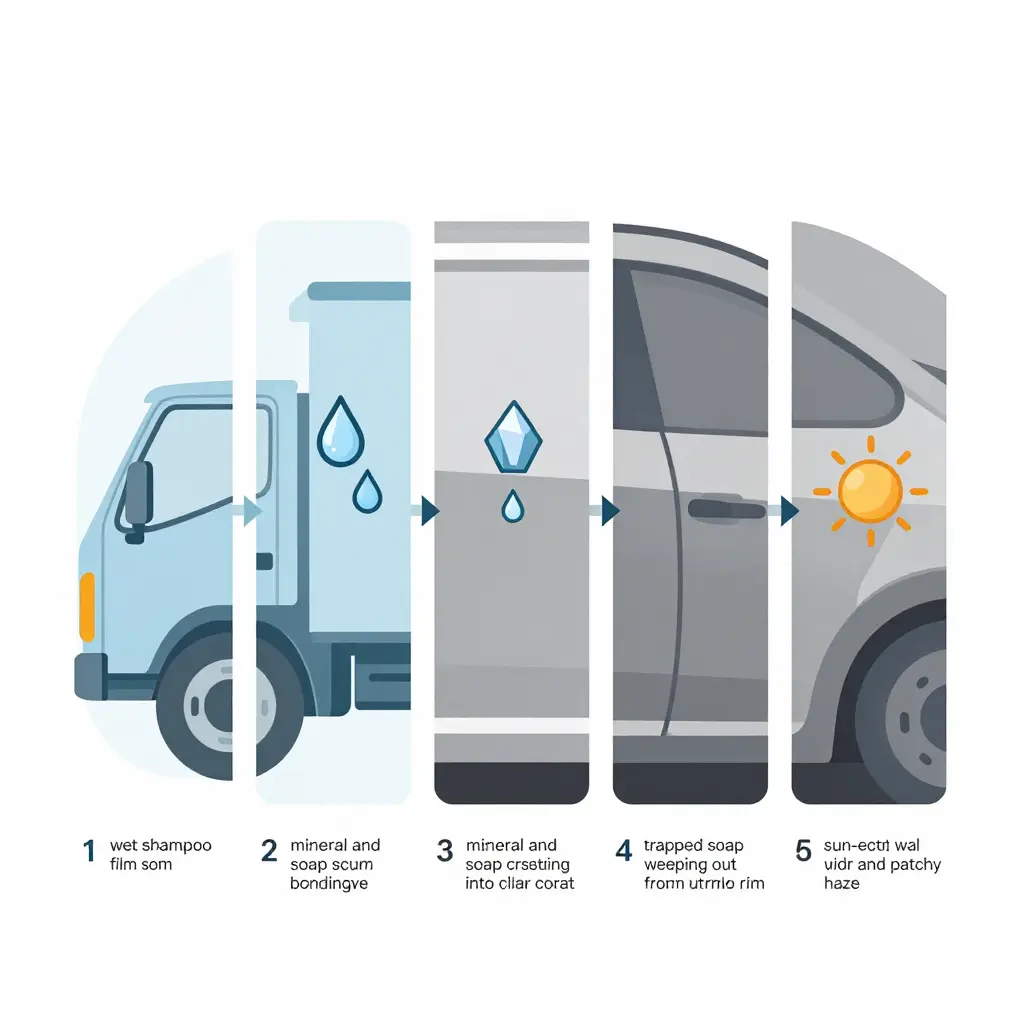
Stage 1: Film Formation and Flash-Drying as Water Evaporates
As water leaves the shampoo film, the surfactant left behind concentrates and the film collapses into a thin, tacky layer instead of rinsing cleanly away. On a hot panel the first few microns of water can flash off in under a minute, which locks that concentrated layer down before the rinse nozzle reaches it. What you see later is the grey haze that gets reported as truck wash residue on paint.
Stage 2: Saponified Oils Meeting Dissolved Minerals in Hard Water
Murphy Oil Soap is a saponified oil product, so its cleaning power comes from fatty acid soaps – the exact chemistry that reacts with calcium and magnesium in hard water. When those ions meet the soap film they form insoluble calcium and magnesium fatty acid salts: soap scum, a waxy precipitate with no affinity for water and a strong affinity for clear coat. Once it precipitates onto the panel it settles into pores and micro-scratches, and plain water will not lift it.
Stage 3: Incomplete Rinsing in Seams, Behind Mirrors, and Under Trim
Body seams, mirror housings, and the gap beneath door trim act as capillary reservoirs that hold shampoo long after the visible panels run clear. Water trapped in those cavities keeps soap in solution, and as the truck is driven or parked in the sun, that solution wicks back out across the paint and dries there. Planning the rinse sequence, as covered in these truck washing techniques, keeps you from re-contaminating panels you have already cleared.
Stage 4: Drying in Direct Sun or Wind Accelerates Spotting and Etching
Direct sun pushes panel temperature well above ambient, and wind strips the moisture boundary layer that would otherwise slow evaporation. Together they shorten dry time and drive dissolved solids to the edge of each droplet. What is left is hard water spotting: mineral rings with a concentrated rim that can etch into clear coat on a dark hood or sleeper. After a few heat cycles that etch is physical topography, not a film you can wipe off.
Stage 5: Interaction With Existing Wax, Sealant, or Ceramic Coating
A healthy coating sheets water, so droplets merge and run off as one continuous film rather than clinging. A soap residue layer disrupts that surface-energy balance: water stops sheeting and starts beading unevenly, while the coating underneath loses the oils that keep it hydrophobic. The result is patchy haze – some panels glossy, some flat – which looks like coating failure but is contamination sitting on top of it.
| Stage | What Happens | What You See |
|---|---|---|
| 1 | Film concentrates as water flashes off | Grey tacky haze |
| 2 | Soaps react with Ca and Mg ions | Waxy scum bonded to clear coat |
| 3 | Soap weeps from seams and trim | Drip trails and streaks days later |
| 4 | Sun and wind force fast drying | Ring-shaped water spots, etching |
| 5 | Coating loses water-sheeting | Patchy gloss, uneven beading |
For Comparison: What a Correctly Formulated Truck Wash Shampoo Does at the Rinse Stage
A pH-neutral, soft-water-tolerant shampoo is engineered to break and release rather than linger. Its surfactants are chosen so the film loses cohesion the moment fresh water hits it and lets go of the panel as a sheet, and chelating agents tie up calcium and magnesium before they can pair with soap. That difference is what separates a panel that dries clear from one that dries spotted.
What to Change First
Two things, before anything else: get the household oil soap out of the wash bucket, and rinse with soft or deionized water in a cool, shaded bay. That removes both the fuel and the trigger from the sequence, and preventing spotting, scum bonding, and patchy haze is far cheaper than polishing them out.
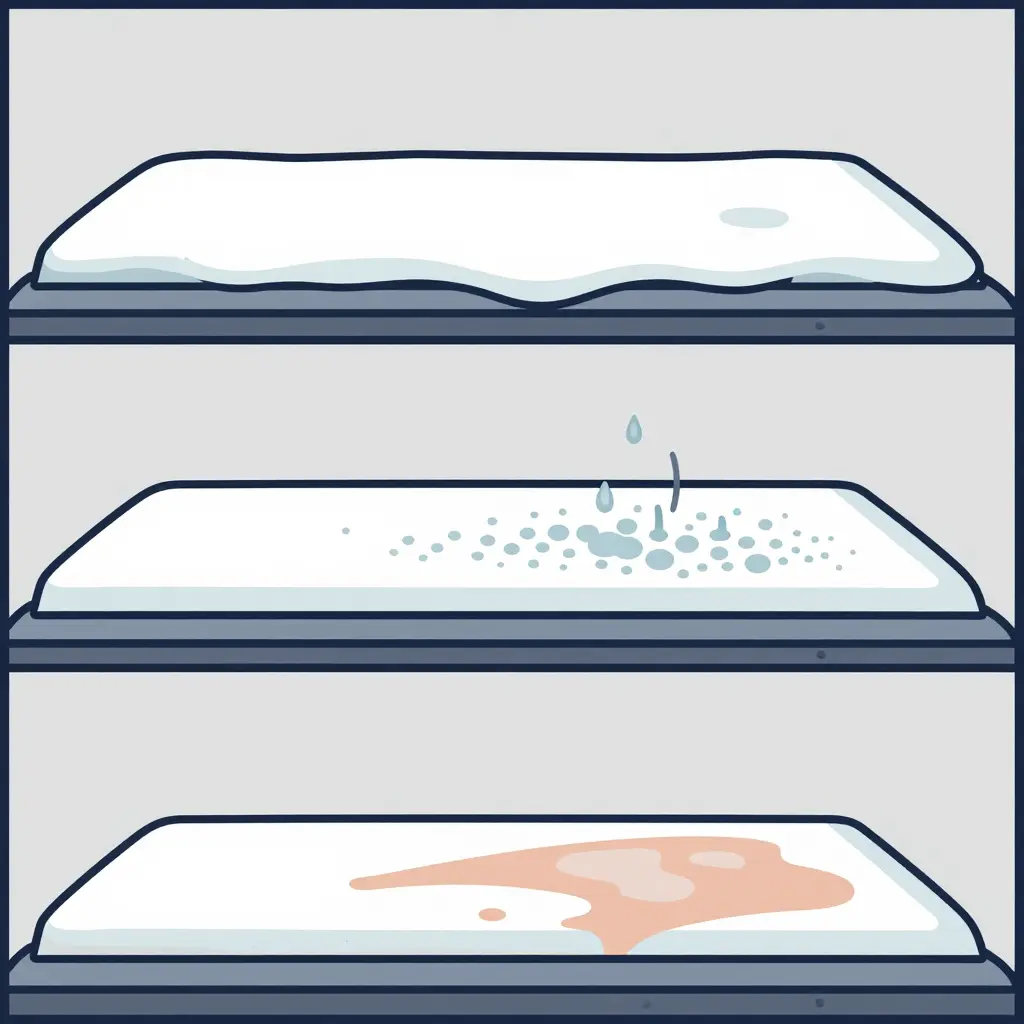
The diagram shows the same sequence as a cross-section: a mobile soap film on top, the water leaving while the dissolved minerals crowd together, and a thin uneven crust pressed against the clear coat. The middle stage decides the outcome, because once those minerals dry in place they bond rather than rinse away. Careful dilution plus a prompt, thorough rinse is the surest way to keep the third stage from happening, and these fast grease and tar removal techniques help you finish before anything sets.
Why Aluminum Trim Shows Residue First and Worst
Walk a truck after a wash and the aluminum tells you first. Mirrors, bumper faces, fuel tank straps, wheel covers, and cab trim haze up before the painted panels do. Aluminum is not dirtier. It is chemically busier, and the finish on it is thinner than paint.
Bare aluminum grows a thin, self-healing oxide layer within minutes of being exposed. That layer is clear, hard, only a few nanometers thick, and amphoteric, which means it reacts with acids and bases alike. An unbuffered product starts working on it, and any oxide removed regrows unevenly, which is what leaves a dull, blotchy face. Dried soap solids also settle into brushed and anodized grain, and hard-water salts dry into white streaks along the edges. To a customer, the chalky line along a tank strap does not read as soap. It reads as corrosion.
The distinction matters here, because not every product does the same damage. At label dilution Murphy Oil Soap is only mildly alkaline; the main harm it does on trim is the oil film that traps dust and the minerals that dry into it. Strongly alkaline truck soap, mixed heavy and left to dwell, is what actually eats oxide, and an acidic brightener removes it on purpose. Neither has a place in a routine wash on polished or anodized trim, even though both are sold for jobs that call for them.
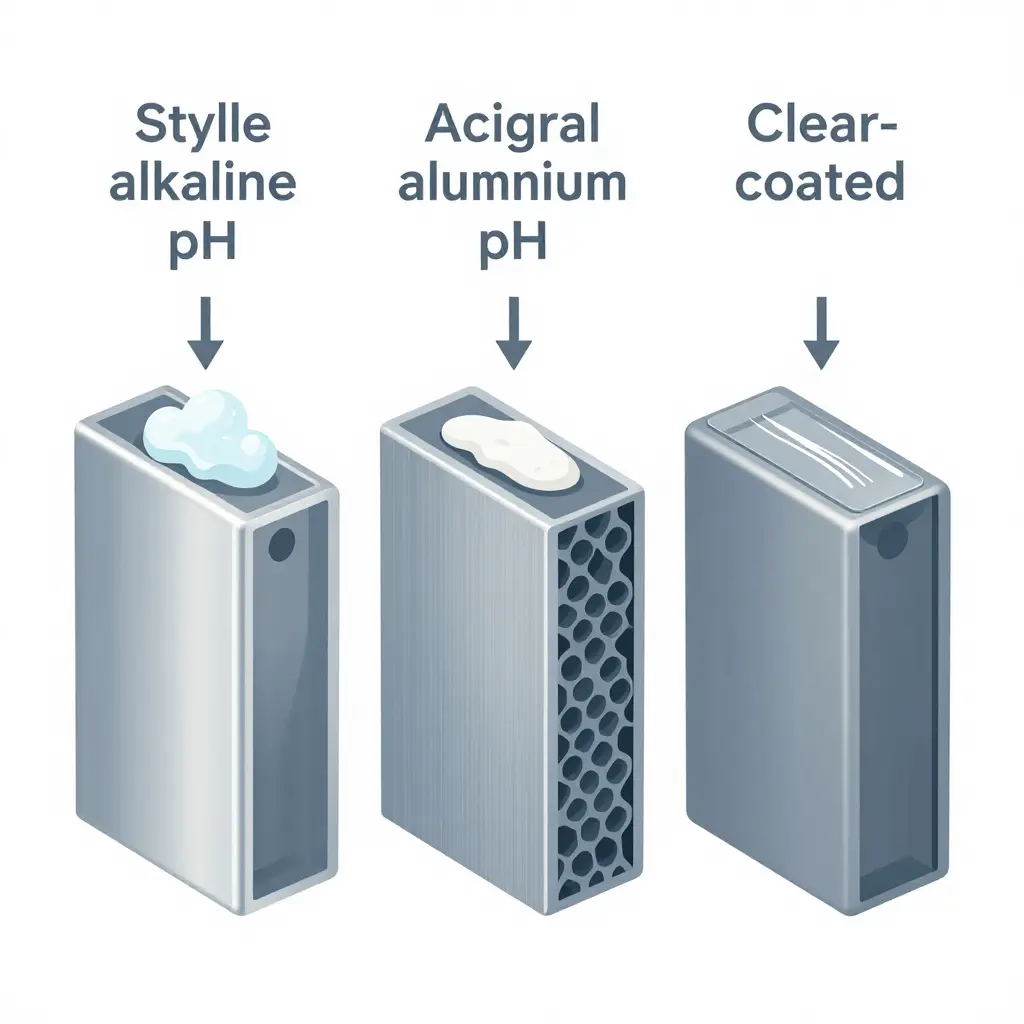
Three Aluminum Finishes, Three Different Failure Modes
| Finish | What Sits on Top | How Residue Behaves |
|---|---|---|
| Bare polished aluminum | Native oxide layer only | Alkaline soap dulls the polish fast; smears show as cloudy patches that need re-polishing |
| Anodized trim | Thickened, dyed oxide layer, partly sealed | Residue wicks into pores that sealing did not close and dries inside them, so streaking reappears after every rinse |
| Clear-coated aluminum | Oxide layer plus a polymer clearcoat | Soap film bonds to the coating and etches at edges, chips, and rivet heads where the barrier is thin |
The anodized case catches most operators out. Anodizing is not a sealed glass shell. It is a thickened oxide matrix, often dyed, and sealing closes most of the pores but not all of them, while worn or thin anodizing holds liquid readily. Once soap solution enters those pores and dries there, you are not washing a surface, you are trying to flush a sponge. That is where stubborn aluminum trim staining comes from, the kind that survives three wash cycles and a pressure rinse.
How a Residue Problem Progresses
- First contact. Soap solution hits the trim at full strength, usually from a bucket mixed heavier than the label recommends, and starts working on the oxide while it sits there.
- Film formation. The wash water runs off, but a thin soap film clings to brushed lines, anodized grain, and seams around brackets and rivets.
- Drying and baking. Sun, engine heat, or a slow final rinse flashes the water away, leaving dried soap solids and mineral salts locked into the texture instead of sitting on top of it.
- Visible chalky streaking. White tide-line streaks appear along trim edges and vertical runs, and the surface takes on a flat, hazy cast that looks like oxidation or galvanic corrosion to anyone inspecting the truck.
- Long-term dulling. Repeated exposure thins the protective oxide, pits polished faces, fades dyed anodizing, and leaves a mottled finish that only mechanical polishing, not chemistry, can recover.
Much of that damage is a technique problem as much as a product problem. Working in small sections, keeping surfaces wet until the final rinse, and getting the truck dry before the sun bakes a film in place all make a measurable difference, as covered in these proven strategies for cleaning grease and tar off your trucks.
The product category that protects aluminum is a pH-neutral, metal-buffered aluminum-safe truck wash built to lift road film without attacking the oxide layer. The practice that causes the damage is bucket-mixing an alkaline household or wood soap at a heavy concentration, letting it dwell, and letting it dry on the trim.
Residue Severity Index on Paint and Aluminum Trim
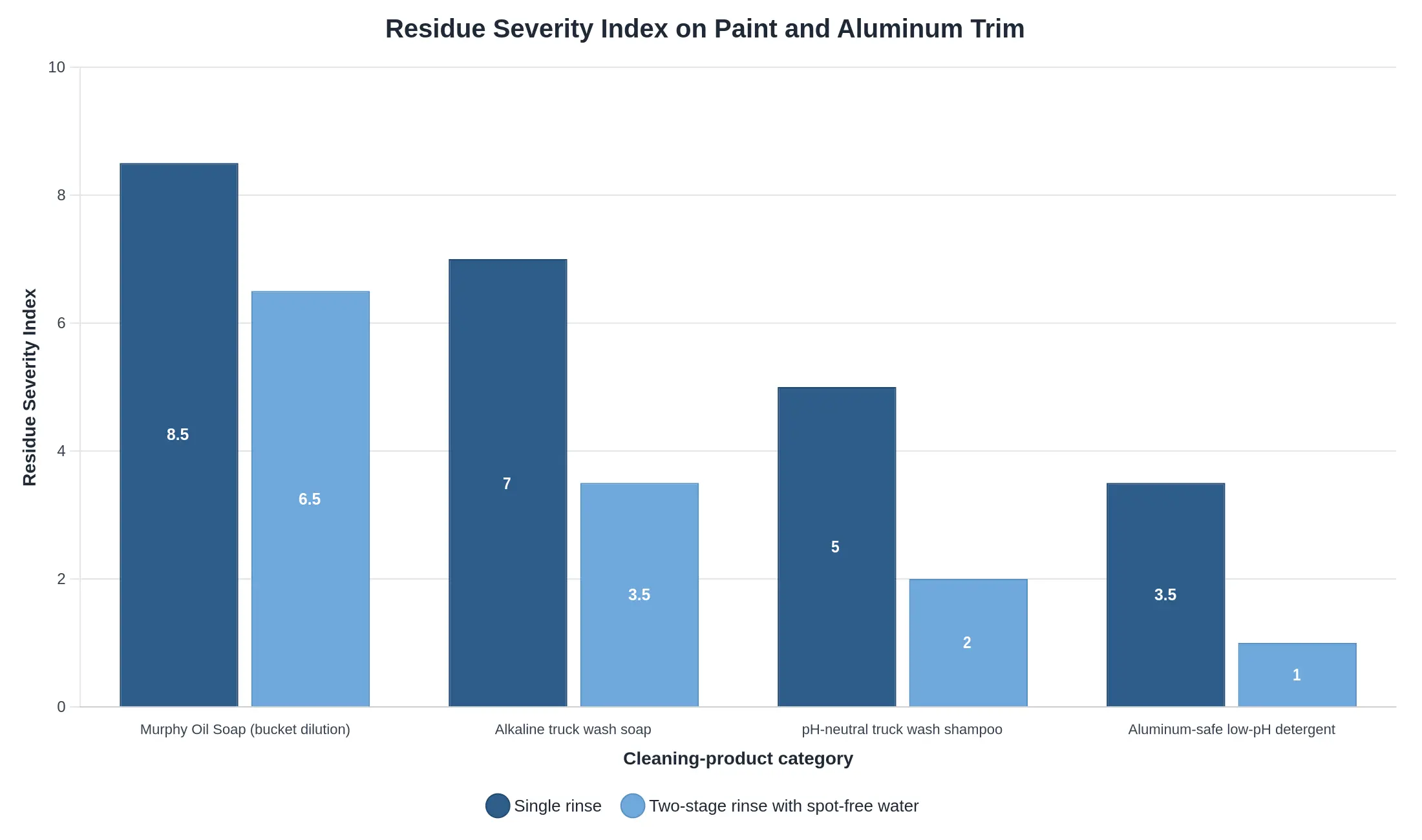
Each pair of bars measures the Residue Severity Index – a 0 to 10 score – for the same cleaning product under a single-rinse pass versus a two-stage rinse finished with spot-free water. The scores are a comparative index built for side-by-side product and process evaluation, not a laboratory measurement of film thickness or mineral content.
Every product improves once the second rinse step is added, but the size of the drop separates them: the soap-based options shed only two points or so, while the alkaline and low-pH detergents fall by roughly half. The pattern points at rinse architecture rather than product strength as the thing that keeps residue off paint and bare aluminum trim, which is why sequencing the rinse stages matters as much as choosing the chemistry. For more on breaking down stubborn films before the final rinse, see these methods for grease and tar.
Eight Wash-Bucket Conditions That Make Murphy Oil Soap Residue Worse
Residue rarely comes from the soap alone. It comes from how the bucket and the bay around it are managed. A bucket of Murphy Oil Soap is a mild, oil-based emulsion, and it rinses away cleanly only if dilution, water quality, and drying conditions are all under control. These are the eight conditions we see most often on rigs with cloudy paint and chalky aluminum trim, and each one has a mechanism behind it.
-
Over-dosing the soap. Extra product pushes the concentration past what a single rinse can carry away, so a fatty film stays behind and traps road dust and brake dirt. More soap does not mean more cleaning power; it means more material left to rinse off.
-
Reusing a bucket that already has soap film on the walls. That dried film re-dissolves into the fresh mix, quietly doubling your dose and releasing whatever grit it collected overnight. A clean, dedicated bucket per wash is the cheapest residue prevention you can buy.
-
Washing in direct sunlight. Hot panels flash-dry the solution before the rinse reaches it, baking the emulsified oils on as a streaky haze. Work in shade or wash one panel at a time so dwell time stays predictable.
-
Washing hot panels. A hood or sleeper still radiating heat evaporates the water fraction on contact, concentrating surfactant and oil into a sticky spot. Let the truck cool to the touch, or pre-cool with plain water before soap touches it.
-
Using hard fill water. Calcium and magnesium bind with the soap’s fatty acids and form an insoluble scum that clings to paint and glass. A softener or a DI final rinse fixes the chemistry instead of fighting the symptom.
-
Skipping the final sheeting rinse. A low-pressure sheet of water pulls the remaining film off in one pass rather than leaving beads behind. Skip it and every bead dries into a mineral-and-soap ring that polishing will not shift easily.
-
Allowing drip-drying in wind. Wind-driven droplets travel across the panel, deposit their load where they stop, and dry in place. Chamois the surface or blow it dry with filtered air instead of letting the breeze finish the job.
-
Washing aluminum trim last with contaminated wash water. By then the bucket holds road grime and oxidized paint from the whole truck, and porous anodizing grabs it. Do trim early with fresh mix, or keep a separate bucket for it, and keep heavy soil out of the wash solution in the first place with these proven strategies for cleaning grease and tar off your trucks.
None of these conditions is exotic. They are ordinary shortcuts that stack up over a shift. Tighten the dilution, the water, the timing, and the bucket, and the residue usually disappears without changing the product at all.
How to Stop the Residue: A Wash-Bucket Protocol
Murphy Oil Soap is a plant-oil cleaner built for interior floors, not for clearcoat and anodized aluminum, so the correction is never a stronger scoop of the same product. It is a repeatable sequence that takes off what the last wash left behind. These eight steps, in this order, cover both.
- Pre-rinse the full unit first. Before a mitt touches paint, flood the whole rig to knock off loose road film, wheel-well grit, and trailer dust. Work bottom-up on the first pass, then top-down, giving each side 60 to 90 seconds. Skip this and you are grinding grit into the panels you are trying to protect.
- Wash top-down and keep panels cool and shaded. If a panel is hot to the back of your hand, move the unit into shade or wait. Hot panels flash-dry shampoo before you can rinse it, and everything the water was carrying settles back onto the surface.
- Use a dedicated pH-neutral or aluminum-safe truck wash shampoo at label dilution, measured with a graduated cup. Not a glug, not “about right” – measure. Over-strength mix is the most common cause of streaking and trim staining. Heavy soil tempts operators to strengthen the bucket, but the right answer is a dedicated degreaser applied as a pre-step; these methods for grease and tar show how to separate those jobs cleanly.
- Keep a two-bucket setup with a grit guard, and never re-dip a dirty mitt. One bucket holds fresh shampoo, one holds rinse water over a grit guard. Rinse the mitt before every reload. A single dirty dip puts road grit straight back onto the panel.
- Rinse body seams, mirror brackets, and trim channels deliberately. Residue hides in joints, behind latches, under mirrors, and in the channel that holds aluminum trim. Direct a low-pressure stream into those lines until the runoff runs clear.
- Apply a final spot-free or deionized sheeting rinse. Flood from the top down at low pressure so water sheets off rather than beading. Sheeting water dries without mineral rings; beaded droplets leave marks as they evaporate.
- Remove standing water from aluminum trim immediately with a microfiber towel. Do not let it air-dry. Blot the trim channels, mirror housings, and grab handles while the surface is still wet.
- Inspect under flat light before the unit leaves. Walk the rig with a hand lamp held at a low angle across each panel and trim run. Surface gloss hides film; raking light does not.
If residue is already there: strip it
For film that has baked on, wash as above, then work one panel at a time with a diluted all-purpose cleaner – typically 1:10 to 1:20 depending on the label – on a cool, shaded surface. Keep it wet, agitate with a soft brush or microfiber, and rinse before it dries. On larger areas or older deposits, a paint decontamination wash built to dissolve the film without stripping wax or sealant is faster and safer than repeated APC passes. Spot-test on a hidden panel first, and never let a cleaner dwell in a seam.
If haze has etched in: buff it out
When the film has sat long enough to etch, washing removes the deposit but not the shadow. Machine-polish with a light-cut compound on a soft foam pad, low speed, small sections, keeping the pad flat and the surface cool. Follow with a finishing polish, then reseal the paint and treat the aluminum trim. Never buff over residue you have not washed off; the pad will drive it deeper into the clearcoat.
Follow the protocol and a washed unit leaves the bay with no towel-detectable film on paint or trim, no visible haze under raking light, and a finish that holds through the next few service cycles. Fewer rework rinses, fewer callbacks, and trim that lasts its service life instead of being replaced early.
The Rinse-and-Dry Sequence at a Glance
Soap residue is rarely a scrubbing problem. It is a sequencing problem, and the graphic below strips the protocol to its skeleton so the order and the handoffs are hard to misread: pre-rinse, a controlled wash, a first rinse, a spot-free sheeting rinse, and an immediate towel dry of the trim.

Each shape is a stage that has to end before the next begins, and each connector is a checkpoint rather than a formality. The first rinse carries loosened soap away from seams and panel gaps. The sheeting rinse changes how water leaves the surface so it runs off instead of beading. The last shape is the handoff nobody is allowed to skip, because trim holds solution long after paint has flashed dry. Pair the sequence with solid wash-bay workflow and quality control habits so it survives a busy day.
Choosing the Right Product and Pricing It Honestly
Most wash-bay chemistry arguments die the moment someone puts a price sheet on the counter. A five-gallon pail of wood soap looks like a bargain next to a purpose-built detergent, and per bottle it usually is. The honest comparison lives elsewhere: at the rinse stage, on the aluminum trim, and on the clock on the bay wall.
Read the technical data sheet before the price tag
Three lines on a TDS do most of the work, and skipping them is how residue ends up on $90,000 of equipment.
pH. Read the number twice – once as supplied, once at use dilution. A concentrate listed at pH 9.5 can behave very differently after a 1:40 cut. As a working rule, anything above roughly 10 or below 4 at use dilution needs a written dwell-time limit and a mandatory rinse step, because high-pH chemistry attacks the oxide on polished aluminum and low-pH chemistry attacks it too, from the other direction.
Dilutability. Ratios are meaningless until you pin down the units and the water. “1:40” tells you nothing about whether it means volume at use dilution, whether the dose assumes soft water, or whether it was validated at 180 ppm hardness. Convert everything to ounces per gallon, do the arithmetic yourself, and check whether the recommended dose assumes a specific pressure or nozzle type.
Aluminum compatibility. The best sheets name the substrate, name the alloy, and carry corrosion data on bare aluminum test panels. Language to look for: “not for use on unpainted or polished aluminum,” “may darken anodized surfaces,” “test on an inconspicuous area first.” Language to walk away from: chloride-containing, caustic, sodium hydroxide, brightener. A sheet that never mentions aluminum has not cleared the product. It has declined to answer the question.
The per-bottle trap: cheap soap, expensive wash
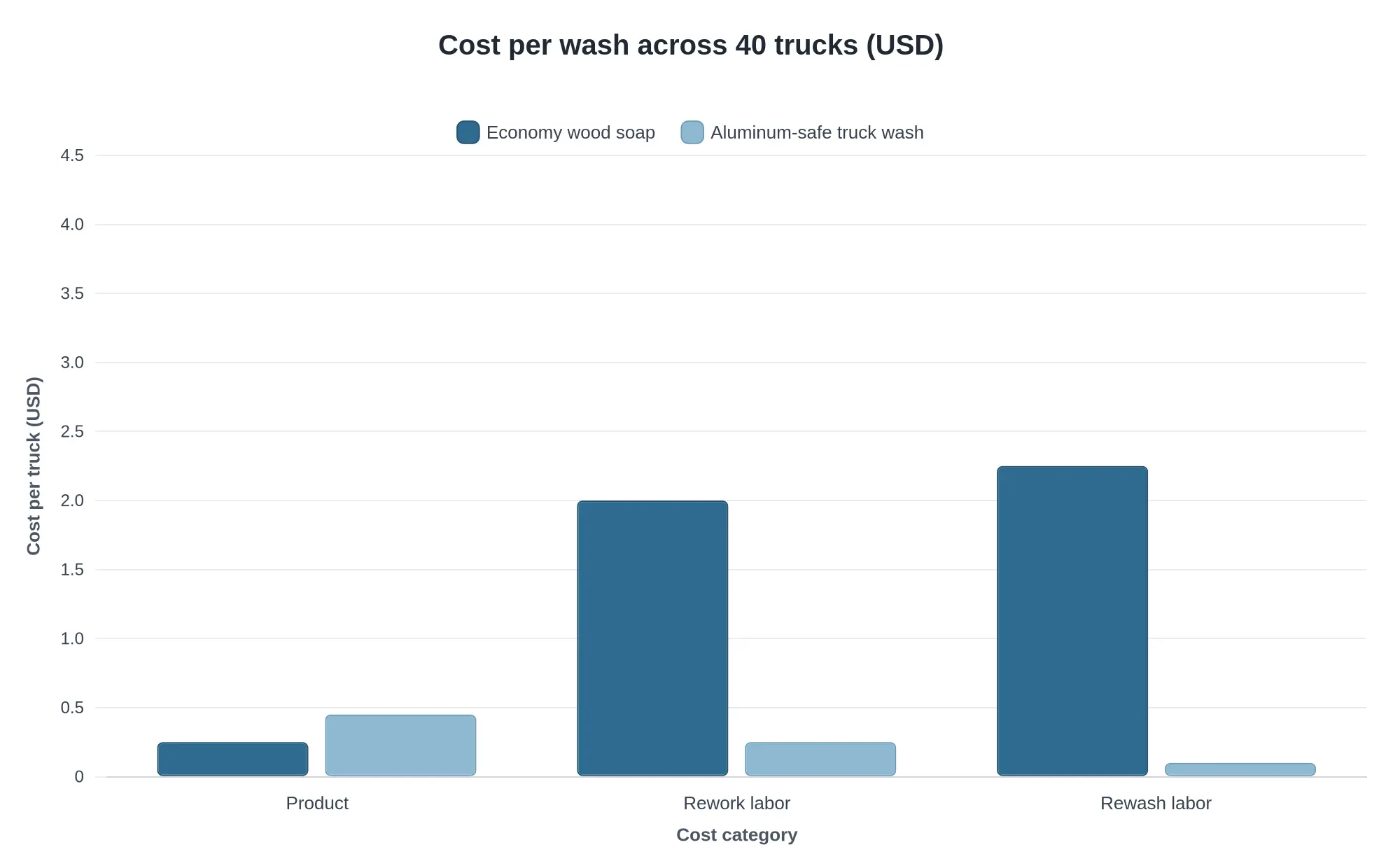
Set the scenario so the numbers can be checked rather than asserted: 40 trucks a week, one 5-gallon bucket per truck, bay labor at $30 an hour, and a bay that can realistically turn 3 trucks an hour.
Start with the economy wood soap at $16 a gallon, dosed at 2 ounces per bucket. That gallon fills 64 buckets, so product costs $0.25 per truck. Now the part nobody puts on the invoice. On one truck in five, the soap leaves an oily film that grabs dust and shows as haze on dark paint and a dull bloom on polished aluminum, and clearing it takes a 20-minute rework pass. That is 8 trucks and 160 minutes, or $80 of labor across the week – $2.00 per truck. On one truck in ten, the film has dried into the clearcoat or collected in trim seams, and the unit needs a full 45-minute rewash: 4 trucks and 180 minutes, or $90, about $2.25 per truck. Add it up and the “cheap” soap costs about $4.50 per truck, plus 5.7 hours of bay time a week, which is capacity for roughly 17 more trucks you never got to wash.
Run the same 40 trucks on a purpose-built aluminum-safe truck wash at $38 a gallon and 1.5 ounces per bucket. That is 85 buckets per gallon, so $0.45 per truck in product, nearly double per bottle. Residual rework runs about one truck in forty, or $0.25 per truck, and full rewashes are rare enough to budget $0.10. Total: about $0.80 per truck.
The gap is $3.70 per truck, $148 a week, roughly $7,700 a year, and it does not include the paint correction you will eventually pay for on a hood that sat in the sun with a soap film on it. Product is the smallest line item in both columns. It is never the expensive part.
Where Murphy Oil Soap genuinely earns its place
Around a wash bay it has real work to do: cab interior wood and laminate trim, wooden cabinetry and shelving in the office or parts room, workbenches and waiting-room furniture, wooden tool handles, and painted interior doors. It lifts hand oils and dust from a sealed finish without stripping it. Dilute per the label, apply with a damp cloth, wipe dry, and keep it out of the wash bucket and the downstream injector.
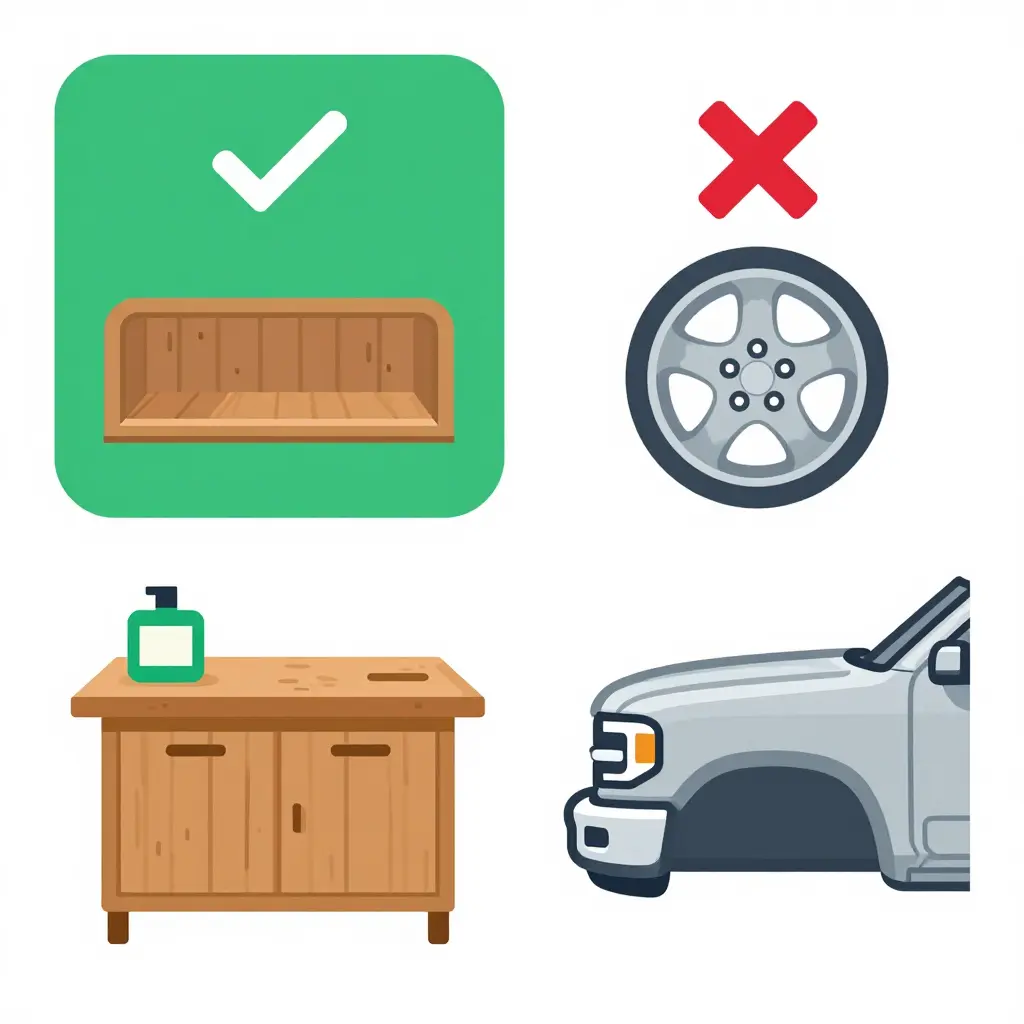
Where it should not go: exterior paint and clearcoat, chrome, bare or polished aluminum on wheels, fuel tanks, side skirts and box trailer skin, anodized trim, glass, rubber seals, and anything inside a food-grade tanker. Wood soap leaves an oil film by design. That is the whole point on a cabinet door and a defect on a hood.
Oil film on trim also holds road dust and grit against the surface, which is why a five-minute walk-around after every wash earns its time. The same walk catches loose fasteners, cracked seals, and chafed wiring, the discipline covered in this guide to regular trailer maintenance.
Bucket, automatic, self-serve: where residue risk actually lives
| System | Residue risk | Why |
|---|---|---|
| Manual bucket wash | High | Dose measured by eye, one bucket reused across panels, oily film left on the surface, and no rinse verification |
| Automated rollover or tunnel | Low | Metered dosing, timed dwell, forced final rinse, and conductivity monitoring on the rinse water |
| Self-serve wand and foam brush | Medium to high | Customer chooses the chemistry and strength, brushes hold grit, and rinse discipline is inconsistent |
Manual washing is not inherently bad. It is simply the only method where the operator is also the dosing system, the rinse cycle, and the quality check, and a film-forming product shows up at exactly that point.
The bottom line
Read the data sheet for pH at use dilution, real dilutability, and an explicit statement about aluminum before you look at the price per gallon. Keep the wood soap on the cabinetry and the workbench, put purpose-built chemistry in the bucket, and measure cost per clean truck rather than cost per bottle.
Turn the Correction Into a Written Standard Operating Procedure
Pulling Murphy Oil Soap off the shelf solves today’s problem. Writing down why it came off the shelf, and what replaces it, solves the next six months. For fleet operators and wash managers, a correction only holds when it lives in a document bay staff read, sign, and follow, not in the memory of whoever happened to catch the streak on the aluminum trim.
Build an approved-product list by surface type
Every bay should work from a list that names what is allowed, at what strength, on which substrate. Paint and clear coat, polished aluminum, anodized trim, glass, vinyl, and tanker interiors all behave differently, and a product that is benign on steel can leave a film on brightwork. Pair each line with the reason it matters and the waste-stream limits that apply, since approved chemistry and industry compliance and emissions regulations are the same conversation.
| Surface type | Approved products | Never use | Rinse standard |
|---|---|---|---|
| Painted cab / clear coat | pH-neutral vehicle shampoo | Oil-based household soaps, degreasers | Full rinse until water sheets clear |
| Polished aluminum | Aluminum-safe wash, no caustic | High-alkaline or solvent blends | Immediate rinse, hand dry |
| Anodized trim | Mild neutral soap only | Abrasive pads with any soap | Low-pressure rinse, no dwell |
| Glass | Purpose-made glass cleaner | Soap residue from shared buckets | Squeegee and dry |
| Tanker interior | Food-grade approved chemistry only | Anything not on the approved list | Potable-water rinse, documented |
Specify dilution and rinse in the wash sheet
A wash sheet that says “soap” is not a specification. Write the ratio, the water temperature, the maximum dwell time, the rinse pressure, and the acceptance test: water should sheet rather than bead, with no chalky edge on the trim. Add a line for water use and runoff handling, because good facility management for truck wash businesses starts with knowing exactly what goes down the drain.
Train new bay staff on the two-bucket rule
Teach the two-bucket method as a habit, not a suggestion: one bucket for wash solution, one for rinse water, grit guard in the bottom, hands never swapping. Wash-water chemistry belongs in the same training session as wand technique, with the same sign-off and the same refresher.
Log rework and residue complaints so patterns become visible
Every rework, every “haze on the mirror bracket” call, and every rewashed trailer goes in the log with date, bay, product, and surface. This is where residue problems scale with fleet standardization: an unapproved product sitting in one bucket touches every unit that passes through that bay, so a single shortcut becomes a fleet-wide defect rate. Documented logs feed directly into fleet standardization and emergency response planning, and turn a complaint file into a decision tool.
Assign inspection responsibility before release
Name one person per shift who signs the unit out. That inspector walks the vehicle under proper lighting, checks trim, glass, and panel edges for film, and initials the ticket before the tractor leaves the lot. No signature, no release.
A written procedure makes quality repeatable across every bay, every shift, and every new hire, and it protects you commercially: when a customer questions a finish, you can show what was used, at what strength, and who approved it.
Frequently Asked Questions: Murphy Oil Soap in a Truck Wash Bucket
Can Murphy Oil Soap damage truck paint?
It can, gradually rather than dramatically. The soap is mildly alkaline and leaves an oil film, and repeated exposure with poor rinsing strips wax, dulls clear coat, and leaves a gummy layer that traps road grit. On a base-coat/clear-coat finish that layer bonds into the clear and produces the blotchy haze that gets mistaken for failing paint. If you have been running Murphy Oil Soap in a truck wash bucket, stop and switch to a pH-neutral car shampoo before the haze has time to set in. Once clear-coat damage is real, only machine polishing takes it out.
Will it stain aluminum trim permanently?
It can, and repetition raises the odds. On bare and polished aluminum, heavy repeated exposure can leave staining that polishing will not fully lift, because the oil and the minerals in the water work into the grain. Anodized trim collects a cloudy film along the edges where the finish is thinnest. The safe assumption is that any film left to dry on aluminum is doing damage you will pay for later, so rinse and dry the trim immediately if the soap touches it.
What dilution should be used if someone insists on using it in a bucket?
If it has to happen, cap it at half an ounce per gallon of water, which is roughly 1:256, and never pour it directly onto a panel. That is far below the label dilution, so expect it to clean poorly. It is also the only way to keep the oil load down, because stronger mixes leave oil on every surface they touch. Add the soap to the water in the bucket and agitate before loading a brush. Realistically, no dilution makes Murphy Oil Soap in a truck wash bucket a good choice, because the oil that makes the product work is the same oil that ruins the finish.
Does dish soap leave the same residue?
No, but it is not innocent either. Dish soap is mildly alkaline, strips wax, and leaves a thin surfactant film that spots with hard water and dulls paint, yet it rinses away cleanly and leaves no oil layer. Murphy Oil Soap leaves oil plus surfactant, which is why the streaks come back after the first rain. Neither belongs in a professional wash bay, but dish soap is the easier mistake to correct.
How do I remove Murphy Oil Soap residue that has already dried?
Wash the panel with an alkaline pre-soak or a paint-safe degreaser, and rinse before it can dry again. Follow with a clay bar pass to pull the bonded film out of the clear coat, then a pH-neutral wash plus wax or sealant. On aluminum, use a dedicated aluminum cleaner at label dilution and keep the surface wet the whole time. Residue that has baked on for weeks may need a light machine polish before it releases.
Is it safe on vinyl, plastic, and rubber trim?
It will not melt them, but it will not do them any favors. The oil soaks into textured plastic and rubber and holds dirt there, turning trim a patchy grey-brown that normal washing will not fix. On vinyl it leaves a greasy sheen that attracts dust and makes dressing slide off. Keep it off porous trim and clean those areas with a trim-specific product.
Does hot water make residue worse or better?
Worse, every time. Heat opens the pores of clear coat, plastic, and aluminum oxide so the oil penetrates faster, and the water evaporates quicker, flashing the residue straight onto the surface. Warm water accelerates the exact reaction you are trying to avoid. Use cool to lukewarm water, work in the shade, and never let cleaning solution dry on a truck.
How often should a truck be washed to keep a residue-free finish?
For a working tractor-trailer, every one to two weeks, and weekly if you run salted winter roads or haul in dusty environments. Regular washing with a pH-neutral shampoo keeps film from accumulating and stops small deposits from curing into paint, and fleets on a fixed wash schedule spend far less on paint correction over a year. Pair that schedule with a proper pre-soak routine, covered in these notes on pre-soaking and heavy soil, and you will not need an aggressive household soap again.
The Bottom Line on Wood Soap in a Truck Wash Bucket
Murphy Oil Soap is a wood-care product, not a vehicle shampoo, and it will leave a film on painted surfaces because its oils are meant to linger rather than sheet away. The staining that follows, aluminum trim first, is what happens when the wrong chemistry meets the wrong surface. It is not a bad batch and it is not a careless wash.
The usual conditions make it worse: sun-baked panels, hard-water minerals, long dwell times before the rinse, and over-strength dilution. Each one pushes the oils deeper into pores and micro-scratches before anything can lift them out. The fix is just as ordinary. A dedicated, pH-balanced truck wash built for cured paint and bare metal releases soil and rinses free, provided the rinse is thorough: a low-pressure flood first, a full sheeting pass over paint and trim, then a quick dry so minerals never get time to settle. Done that way the film stops forming, the trim keeps a uniform finish, and the result holds from the first truck of the day to the last one through the bay.