
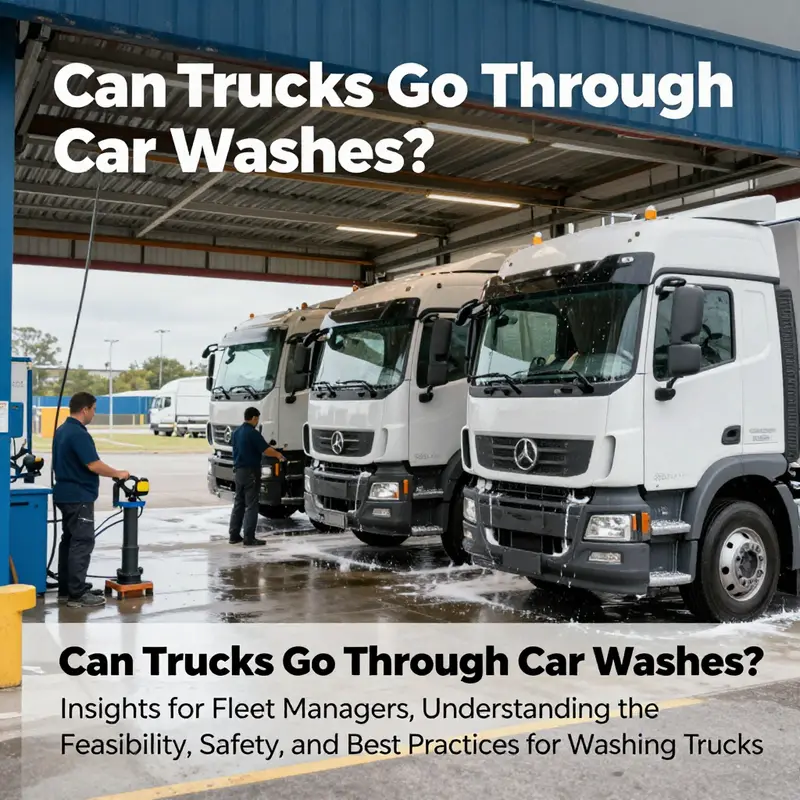
Trucking companies and logistical operations face unique challenges, among which maintaining fleet cleanliness is crucial. A clean truck not only enhances the company’s image but also helps prolong the lifecycle of the vehicles. This article examines the critical question: Can trucks go through car washes? Each chapter delves into various aspects of truck washing, providing fleet managers with essential insights on available washing options, safety considerations, and best practices for effective cleaning routines.
Rolling Through the Wash: Practical Guidelines for Trucks in Auto Car Washes

Can a heavy truck really pass through a car wash without scraping the sides or stalling the process? The short answer is yes in many cases, but the full answer is more nuanced. The ability of a truck to go through an automated wash depends on a careful match between the vehicle’s size, the wash’s design, and the facility’s operating rules. In practice, many fleets learn early on that there are washes built with heavy vehicles in mind and others that are strictly passenger-car oriented. The distinction matters because it shapes the kinds of cleaning you can reasonably expect, the risks you take, and the impact on fleet downtime. In the broader sense, the question touches on the same core issues that drive any fleet maintenance decision: safety, efficiency, and the long-term care of assets. The landscape is not simply dichotomous—some sites offer dedicated truck wash lanes or even whole facilities designed to handle large vehicles, while others require potential customers to seek alternatives if their truck cannot fit the tunnel. This reality is echoed in the industry’s move toward specialized heavy-vehicle cleaning solutions that account for size, weight, and the particular grime that trucks accumulate on the road and at job sites. For fleet managers, the practical takeaway is straightforward: know your vehicle dimensions, know the wash’s limits, and plan the wash as part of a broader maintenance schedule rather than as a one-off chore.
Height and width restrictions are the most visible gatekeepers when you approach a wash with a big vehicle. The typical clearance in many standard tunnel washes sits around seven feet or roughly 2.1 meters. A tall cab, a rooftop storage rack, or a cargo extension can push a truck beyond that limit, even if the rest of the dimensions would otherwise seem to fit. It is always worth checking the facility’s posted specifications, calling ahead, or using social media or a business directory listing to confirm the current clearance. The risk of attempting a wash that doesn’t accommodate your truck is not merely cosmetic; it can trigger costly damage if a guide rail, an overhead sensor, or the tunnel’s ceiling engages a protruding feature. A phone call to verify size compatibility may save both time and money, especially for a fleet that runs a mix of vehicle types.
Beyond the physical fit, compatibility hinges on the vehicle type and the wash’s intended customer base. Some car washes are versatile enough to handle light-duty trucks and SUVs, while others reserve their bays for passenger cars or small commercial vehicles. In this sense, a truck owner’s decision to wash at a particular facility is not merely about whether the machine can reach the dirt but whether the facility’s workflow aligns with the truck’s construction and operational needs. Some facilities accommodate larger vehicles with what are effectively truck wash lanes or sections, while others may insist on alternative cleaning arrangements. The central thread here is that not all washes are created equal for trucks, and the best choice is to confirm a site can handle the specific truck model and its features before arriving.
The wash type itself can influence both safety and cleaning outcomes. Brush-based tunnel systems, while common for passenger cars, can present more risk to larger vehicles if height or width restrictions are misjudged or if shielded areas are not properly aligned. Brushless systems are generally gentler on paint and trim and can be more forgiving for oversized vehicles in terms of contact with moving parts. However, even brushless configurations carry considerations: the water pressure, nozzle arrangement, and debris in the undercarriage or wheel wells can lead to abrasions or water intrusion if the vehicle carries heavy mud or rust-prone coatings. When evaluating a wash, fleets should consider not just whether a truck can pass through, but how the system’s cleaning method interacts with the truck’s finish, chrome, and rubber components. The goal is a thorough yet respectful clean that minimizes the risk of paint damage, seal degradation, or other wear that accumulates with high-pressure contact over many wash cycles.
Preparation before entering a wash may seem small, but it is a critical step in achieving consistent results. Loose items such as bike racks, cargo on racks, or exterior equipment should be removed to prevent jamming or misalignment of the wash arms. Heavy mud and salt buildup, common on highway segments in winter, can clog filters, increase the risk of channel blockages, and reduce the effectiveness of the wash. For trucks with roof-mounted equipment, engineers and operators should consider temporary removal or secure stowage to ensure nothing protrudes into the wash tunnel. The undercarriage can accumulate grime that requires aggressive cleaning. Owners should also verify that any aftermarket devices like trailers or hitch-mounted accessories do not extend beyond the truck’s standard footprint in a way that could contact tunnel components. In short, a little pre-wash housekeeping pays off in cleaner results and reduced maintenance hassle for the wash line itself.
Pre-wash preparation also extends to the fleet’s maintenance schedule. Regularly cleaning and inspecting wash equipment that a truck frequently uses can prevent recurring issues. For example, keeping sensors clean helps to avoid false readings that may stall a wash sequence or trigger unnecessary shutdowns. Fleet operators should keep a record of which trucks used which wash bays, noting any fit issues or exceptions. This data becomes part of a broader logistics picture that helps planners optimize routing to washes that will reliably accommodate each vehicle type and load. In practice this means that a warehouse district route can incorporate a truck wash with a dedicated lane on days when multiple heavy vehicles need attention, rather than forcing a single site to bear the entire load, which might not be the most efficient arrangement for the entire fleet.
When a truck simply cannot fit into a tunnel wash, or when the wash specification does not adequately address a vehicle’s size, there are practical options. A truck may be directed to a facility with a dedicated truck wash lane or to a standalone heavy-vehicle cleaning station. Some fleets also rely on mobile or on-site washing services for large or unusual equipment. While these alternatives may have different cost profiles or frequency considerations, they can still deliver the same level of cleanliness and rust-inhibiting protection that modern fleets expect. The key is to treat the wash as part of a broader maintenance and operations plan, not as an isolated action. Fleet managers who integrate wash decisions with maintenance windows, downtime allowances, and route planning can keep fleets on the road with minimal disruption while maintaining vehicle appearance and service life.
To support managers in aligning facility choice with fleet needs, there is value in looking at the broader practice of facility management for truck wash businesses. This perspective emphasizes space planning, safety protocols, and workflow efficiency—factors that matter just as much as the wash’s cleaning capability. By considering facility design, staff training, scheduling, and contingency plans, fleets can reduce the risk of bottlenecks and equipment damage while maximizing uptime. For readers who want to explore this topic further, a detailed resource on facility management for truck wash businesses offers practical guidance on balancing capacity with safety and service quality. facility management for truck wash businesses
The decision to wash a truck is ultimately a risk-reward calculation. On one hand, a well-suited wash can deliver a high-quality clean that protects paint, reduces corrosion from road salts, and maintains a professional appearance for fleets. On the other hand, attempting to push a vehicle beyond a wash’s design envelope can cause misalignment, damage to sensors and seals, and even injury to equipment operators. The best practice is to approach wash selection with a clear picture of the vehicle’s dimensions, a quick check of the site’s capabilities, and a willingness to adjust cleaning plans if a site cannot meet the vehicle’s needs. A fleet that establishes a reliable set of approved washes—those with documented clearance, known lanes for larger vehicles, and standardized pre-wash prep procedures—will minimize surprises and keep maintenance costs predictable. In the end, trucks can go through car washes, but the path is smoother when operators treat the wash as a system with its own constraints and opportunities, rather than as a one-size-fits-all solution.
For readers seeking deeper insight into standards and performance in heavy-vehicle car washing, a comprehensive overview is available through industry analyses that explore the nuances of wash design, throughput, and protective measures. External resource: https://www.industryweek.com/automotive/comprehensive-overview-heavy-vehicle-car-wash-standards-performance-best-practices
null

null
Washing Giants: How Trucks Can Safely Navigate Commercial Truck Washes

The question of whether a truck can go through a car wash invites a broader examination of purpose, design, and safety. It is not simply a matter of whether the wash can accommodate a large vehicle, but whether the facility’s layout, equipment, and cleaning regimen are suited to the size, weight, and complexity of a commercial truck. In practice, the answer is nuanced. Trucks can pass through certain car wash environments, but only when the facility is purpose-built for heavy vehicles or when a dedicated truck wash is available. Standard car wash bays that cater to passenger cars frequently lack the clearance, reinforcement, and wash- bay infrastructure to handle tall, wide, and heavy vehicles. A misfit here can lead to damage, not only to the truck but also to the wash equipment and the operator’s livelihood. The distinction matters because fleets and independent drivers alike rely on predictable, safe, and timely cleaning to maintain asset value, safety, and compliance with environmental and regulatory expectations. The bottom line is that trucks require either specialized, high-capacity systems or access to facilities designed specifically for large vehicles, with clear specifications for height, width, weight, and track or bay dimensions.
Commercial truck wash facilities exist precisely for this need. They are built around heavy-vehicle dimensions and the realities of dirt and grime that accumulate on long hauls: dust, oil residues, road grime, and inert matter that can cling to undercarriages and roofs. Rather than a single conventional wash cycle, these facilities deploy robust, industrial-grade equipment and automated systems designed to clean the front, roof, sides, and rear of large vehicles. Operators can expect a controlled sequence that may begin with a foam pre-treatment to loosen buildup, followed by high-velocity water or foam spraying, and finally targeted brushes and rinse cycles. The emphasis is on thoroughness and efficiency rather than a quick, passenger-car-like scrub. Facilities emphasize reliability under heavy use, with components that tolerate frequent cycles and the higher pressures required to reach rooflines, cargo areas, and trailer undercarriages.
One core aspect of their design is the movement or access mechanism. Many truck wash systems rely on a rollover or track-driven approach that allows the wash apparatus to travel along the vehicle’s exterior while maintaining consistent contact with surfaces that are often uneven or obscured by large mirrors, antennas, or load-bearing equipment. This kind of system can execute a complete cleaning pass from the truck’s nose to its tail, including the roof, top rails, and the often-neglected crown of a cab. Because these systems operate with industrial-grade detergents and spraying sequences, they can also incorporate foam pre-treatment and a sequence of wash durations and intensities that operators can customize. The result is a standardized, repeatable clean that supports fleet aesthetics, corrosion prevention, and safer, more visible vehicles on the road.
The cleaning chemistry itself is a key factor. Heavy-vehicle washes typically rely on detergents and rust- and corrosion-inhibiting agents chosen for their effectiveness on metallic surfaces and the weathering that trucks experience on open highways. The use of cold-water or temperature-managed wash cycles helps to minimize thermal stress on coatings and seals while delivering robust cleaning action. The emphasis on rust and corrosion control is not incidental; trucks spend significant time in varied climates, exposing vulnerable components such as frame rails, undercarriages, and fasteners to moisture and road salts. A well-managed truck wash program considers the environmental footprint as well, incorporating water recycling, filtration, and runoff controls that meet local regulations and protect ecosystems along transport corridors. In this way, the facility supports both asset longevity and community stewardship.
Location is another practical dimension. Trucks cannot simply roll into any car wash and expect a safe, effective outcome. Designated commercial truck wash stations are strategically positioned to serve fleets and long-haul drivers who require reliable cleaning between legs of a journey. Truck stops often integrate wash services as a convenience for drivers who need to maintain fleet appearance and compliance with vehicle standards. Fleet maintenance centers—whether corporate-owned or third-party—may house in-house wash bays designed to integrate with maintenance schedules, making it easier to pair washing with inspections, tire rotations, or brake checks. Logistics hubs frequently maintain wash facilities to keep fleets in peak condition between deliveries, while public transportation depots apply similar practices to buses and other heavy-duty vehicles. The recurring theme across these settings is predictability: drivers should know where to wash, what the bay can accommodate, and how long the process will take.
But even within dedicated truck wash facilities, the specifics matter. Height, width, and weight are the baseline constraints. A bay that can swallow a mid-size delivery van might still be too tight for a heavy trailer or a high-cab configuration. For this reason, informed operators verify bay specifications before arrival. They also prepare the vehicle by retracting or shielding protrusions that could snag on overhead spray arms or brushes, such as tall antennas, roof racks, or extended mirrors. Pre-cleaning steps, like removing loose debris and ensuring tires are properly inflated to maintain stability during washes, contribute to a smoother process and reduce downtime. The sequence of steps—pre-wash, soap or foam application, scrub phase, undercarriage rinse, and final rinse—can be tailored to the vehicle’s actual build and the degree of soiling. High-pressure undercarriage spray is particularly valuable, since it addresses mud, road grime, and potential chemical residues that accumulate where weight and springs press the vehicle to the ground.
An underlying theme in the practical operation of these facilities is safety, not only for the vehicle and driver but also for wash staff. The heavy loads, vertical clearance, and rotating components all pose risks that require clear procedures, training, and oversight. For fleets, this translates into standard operating procedures that spell out who supervises the wash, how drivers approach the bay, and what signals indicate readiness to proceed. For drivers, understanding the wash cycle and any required pre-wash checks helps ensure a smooth experience. It also reduces the likelihood of contact with moving parts that might be exposed during a cycle. A well-run facility will provide visible clearance indicators, standardized hand signals, or digital interfaces that let the operator select the correct wash program and confirm the vehicle’s compliance with the bay’s parameters.
Beyond the mechanical and logistical realities, the decision to wash a truck at a dedicated facility is often driven by environmental and regulatory considerations. Industrial washes are designed with containment in mind. Runoff management, water filtration, and the systematic use of rust inhibitors are balanced with environmental protections to minimize leakage and runoff into storm drains or groundwater systems. This is not merely about appearance; it is about maintaining a consistent and compliant maintenance regimen that protects the vehicle while safeguarding public health and ecosystems. In many regions, fleets are encouraged or required to adopt such practices as part of broader emissions and maintenance standards, reinforcing the idea that wash operations are an integral, not incidental, part of fleet management.
For drivers and fleet managers, a clean truck is more than a cosmetic win. It reduces drag, lowers fuel consumption slightly, and helps keep visibility and signaling equipment clear. Clean wheel wells, trailers, and undercarriages reduce the chance of debris causing damage at highway speeds. A thorough wash can also reveal issues that might otherwise go unnoticed, such as small paint nicks, corroded fasteners, or soft spots on rubber components. In this way, a well-timed wash becomes part of a broader preventive maintenance routine, integrated with inspections and service scheduling. When approached with a clear plan, washing a truck at the appropriate facility supports uptime, safety, and compliance, while also extending the vehicle’s useful life on the road.
Within this context, the practical implications for someone planning to wash a truck are straightforward. Confirm the bay’s clearance specs before arrival. If the truck exceeds the bay’s height, width, or weight limits, seek an alternative service location that can safely accommodate the vehicle. Prepare the vehicle by retracting or shielding any nonstandard equipment and ensuring that windows and vents are closed to prevent water intrusion. Communicate any special cleaning needs—such as extra attention to the undercarriage or trailer wheels—so the operator can tailor the wash program accordingly. And crucially, recognize that not all car washes are interchangeable for heavy vehicles. The value lies in using facilities designed for large vehicles, with staff trained to handle trucks and buses and equipped to manage the higher workloads and potential environmental considerations that come with them.
In real-world fleet operations, the practical lessons accumulate over miles of road and multiple wash cycles. A fleet that integrates truck wash visits with its maintenance schedule tends to stay ahead of corrosion, surface wear, and regulatory concerns. The human element remains essential here: drivers need clear guidance, clean facilities, and predictable service times. A narrative from a trucking professional’s perspective—such as the enduring lessons from a Derrick Wolfe trucking success story—highlights how access to suitable wash facilities translates into smoother daily operations and better utilization of assets. Derrick Wolfe trucking success story.
For readers seeking a broader, standards-focused lens, sustainable practice and performance in heavy-vehicle car washing are well documented in industry resources that synthesize practical experience with engineering guidelines. A comprehensive overview of heavy-vehicle car wash standards, performance, and best practices can provide useful context for fleets evaluating facility choices and cleaning programs. External readers may consult established industry analyses to align their own wash routines with recognized benchmarks: Comprehensive Overview of Heavy Vehicle Car Wash: Standards, Performance, and Best Practices.
Clearing the Hurdle: Safely Navigating Car Washes with Large Trucks
Can trucks go through car washes? Yes in many cases, but the real answer hinges on wash system design and the truck’s footprint. Height, width, and overall geometry must fit within the tunnel and the bay’s operational envelope. Roof racks, antennas, and extended mirrors can increase height or width, while a longer wheelbase affects lane occupancy. Drivers should measure critical dimensions and verify the facility markets itself as capable of handling large vehicles. When possible, treat large-vehicle access as a dedicated service line rather than a casual add-on. The wash type matters: touchless systems reduce risk of contact but can still nick features if misaligned; brush-based systems offer deeper cleaning but risk contact with chrome or fixtures. Pre-entry planning, securing loose parts, and a calm driving pace reduce risk inside the tunnel. Maintenance quality and cycle customization for heavy soils further influence results. Fleet managers should document procedures and monitor wash outcomes to identify recurring issues. Regular audits help determine when a facility should be used or avoided for large vehicles.
Going Through the Wash: A Practical Guide to Getting Trucks Safely Cleaned in Car Washes
The question of whether a truck can go through a car wash is less a simple yes-or-no answer than a careful assessment of size, design, and the wash environment. In the broad landscape of vehicle maintenance, trucks occupy a space all their own. They ride higher, spread wider, and often wear accessories like roof racks, toolboxes, or oversized tires that push the envelope of what a standard wash was built to accommodate. The short truth is that many trucks can indeed pass through car washes, but only when the facility and the wash method align with the truck’s dimensions and the service needs. This alignment is not always guaranteed in generic passenger-car washes, which are typically optimized for sedans and SUVs. The core dynamic, then, is about matching the vehicle’s scale and the wash’s capabilities to avoid damage to either the truck or the equipment. Large commercial and industrial wash facilities are increasingly designed with heavy vehicles in mind, offering options that range from semi-automatic to fully automated systems that can handle fleets of trucks, buses, and delivery vans. These facilities often emphasize robust cleaning cycles that can contend with mud, road salt, and other industrial grime while protecting sensitive components of the vehicle. Still, even in such environments, the decision to run a truck through a wash rests on a few nonnegotiable checks: height and width clearances, weight limits, and the presence of undercarriage cleaning features that can complicate rather than simplify the wash process if misapplied. The practical reality is that trucks must be treated as larger, differently shaped vehicles whose cleaning requirements can outstrip the design assumptions of a standard tunnel wash. The importance of verification cannot be overstated. Before attempting any wash, fleet managers and drivers should confirm the facility’s maximum height, width, and weight limits. A quick glance at the posted specifications at the entrance or in the wash bay area can prevent costly damage and downtime. When those specs are borderline for a truck’s dimensions, a better choice may be a self-service option. In many cases, self-service bays offer the precise control a truck needs: the ability to set water pressure, dial in detergent strength, and focus cleaning where it matters most—around wheel wells, undercarriages, and lower panels where mud and brine accumulate. The advantage here is not merely gentleness; it is control. With a self-service setup, a driver or operator can tailor the sequence to the truck’s contours, avoiding aggressive brushes and indiscriminate spraying that could scuff trim, dislodge mirrors, or misalign spray arms. The trade-off is time and labor, but the payoff is safety and thoroughness when the goal is to preserve paint, seals, and chrome while delivering a deep clean in stubborn areas. For trucks that regularly encounter harsh service conditions, this approach also offers the flexibility to perform spot cleaning on spots of heavy grime, something that automatic tunnel washes often find challenging to do without full-cycle adjustments. The human-in-the-loop advantage becomes a practical, cost-effective asset in fleets that prioritize longevity and uptime over a single pass-through experience. The decision framework, therefore, hinges on three pillars: the vehicle’s physical profile, the wash’s technical capabilities, and the operator’s ability to leverage the wash in a targeted, careful way. A careful pre-entry check should include ensuring there are no roof-mounted items that would interfere with spray arches, that mirrors are folded in if possible, and that the weight distribution of the truck won’t exceed the bay’s safe operating limits when a vehicle is supported by the wash’s infrastructure. Beyond the gate, the undercarriage deserves specific attention. Trucks accumulate salt, mud, and tar beneath the chassis, especially during winter routes or off-road work. Inappropriate undercarriage cleaning can push grime into seals or components, so a deliberate strategy is warranted. Some operations encourage a low-angle, high-pressure approach to avoid blasting sensitive exhaust components or frame rails while still delivering a thorough rinse. A practical technique is to combine a controlled undercarriage wash with targeted cleaning of wheel wells and suspension areas. When possible, a hydraulic lift or a gentle tilt, if the facility’s equipment supports it, can expose hard-to-reach areas and allow a more complete cleaning. This is not a universal recommendation for every wash bay, but it illustrates how the right environment enables a deeper clean without compromising safety. In the broader context of truck maintenance, changing the method to fit the vehicle’s needs is a hallmark of responsible fleet care. Cleaning is not merely cosmetic; it directly affects corrosion resistance, braking efficiency, and the longevity of trim and protective coatings. The choice between a self-service bay and a tunnel wash should align with maintenance goals. If the objective is rapid turnover for a large fleet, a properly configured automatic wash may still be preferable, provided the vehicle fits within the bay’s dimensions and the wash program can be adjusted to accommodate a truck’s height, width, and weight. In facilities that routinely handle heavy vehicles, the staff is trained to map out clean paths through the wash sequence, ensuring the vehicle enters squarely and remains stable throughout the cycle. Operators may direct the truck through with the wheels aligned to minimize the risk of contact with brush arms or spray nozzles, and they may override standard sequences to emphasize wheel and undercarriage cleaning. For individuals and fleets that emphasize control and detail, the self-service pathway remains the most reliable option. The driver can carefully position the vehicle, manually applying pressure where needed and pausing to inspect areas that often harbor stubborn grime—around mud flaps, within wheel wells, and along rocker panels. In practice, this translates into a routine that balances time with quality. A weekly quick-clean regimen can be followed by a deeper monthly wash that targets salt deposition and rust-prone zones. This cadence isn’t arbitrary; it reflects insights gathered from fleets that measure the cost of neglected undercarriage corrosion or paint degradation against the time spent in maintenance wash cycles. A careful approach to products is essential. Harsh detergents can strip protective waxes and dull finishes, especially on chrome or painted surfaces. The recommendation is to use pH-balanced detergents designed for heavy vehicles and to favor microfiber towels and non-abrasive applicators for touch-up work. The aim is to preserve the coating system and extend the vehicle’s aesthetic and functional lifespan. This philosophy of restraint—using the right tool for the right area—applies equally to interior cleaning tasks, where vacuums and targeted sprays can lift dust, road grit, and residue from dashboards and trims without saturating sensitive electronics. When the washing is finished, thorough drying remains crucial. Trucks, with their flatbeds, steps, and chrome accents, are prone to mineral deposits that show up as water spots. A prompt, careful dry using clean towels or chamois helps maintain a showroom finish and reduces the risk of water-spot staining on brightwork. For fleets that pursue a balanced maintenance program, a combined approach makes sense: a weekly quick rinse to keep surfaces free of loose grime, followed by more comprehensive, detail-oriented sessions on a monthly cycle or as needed after heavy-duty work. This rhythm harmonizes with the realities of operation, where trucks return from assignments with varying degrees of dirt and exposure. It also aligns with the broader discipline of fleet maintenance, where wash routines are integrated with engine, chassis, and tire maintenance schedules, rather than treated as standalone chores. Within this framework, a practical consideration emerges: the need to stay informed about the capabilities and limits of the wash facilities themselves. Fleet operators should maintain an up-to-date record of which sites can accommodate which vehicle configurations and what specialized services they offer. This knowledge reduces bottlenecks and supports smoother scheduling across the fleet. It also invites a conversation with site personnel about any evolving capabilities or constraints. For operators seeking guidance on how to optimize wash operations, the literature on facility management for truck wash businesses offers valuable perspectives. It emphasizes planning, safety, and resource allocation as core levers that influence throughput, quality, and vehicle preservation. See for instance how facility managers structure maintenance windows, train staff, and calibrate washing sequences to protect fleet integrity while meeting cleanliness standards. facility management for truck wash businesses This kind of holistic approach helps fleets mature from ad hoc washing to a more disciplined, data-informed practice. In the end, the question of whether a particular truck can pass through a car wash hinges on fit and function. When the fit is right and the function is aligned with maintenance goals, a truck can emerge from the wash clean, protected, and ready to perform. The most reliable path is to choose the wash type that matches the truck’s size and the desired level of cleaning, to respect the facility’s specifications, and to employ the method that preserves both the vehicle and the equipment. The discipline of careful matching—vehicle, wash, and operator—transforms a potentially risky undertaking into a routine that supports fleet longevity and efficiency. It is a reminder that cleaning is not a one-size-fits-all operation; it is a tailored process that respects the unique architecture of every truck while leveraging the strengths of modern wash infrastructure. For those who want a deeper dive into the standards, performance, and best practices surrounding heavy-vehicle car washes, the broader industry literature provides a detailed, standards-oriented lens on how these facilities operate at scale and how they can be optimized for reliability and safety. External resource: https://www.industryweek.com/automotive/comprehensive-overview-heavy-vehicle-car-wash-standards-performance-best-practices
Final thoughts
Understanding whether trucks can go through car washes involves numerous factors, from selecting the right type of wash to ensuring safety for both the vehicle and the equipment. A mix of commercial washing facilities tailored for larger vehicles and adherence to best practices will guarantee that trucks are kept clean without increasing the risk of damage. Implementing these insights can enhance operational efficiency and extend fleet lifespans, ultimately benefiting your logistics operations.