
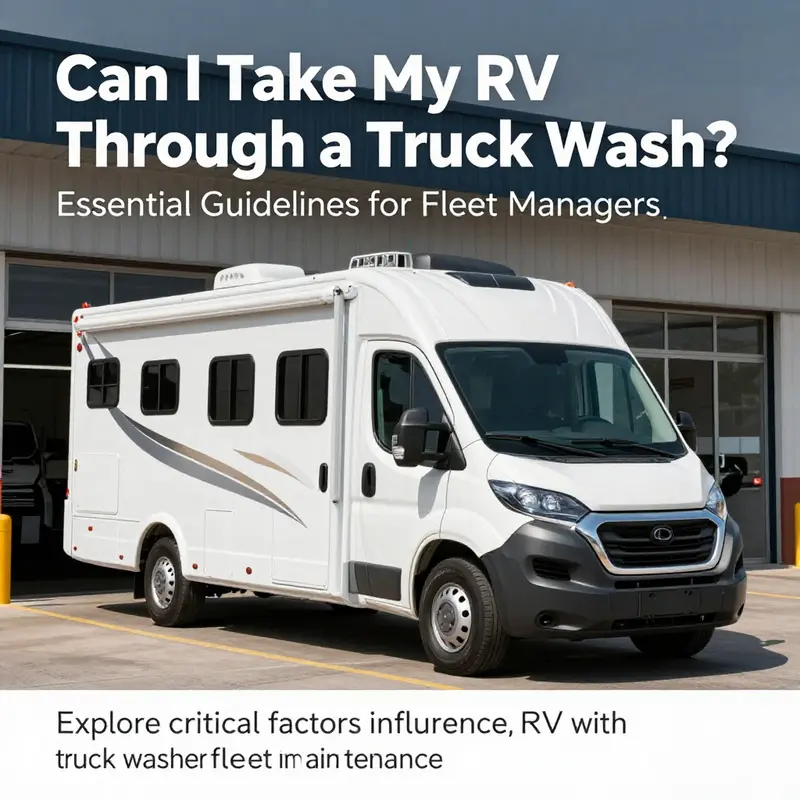
For fleet managers overseeing diverse vehicle types, ensuring the cleanliness and upkeep of RVs is essential. While truck washes offer convenience for larger vehicles, varying factors determine if an RV can safely pass through these facilities. This article elucidates the key considerations—size and clearance, wash type, water pressure risks, and facility policies—to guide fleet managers and operators in making informed decisions regarding RV maintenance. By understanding these dimensions, you can protect your fleet investment while maintaining compliance and reliability.
Sizing the Wash: Gauging Clearance, Risks, and Safe Cleaning for Your RV in Truck-Wash Environments
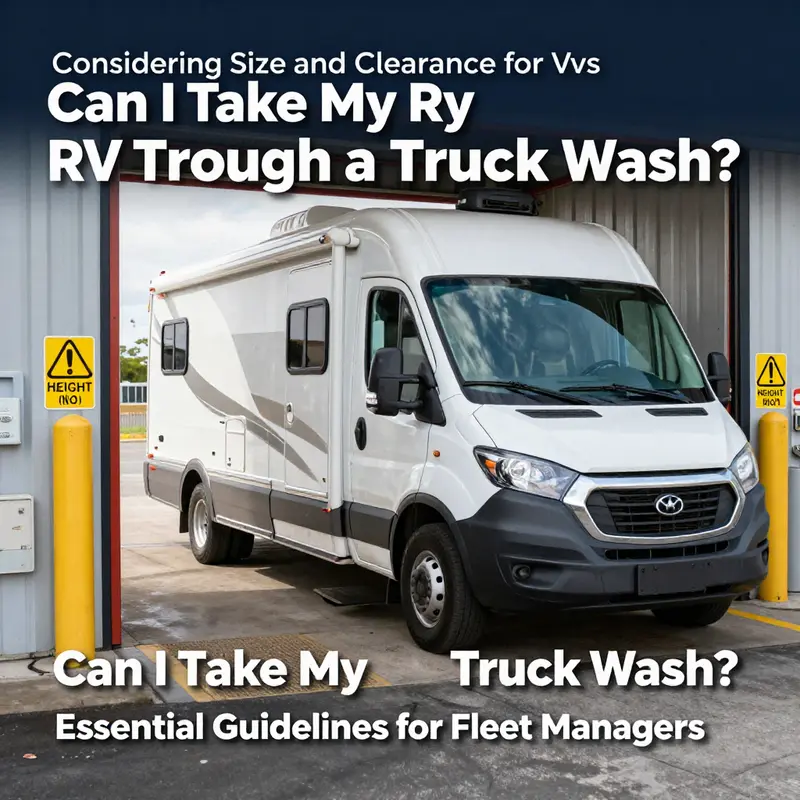
Can you push an RV through a truck wash and call it a quick rinse before a long road trip? The short answer is that it depends. The longer, practical answer centers on three interlocking realities: the size of your RV, the wash facility and its standard process, and the potential risks to your vehicle. Taken together, these factors form a careful calculus that separates a convenient wash from a costly mistake. Before you pull into a bay, use a clear framework to ask the right questions and verify safe passage.
The size and clearance hurdle is the most immediate barrier. Many truck washes are designed around standard commercial trucks, with bay widths, turning radii, and roof clearance tailored to a fairly narrow envelope. For taller RVs with rooftop gear, the ceiling height can become a silent obstacle that appears manageable from the street but reveals itself as the vehicle enters the bay. A typical height of around 12 to 14 feet often feels sufficient for everyday trucks, yet a high-profile RV can exceed that when you account for air conditioners, antennas, and solar gear on the roof. The risk isn’t just a scrape; it’s possible stress on seals around roof vents and windows that can show up later as leaks or wear.
Beyond height, the width and turning geometry matter. RVs are wider than many trucks thanks to slide-outs and mirrors, and the approach to the wash can bring you uncomfortably close to bay walls or equipment. The best approach is to measure your RV against the facility’s published bay dimensions and request a briefing that confirms the route and space for mirrors, roof gear, and protrusions. If any element cannot be accommodated, the prudent choice is to explore alternatives rather than risk damage.
Wash type and water pressure matter deeply for a vehicle with varied finishes and sensitive seals. Automated bristle washes risk micro-scratches on delicate paint, while touchless systems rely on higher pressure that may miss stubborn grime and leave water near seals. A good question is whether the facility can offer a dedicated RV wash, a wide-bay option, or a gentler sequence with lower pressure. Post-wash rinsing and proper drying are also important to prevent moisture near seams and vents.
Preparation is a central theme. Before washing, secure loose items, retract or cover rooftop gear, close vents and windows, and photograph the exterior to establish a baseline. Clear communication with the wash team about troublesome corners and edge areas dramatically reduces the chance of inadvertent contact. If the facility cannot safely accommodate your vehicle, or if the risk seems too high, seek an RV-specific detailing service or arrange for a private, off-hours wash that is designed for large vehicles. The goal is a clean exterior without compromising the integrity of seals, windows, or interior space. If you choose RV-specific options, you’ll typically get lower-pressure cleaning, targeted drying, and coatings designed for RV finishes. External resources on RV care and large-vehicle maintenance can provide additional context as you compare options.
Can an RV Go Through a Truck Wash? A Practical Guide
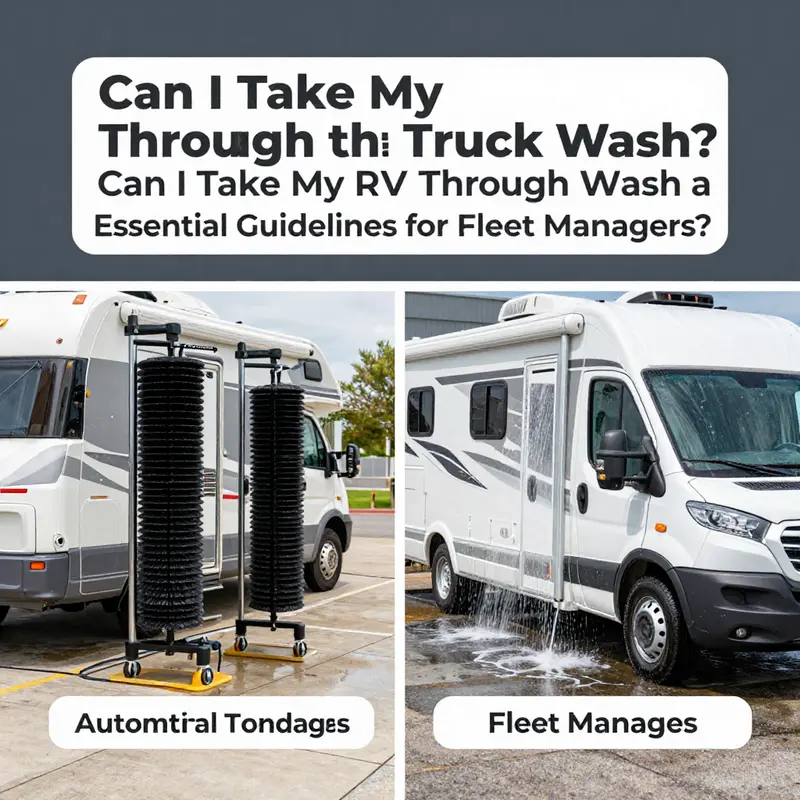
Taking an RV through a truck wash is a decision that requires careful consideration rather than a blanket yes or no. RVs differ from standard trucks in height, length, slide-outs, and roof-mounted gear, all of which intersect with bay geometry and wash equipment.
First, check the numbers: total height and width, door clearance, mirrors, awnings, and any protrusions. Compare these with the bay’s stated clearances. If you cannot confirm safe passage, avoid the risk.
Wash type matters: brush-based cycles can scratch fragile finishes or decals, while touchless washes use higher pressure to remove grime but may still damage loose seals or sensitive components. Ask about the exact equipment, test a small, non-critical area if possible, and request a non-brush option for your RV.
Water pressure and spray pattern are also critical. High-pressure jets aimed at roof vents, seals, or joints can cause leaks or damage. Ensure the bay can adapt to oversized vehicles and that the staff understands how to position nozzles away from vulnerable areas.
Facility policies vary. Some operators prohibit RVs or require retracting mirrors and slide-outs; others may permit RVs with precautions. Always get written confirmation of any requirements and restrictions before entering.
Practical preparation helps: retract or secure satellite dishes, shield solar panels if possible, close exterior compartments, remove or secure items that could be damaged. Pre-clean lower sections and wheels with a soft cloth and mild cleaner to reduce the load on the machine. Consider an RV-specific detailing service for a controlled, hand-wash approach if a bay visit isn’t ideal.
If you’re unsure about compatibility, alternatives include RV-focused detailing, self-cleaning methods with RV-safe products, or traveling to a facility that specializes in large vehicles. The goal is to protect finishes, seals, and moving parts while achieving a clean exterior.
Key questions to ask staff: Do you accommodate RVs? What is the maximum height and width? Is there an RV-specific wash option or protective procedure? Are mirrors and slide-outs required to be retracted? Is there a recommended sequence for passing through the bay? If the staff cannot answer clearly, choose a different option.
The High-Pressure Dilemma: Safely Navigating RV Washes When Truck Facilities Push the Limits
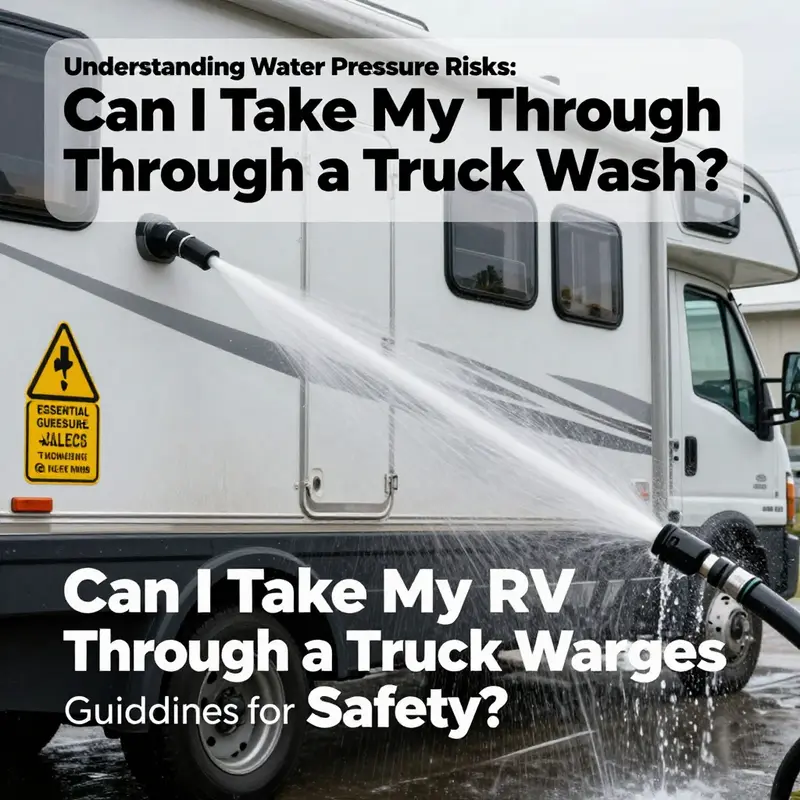
Can I take my RV through a truck wash? It’s a question that sits at the intersection of practicality and caution. For many RV owners, the allure of a quick, rinse-and-go cleaning solution is strong. A drive-through wash promises convenience, a tidy exterior after a road trip, and, in some cases, the impression of routine maintenance. But RVs are not the same as the commercial trucks those facilities were designed to handle. The reality is that the answer isn’t a simple yes or no; it depends on the size and shape of your rig, the wash process being used, and whether the facility is equipped to accommodate vehicles that don’t fit the standard truck profile. The safer approach is to treat this as a risk assessment rather than a reflex, and to proceed only after clear confirmation from the wash operator about what is permissible and what precautions they can provide. When differences between a semi-truck and a recreational vehicle are acknowledged, the path toward a safer outcome becomes clearer, even if it means choosing alternatives that protect the RV’s exterior and its sensitive systems.
High on the list of factors is water pressure. Truck washes rely on high-pressure jets and, in some systems, aggressive mechanical brushes designed to strip away heavy grime from large metal surfaces. The psi in many automatic bays often exceeds 1,000 pounds per square inch. That kind of force is perfectly suitable for steel truck frames and rugged paint, but it is far from ideal for an RV’s more delicate exterior. Fiberglass and gel coats, the vinyl or composite siding some RVs use, and the roof membranes that protect interior living spaces are not built to withstand repeated, point-blank blasts from industrial nozzles. And because many RVs have roof-mounted gear—satellite domes, solar panels, vent covers, and antennae—the risk isn’t limited to the walls. A high-pressure spray can push water behind seals, squeeze into gaps around windows, or shake loose fittings that were never intended to bear that kind of impact.
Even when a wash facility markets a “soft touch” or “brushless” option, there are caveats. Soft brushes can still scratch a faded or dirty surface if grit is trapped in the bristles. The same goes for touchless systems that rely primarily on jets: the force of the spray can dislodge trim pieces, rattle roof-mounted accessories, or destabilize seals around doors and windows. The combination of high pressure and uneven surfaces present on many RVs can magnify risk, especially when the vehicle’s age or recent paint work makes the surface more vulnerable to abrasions. It’s not just about aesthetics. Micro-scratches can harbor moisture and dirt, making it harder to maintain a watertight seal. Over time, this can contribute to leaks, mold growth, or compromised insulation in the walls and roof.
Delicate materials add another layer of concern. Many RV exteriors employ fiberglass or gel coat finishes with clear coats that rely on a relatively gentle touch. Vinyl siding, if present, can degrade under harsh chemical cleaners or abrasive contact. Roof membranes, seals around windows and doors, and the sealants that keep the structure weatherproof are all potential weak points in the wash bay environment. Detergents formulated for heavy equipment, while effective at removing grease and road grime, may strip away protective coatings, leaving the paint vulnerable to oxidation and sun damage. The risks extend beyond surface aesthetics; water intrusion through compromised seals can lead to long-term interior moisture issues, warped panels, and even electrical concerns in roof-mounted systems.
For RV owners who still want to use a commercial wash, the prudent move is to call ahead and ask targeted questions. Inquire whether the facility can offer a low-pressure option specifically designed for recreational vehicles, or if they can shield or avoid areas that contain roof-mounted components. Some wash facilities will accommodate large, irregular vehicles only in certain bays or during specific hours, and they may permit a limited spray in a controlled manner. The key is to obtain a clear, documented understanding of what the wash will actually do to your RV, not just what it claims to offer. If the operator cannot guarantee low-pressure treatment and careful handling of roof gear, it’s wise to walk away and pursue safer alternatives.
Safer alternatives are abundant and often more economical in the long run. RV-specific detailing services and mobile cleaning options are built around the realities of RV construction. These services use lower-pressure equipment, targeted attention to problem areas, and products chosen for compatibility with fiberglass, gel coats, and roof components. At-home washing—using a garden hose with a gentle spray nozzle, mild soap, and soft sponges or microfiber cloths—can be effective for routine maintenance. The advantage of a careful, hands-on approach is control: you determine water pressure, you avoid direct spray on delicate roof equipment, and you can monitor the interaction between the cleaning solution and the surface.
If you do decide to visit a commercial wash, preparation matters. Begin by measuring your rig’s height and width and comparing those figures to the wash bay’s clearance and turning radius. You don’t want to discover, along the approach, that a mirror or vent protrudes beyond the bay boundary. Consider retracting or folding in mirrors, and securing or removing items that could be damaged by wind, spray, or brush contact. It’s also wise to remove or secure any roof-mounted gear that could be bent, loosened, or dislodged by a misdirected jet or brush. If you have a solar array or rooftop accessories, the potential for damage increases, and the special sensitivity of those components deserves explicit acknowledgment from the wash operator. It can be helpful to discuss with the facility whether they can temporarily shield roof fixtures or adjust their process to minimize contact with rooflines.
Beyond the mechanics of the wash, there is an emotional and practical layer. An RV is a home on wheels, with personal investment in its condition and its aesthetics. Even small incidents—a scratch, a loosened seal, a wobbly roof accessory—can fuel stress in an already busy travel schedule. The decision to bypass a truck wash is not a surrender to dirt; it’s a deliberate choice to maintain the RV’s integrity. A clean finish can be achieved safely with the right approach, and the choice is often between a cautious, targeted, low-pressure wash by specialists or a thorough but careful hand wash performed by the owner or a trusted technician. In the latter case, using the right products and tools becomes an extension of the craft: microfiber cloths, non-abrasive sponges, and cleaners designed for RV finishes—these are not luxuries but safeguards.
For those who want to explore how roof-mounted systems and exterior gear intersect with cleaning practices, it helps to consider the broader ecosystem of RV maintenance. Roof equipment, age-related wear, and the sensitivity of electronics all influence how you sequence care tasks. Even the best-kept solar arrays or antennas can suffer from improper washing techniques. The decision tree becomes practical: if the facility cannot offer a low-pressure, RV-focused option or if they cannot guarantee that delicate components will be protected, then the safer path is to decline the truck wash in favor of an RV-specific service or a trusted home-care routine. When you are protecting a roof full of delicate gear, the cost of a mistake is measured not merely in cosmetics but in potential longer-term repairs and downtime during travel.
Incorporating a sense of practical caution can also lead to a smoother journey when you err on the side of safety. For RV enthusiasts who keep an eye on efficiency and innovation, there are ways to integrate protective ideas into ongoing care. For example, some owners plan ahead for roof equipment by selecting compatible accessories and configurations that emphasize sturdiness and easier maintenance. When those choices are coupled with informed cleaning practices, the risk of damage from a washing process decreases. For RV owners with roof-mounted solar arrays, the decision to keep those systems in good shape through careful cleaning and protective measures becomes part of a holistic approach to vehicle upkeep. In some cases, reflective maintenance strategies that reduce heat load on the roof can also reduce the frequency of aggressive exterior cleaning, since a cooler exterior often means less stubborn grime.
The practical bottom line is that there is no universal rule that can be applied to every RV and every wash facility. It is always a matter of matching the vehicle’s particular characteristics with the wash’s capabilities, and of communicating clearly with the service provider about limits and expectations. Should you choose a commercial wash under carefully controlled conditions, treat it as a temporary measure rather than a regular habit. If your routine involves frequent cleaning, build a schedule around RV-safe methods, and reserve truck-wash access for situations where it can be performed with explicit safeguards. The safest path, particularly for rigs with complex roof gear or newer finishes, is to rely on RV-oriented cleaning approaches that respect the delicate balance between a clean exterior and a vanguard of protective measures that keep living spaces dry, safe, and comfortable for travel.
For readers who want to ground these ideas in a broader context, consider the role of technology and design in shaping how we approach exterior care. Some RV configurations are now optimized for easier maintenance, with features that minimize the risk of water intrusion and simplify cleaning without compromising performance. In the end, the goal is a clean exterior that does not threaten the integrity of the vehicle or its critical systems. If you encounter a wash facility that insists on aggressive methods, or if you are unsure about the compatibility of your rig with their process, err on the side of caution. Remember that the effort you invest in choosing between a truck wash and an RV-safe alternative pays off in fewer emergencies on the road, fewer concerns about interior moisture, and more time to enjoy the journey.
For readers who want to explore related considerations about roof gear and safety, see the guidance on Bunduvry Truck Camper Solar Innovations, which discusses how roof-mounted systems influence maintenance choices and safety planning: Bunduvry Truck Camper Solar Innovations.
External resource: https://www.rvusa.com/learn/faq/rv-wash-safety/
Policy, Size, and Surfaces: Decoding Whether Your RV Belongs in a Truck Wash
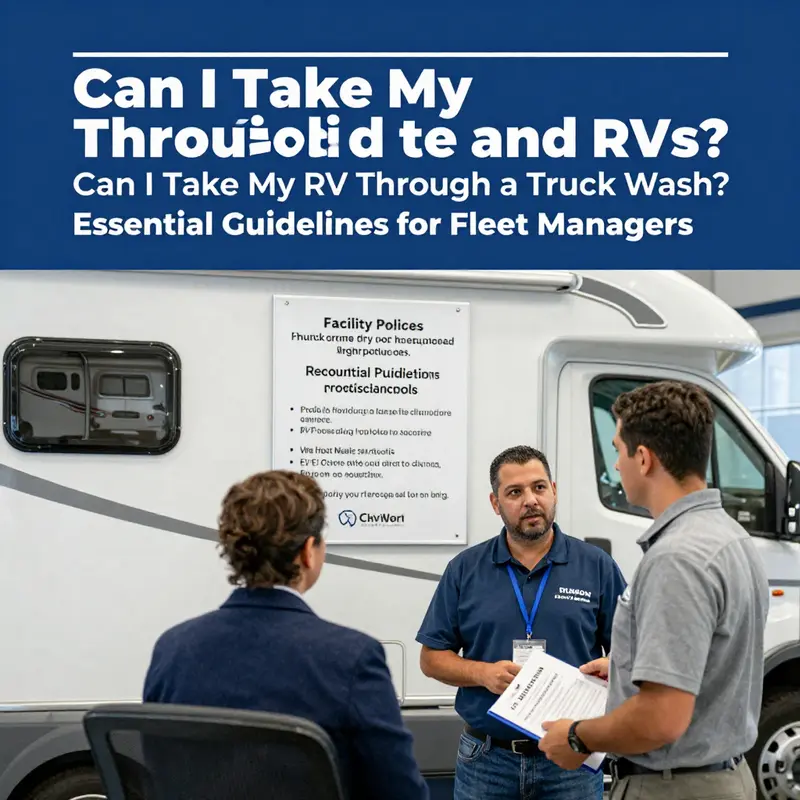
When an RV owner asks if it’s possible to roll through a truck wash, the question never stays simple for long. The answer hinges on a handful of practical realities: the exact dimensions of the RV, the wash equipment in question, and the policy stance of the facility. It’s a moment when convenience collides with caution, and the outcome depends on doing careful homework before you pull into a bay. The core of the matter is not merely whether your rig can fit but whether the facility’s process and safeguards align with the delicate balance an RV demands. A vehicle built for living on the road is often bigger, taller, and more irregular than a typical commercial truck. That irregularity matters because many truck washes are optimized around standardized truck frames, rigid axles, and predictable contours. RVs, by contrast, bring curved rooflines, satellite dishes, solar panels, antennas, and side-mounted awnings into play. Even when a bay appears large enough to admit an RV, the rest of the wash process can present hidden hazards. The sector’s design philosophy tends to favor speed and scale over the nuanced care that a mobile home on wheels requires. This tension is not a knock on the industry; it’s simply a reminder that a one-size-fits-all approach rarely serves vehicles as diverse as RVs. In practice, the decision to run an RV through a truck wash begins with sizing, but it quickly expands into a broader consideration of how the wash system operates and what the facility is willing to accommodate. The clearance that looks ample from the driver’s seat may vanish at roof height, where vent caps, satellite dishes, or mounted solar gear can collide with overhead components or the wash’s mechanical arms. The turning radii that might be forgiving for a semi can feel tight for a motorhome equipped with wide profile mirrors and extra-wide bodywork. Even the sequence of cleaning, which is finely tuned for steel-framed trucks, may deliver unexpected outcomes on a fiberglass or painted RV surface. In other words, the capability to pass through a truck wash is not only about if the vehicle can physically fit in a bay, but whether the wash’s approach—brush or touchless, aggressive or gentle, high or low pressure—will respect the RV’s exterior and its fixtures.
Design considerations sit at the heart of most advisories. Most commercial truck washes are engineered with large, straight-sided vehicles in mind. They rely on towering bays with defined clearance and standardized spray patterns, calibrated for the typical bodywork and fastened undercarriage of a commercial truck. The reality for RVs is more complex. An RV’s roof often features satellite dishes that must remain aligned for satellite reception, and many models sport solar panels that blur the line between exterior feature and structural vulnerability. Slide-out mechanisms, if extended, alter the vehicle’s silhouette and mass distribution, potentially increasing the risk of contact with wash exterior elements. The pressure profiles in many automated washes—especially those using high-pressure jets—are designed to dislodge dirt quickly from metal and painted surfaces. When those jets are directed at an RV with seals and windows that were not designed to withstand aggressive exposure, leaks can develop along door frames and skylights. The paint or clear coats on an RV can also be more susceptible to abrasion from mechanical brushes, particularly on aging or softer finishes. In short, even a well-maintained RV can experience unintended marks or micro-damage after a pass through a system optimized for a different vehicle class. The risk, while not universal, is real enough that many RV owners decide the potential payoff is not worth the gamble.
But there’s more to the decision than the wash mechanics. Facility policies play a decisive role that isn’t always obvious from a roadside sign. Some truck washes explicitly prohibit RVs, either because of liability concerns or because the equipment and workspace aren’t designed to handle the irregular shape and extras that RVs bring. Others may permit certain RVs only under specific conditions—for instance, by directing the vehicle to a particular bay, limiting the length or height in that lane, or requiring pre-cleaning steps at the curb to minimize time in a busy cycle. In other facilities, written rules are deliberately strict to avoid insurance headaches if damage occurs. The concrete reality is that a facility’s stance can shape your options long before you approach the wash bay. A quick phone call or email inquiry can save you from an awkward moment at the gate, a delay in your travel plans, or a potential claim dispute later on. If staff express uncertainty, it’s a sign that you should not assume you can pass through without a confirmed policy or a documented authorization. The prudent move is to ask what dimensions are permitted, whether slide-outs or roof devices affect eligibility, and whether a dedicated RV service lane exists. If they say no, that answer should be respected, not challenged, because the underlying question is about safety for both the vehicle and the wash equipment as designed.
The practical path forward is clear: verify, assess, and decide. Start by measuring the RV’s tallest point with any roof devices stowed or retracted as much as possible. Note the width with mirrors in folded position and the added width if any slide-outs are extended. Then contact the facility to confirm they accept RVs and to learn their specific constraints on size and configuration. If the facility allows an RV, ask about the wash’s mode of operation—whether it uses brushes or relies on water-only or spray patterns that minimize contact. A touchless system, while not always available, is generally safer for RV exteriors, though it can still stress seals if misused. If the wash is brush-based, you should be aware of the heightened risk of surface abrasion. Given that some RVs feature delicate finishes or aftermarket paint, you may decide that even a brush-based option is not worth the risk. The smart choice, in most scenarios, is to opt for manual cleaning when possible. Hand washing with soft sponges, mild cleaners, and controlled water pressure lets you protect the finish and address protrusions and delicate areas with care. This approach also gives you the chance to inspect for any preexisting issues, such as minor paint chipping or seal wear, before potential exposure to a harsher cleaning process. Manual cleaning isn’t a setback; it’s a precise, hands-on way to honor the vehicle’s investment and its long-term appearance.
If you still need to consider using a truck wash for time or convenience, plan a conservative, risk-aware strategy. First, retract or secure any protruding components as much as possible. Lower or remove antennas, retract satellite dishes, and, if feasible, stow away solar panels or shielding devices according to the manufacturer’s guidance. Close all windows securely, and verify that the door seals are intact and free from debris that could trap moisture after washing. It’s wise to remove loose items around the exterior that could become projectiles in a wash cycle. If a facility permits an RV, request a dedicated lane or a specific bay and ask for a slower wash setting, if available, that reduces the force of the jets and the likelihood of vibration-induced impacts. Lastly, document the interaction with the facility—note the exact policy, the dimensions confirmed, and any precautions you were required to take. This keeps your records tidy should questions arise later and reinforces the practice of proactive communication with service providers.
In contemplating these steps, it helps to view the decision as part of a broader ownership discipline. An RV is a moving home, and its exterior requires as much care as its living space. The high-traffic, high-volume approach of a truck wash is useful for quick, in-batch cleaning of commercial fleets, not a tailored vehicle that carries personal fixtures, solar arrays, and travel memories. When you align your choice with both the technical realities of the wash system and the facility’s policies, you reduce the risk of costly damage and keep your travel schedule intact. If the facility policy clearly excludes RVs, or if you sense hesitancy about the process, the safest route is to proceed with a thorough manual wash or to seek an RV-specific detailing service. RV detailing specialists bring experience with elevation, roof access, and the careful handling of awnings, vents, and mounted gear, ensuring a wash that protects rather than destabilizes your vehicle’s exterior. It’s a reminder that sometimes the best way to stay efficient on the road is to invest a little more time in the right cleaning approach at the right location.
For those who want to explore how facilities manage these questions at a structural level, consider the wider context of facility operations and policy development in the truck wash industry. The realities of space constraints, safety protocols, insurance considerations, and equipment design all shape whether an RV can safely pass through a wash bay. Understanding these dynamics helps owners approach the decision with clarity and reduces the friction that comes from ambiguous expectations. If you are curious about how facility management for truck wash businesses approaches similar questions of equipment compatibility, there is a resource that examines governance, workflow, and operational best practices in a broader setting—providing a lens into why policy decisions matter and how they are implemented on the ground. facility management for truck wash businesses.
External reference: For readers seeking a concise, externally sourced perspective on the practicalities and cautions of driving an RV through a truck wash, a detailed discussion is available at the RV Life article linked here: https://www.rvlife.com/2023/11/14/can-i-drive-my-rv-through-a-truck-wash/
Final thoughts
Proper maintenance of your RV is crucial for ensuring their longevity and operational efficiency. Fleet managers must assess individual truck wash facilities for size, wash type, water pressure risks, and specific policies restricting RV access. Direct communication with truck wash operators is recommended to confirm RV compatibility and avoid costly damage. By considering these factors, you can make informed decisions that protect both your vehicles and your business operations.