

How pH and Dilution Decide Whether Road Film Lifts or Streaks
Two numbers decide how a truck wash performs: the pH of the soap and how far you dilute it. Get them right and road film lifts off clean. Get them wrong and it smears into streaks you have to chase. Brand name and price on the label do not change that. Even an expensive detergent fails when the chemistry is off.
Road film is diesel soot, oil, brake dust, and road salt bound together on paint, chrome, and aluminum. A pH that doesn’t match the soil won’t break that bond. A mix that runs too weak or too strong leaves residue behind, and the residue dries into haze and streaks. These proven strategies for cleaning grease and tar off trucks fast show what that looks like in a real wash bay.
It applies whether you wash one pickup or a hundred rigs. Owners want paint that stays bright without etching or swirl marks. Wash operators need the same result every time, because rework eats throughput and margins. Fleets need trucks clean and back on the road without delays. pH and dilution are what separate one clean pass from a second trip through the bay.
What Road Film Really Is and Why It Sticks
Road film is not dust sitting on top of the paint. It is layers of contamination fused to the surface by heat, pressure, and time. Once you see it that way, cleaning stops being about scrubbing dirt off and becomes about breaking a bond apart.
- Hydrocarbon oils and grease – fuel residue, engine blow-by, and road tar form the sticky base layer that grabs everything else above it.
- Diesel soot and exhaust carbon – fine carbon particles settle into that oily base and darken it into the familiar dull grey-brown haze.
- Brake dust and metal particulates – iron-rich dust from pads and rotors embeds in the softened surface and oxidizes, leaving rust blooms behind.
- Oxidized rubber and mineral grit – tire rubber, silica, and road minerals bake on top under sun and exhaust heat.
The layers hold because the oily base softens the clear coat just enough for soot and metal particles to sink in. Heat then cures the stack like a low-temperature bake. By the time it cools, the dirt is not on the paint. It is in the paint.
That is why removal order matters. Attack the baked top layer with a brush and you grind grit across the finish while pushing oil sideways. Dissolve the hydrocarbon base first, and the layers above it lose their grip and come off together. When that base is stubborn, these proven strategies for cleaning grease and tar off your trucks cover how to break it down before you pick up a brush.
The right professional truck wash soap, diluted correctly and matched to the surface, dissolves that base so the film rinses away. Pressure and scrubbing alone just move it around.
How pH Controls Soil Removal: Acids, Neutrals, and Alkalis
Different soils respond to different pH ranges. Match the chemistry to the dirt and it lifts clean. Mismatch it and you either smear the grime around or strip the coating you were trying to protect.
pH runs from 0 to 14 and measures how acidic or alkaline a liquid is. Seven is neutral. Truck wash chemistry works at both ends of that scale, and each end goes after a different soil.
An alkaline wash sits above 7, often between 10 and 12, and goes after oily and greasy road film. The alkali saponifies fats, turning grease into a water-soluble soap that rinses off instead of clinging to paint.
An acid wash sits below 7 and dissolves what alkali cannot: mineral scale, rust bloom, and hard-water spots. Those deposits are inorganic, so they respond to acid rather than to detergent.
A neutral wash near pH 7 is the everyday maintenance option. It lifts dust and fresh film without wearing down wax, sealant, or clear-coat protection, so you can wash often without slowly eating the finish.
Both ends fail in their own way. Too much alkali strips wax and leaves a dull haze, and left to dwell on bright aluminum it etches the metal. Stray acid on bare steel flashes to rust. Too weak a mix on heavy film just moves soil from one panel to the next. Either mistake shows up later as dull paint, stubborn water spots, or corrosion creeping under the clear coat.
Guessing costs water, time, and a second wash. When heavy deposits shrug off a normal bath, the proven strategies for cleaning grease and tar off your trucks fast show how to pair technique with the pH logic above.
Match the pH to the soil, not to habit: alkaline for grease, acidic for minerals, neutral for maintenance.
Table 1: pH Range vs. Target Soil and Best Use Case.
The right pH for one soil is the wrong pH for another. Use this table to match formulation strength to the job in front of you.
| pH Range | Soil Type Removed | Typical Application | Cautions |
|---|---|---|---|
| 1-3 (strong acid) | Heavy rust, mineral scale | Aluminum brightener, acid presoak | Never on paint or glass |
| 4-6 (mild acid) | Exhaust soot, water spots, mineral haze | Presoak for soot and water spotting | Keep dwell short, rinse fast |
| 7 (neutral) | Dust, light road grime | Maintenance wash, hand washing | Won’t cut heavy grease |
| 8-10 (mild alkaline) | Oil film, traffic film | Standard daily truck soap | Spot-test polished aluminum |
| 11-14 (strong alkaline) | Grease, tar, carbon buildup | Engine bays, chassis degreaser | Strips wax, may etch aluminum |
That covers most of what shows up in a bay, from hard-water spotting on the hood to baked-on grease under the cab. Dilute to the label and spot-test before committing to a full wash.
Dilution Ratios: Why More Soap Is Not Better
A dilution ratio says how much concentrate goes into the water. A 1:10 ratio means one part soap to ten parts water. A 1:40 ratio means one part soap to forty parts water. A 1:100 ratio means one part soap to one hundred parts water. The larger the second number, the weaker the mix.
This is where people go wrong. A smaller number like 1:10 is stronger, so the reasoning goes that more soap must clean better. It doesn’t. Over-concentration leaves a chalky film that traps dust and dries in streaks. Under-concentration is just as bad: it cannot lift stubborn road film, so grime stays bonded to the paint and hardens. The goal is the correct dilution ratio, not the most soap.
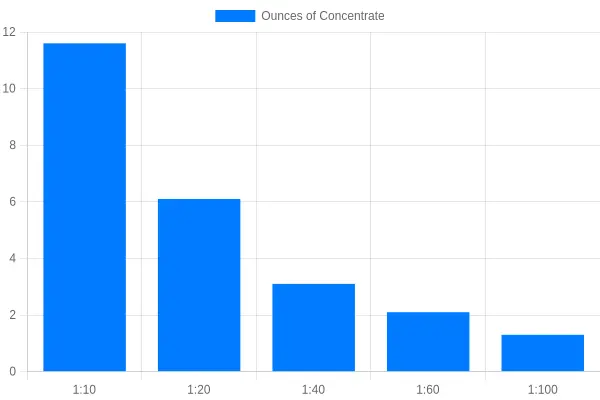
To work out how much professional truck wash soap goes into a given volume of water:
- Add the two ratio numbers to get total parts. For 1:40, that equals 41 parts.
- Convert your container to ounces. One gallon equals 128 ounces.
- Divide the container size by the total parts. So 128 / 41 = about 3.1 ounces of concentrate.
- Measure that amount, pour it into the water, and stir gently.
That gives you one gallon of ready-to-use solution at 1:40. For a five-gallon bucket, multiply 3.1 by five and add 15.5 ounces of soap. Think in parts, not guesswork. Measuring by eye is the fastest way to waste concentrate or dull a finish. A cheap measuring cup beats an expensive mistake.
Water hardness changes the effective strength. Hard water carries calcium and magnesium that bind to soap molecules before they reach the truck, so the same dilution cleans weaker and you may need slightly more concentrate. Soft water does the opposite. The proven strategies for cleaning grease and tar off your trucks fast show the same principle at work. Always test on a small panel before washing a whole fleet.
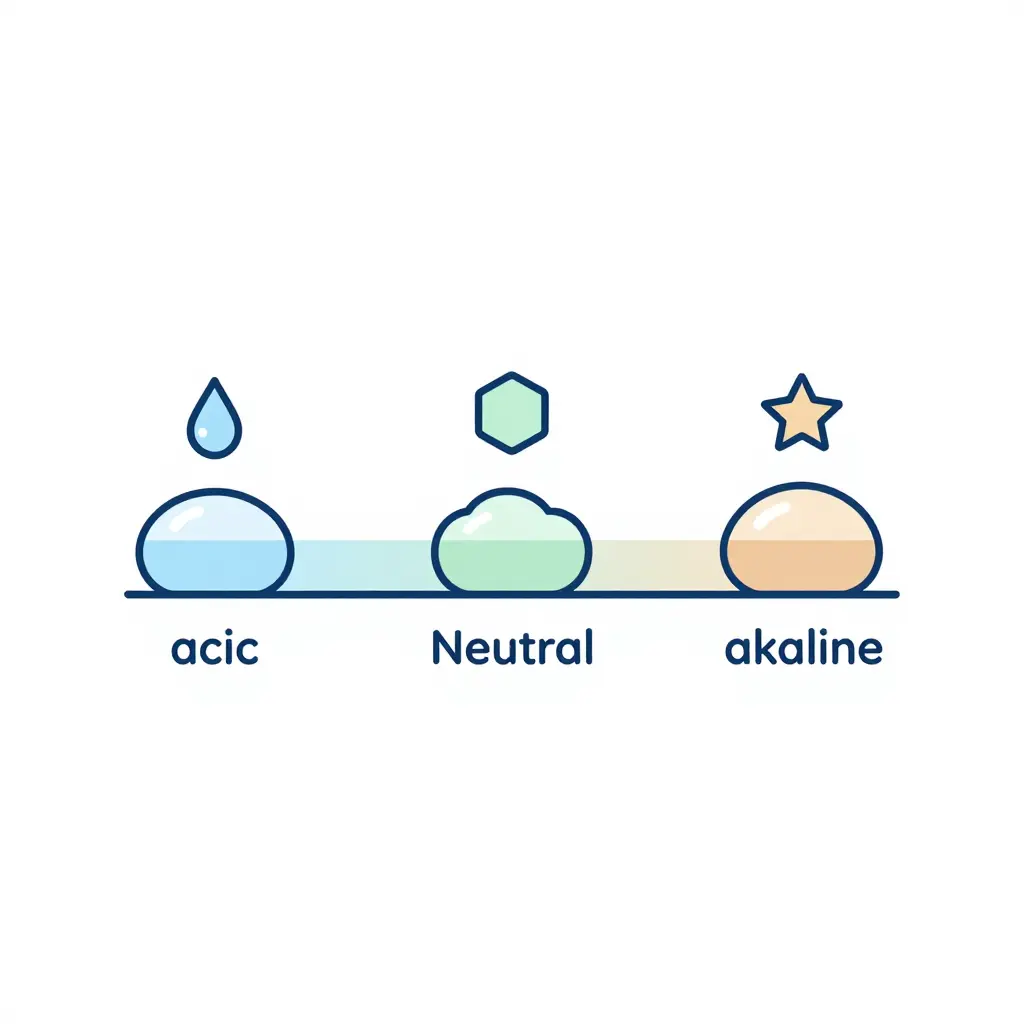
The diagram lays the pH scale next to the soil types it handles: acids on the left with the molecules and soil they target, the neutral zone in the middle, alkali on the right. The point is straightforward. Just as different soils call for different chemistry, different road films call for soaps matched to the right pH. When the soap chemistry lines up with the soil you are actually fighting, road film lifts cleanly instead of smearing into streaks.
Lift or Streak: The Moment Chemistry Decides
Every wash is a chemical negotiation with the surface. When the pH and dilution ratio match the soil on your truck, surfactant molecules penetrate the road film, break its grip on the paint, and lift it into suspension so a simple rinse carries it away. Get that balance wrong and the same film is only partially emulsified: the chemistry loosens a fraction of the contamination, then redistributes it as pale streaks and hazy patches that bake on harder than before.
Three things decide which you get: pH, dwell time, and surface temperature.
- Correct pH matched to the soil type, so surfactants attack the film’s bond instead of simply wetting it.
- Adequate dwell time that lets the chemistry penetrate before it dries or runs off.
- Surface temperature in the working range, where surfactants stay active and don’t flash-dry into haze.
Contact time and dwell time get used interchangeably, but they differ. Contact time is how long the solution touches the surface; dwell time is how long it sits undisturbed. Too little and the road film never fully releases; too much and the panel dries, leaving residue. Temperature sets the ceiling on both. A hot hood in direct sun can drive a mismatched dilution to streak in seconds, while a cool, shaded frame gives even a modest mix room to work.
That is why the same soap can look brilliant on one rig and terrible on the next: the chemistry is right, but the conditions are not. The conditions behind stubborn grease and tar follow the same timing and temperature rules.
Get the balance right and every wash ends in a clean lift rather than a fresh set of streaks.
Cleaning Efficiency vs. Streak Risk Across Dilution Ratios
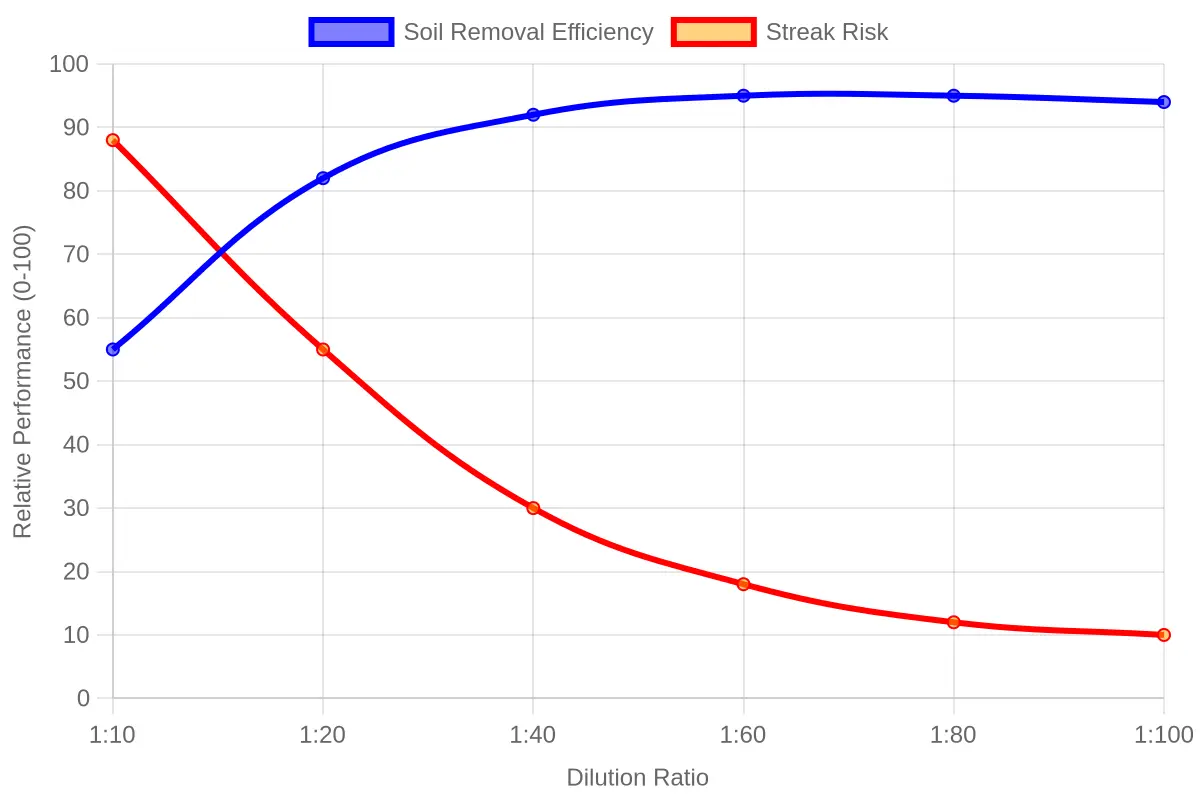
How to read this chart: The blue line is soil removal efficiency. It climbs fast as you dilute the concentrate, levels off around 1:60 to 1:80, then dips slightly. The red line is streak risk: highest at very high concentration (1:10) and falling steeply once you dilute. The sweet spot sits where efficiency is high and the two lines are farthest apart. For hands-on techniques that keep efficiency up without triggering streaks, see these proven strategies for cleaning grease and tar off your trucks fast.
Common pH and Dilution Mistakes That Cause Streaking
Even a premium truck wash soap can streak when pH and dilution drift out of their target range, so pair these fixes with proven strategies for cleaning grease and tar off your trucks fast and watch your panels come out clean.
- Using alkaline soap for mineral scale – A high pH leaves a stubborn film that dries into visible streaks; switch to a pH-matched acidic soap instead.
- Reusing dirty wash water – Suspended grit and spent soap residue redeposit on panels, causing streaking; dump and refill with fresh water every wash cycle.
- Skipping a pH-matched pre-soak – Road film never fully releases, so the wash drags soil around; always pre-soak at the correct pH before scrubbing.
- Eyeballing dilution instead of measuring – An inconsistent mix cleans unevenly and leaves streaks; use a calibrated dispenser to hit the exact dilution ratio.
- Washing in direct hot sunlight – Heat flashes water and soap dry mid-panel, baking in streaks; wash shaded areas or cool the surface before you start.
- Letting soap dry on the surface – Residual soap etches and streaks as it dries; rinse each section promptly before it air-dries.
- Mixing incompatible soaps – Conflicting pH values neutralize each other and leave residue streaks; never blend an acid and alkaline soap in one tank.
- Ignoring hard-water dilution adjustments – Minerals plus a wrong dilution amplify spotting and streaking; soften the water or adjust your soap dose for hardness.
Dial in your pH and dilution and road film lifts clean; guess at either and you trade clean trucks for stubborn streaks, wasted soap, and constant rework.
Table 2: Dilution Ratio Quick Reference by Soil Type
| Soil Type | Recommended Soap pH | Suggested Dilution Ratio | Dwell Time | Rinse Note |
|---|---|---|---|---|
| Heavy diesel soot | 12.0-13.0 alkaline | 1:10 to 1:20 | 3-5 minutes | High-pressure rinse, top down |
| Oil and grease film | 11.0-12.0 alkaline | 1:20 to 1:40 | 2-4 minutes | Warm rinse at 1200 psi |
| Mineral scale | 2.0-3.0 acidic | 1:15 to 1:30 | 1-3 minutes | Rinse at once, never dry |
| Aluminum brightening | 1.5-2.5 acidic | 1:5 to 1:10 | 30-60 seconds | Neutralize, rinse within 2 minutes |
| Routine maintenance wash | 7.0-9.0 neutral | 1:50 to 1:100 | 1-2 minutes | Spot-free rinse or air dry |
Always match pH and dilution to the soil type – double the strength rarely doubles the clean, so follow our proven strategies for cleaning grease and tar off your trucks fast instead.
Frequently Asked Questions About pH and Dilution
These questions come up again and again in the wash bay, so the answers below stay practical and direct.
Does higher pH always clean better? No. A higher pH can help break down oily road film, but pushing it too high risks damage to paint, brightwork, and aluminum. The goal is matching pH to the soil type, not chasing the maximum number. A balanced professional truck wash soap often cleans better because it stays within a safe working range.
What dilution ratio works for most road film? Most road film lifts well at a dilution between 1:20 and 1:50, depending on the product and sprayer. Heavy buildup favors a stronger mix, while light road dust favors a leaner one. Follow the manufacturer’s chart and adjust for your equipment’s flow rate. For stubborn buildup, these strategies for cleaning grease and tar off trucks can help you fine-tune the approach.
Can too much soap cause streaks? Yes. An over-concentrated solution leaves residue that dries before it rinses, and that residue appears as streaks and spots. Streaking usually signals that dilution is too rich or that rinse pressure is too low. Correcting the mix often clears the problem without changing products.
Is neutral pH safe for all surfaces? Neutral pH is gentler on paint, glass, and trim, but it is not automatically safe for every surface. Some coatings and older finishes still react to specific additives, even at neutral pH. Confirm that your professional truck wash soap suits your fleet’s actual materials. When in doubt, spot-test on an inconspicuous area first.
How does water hardness change dilution? Hard water contains minerals that interfere with the cleaning chemistry, so you usually need more soap to get the same result. Soft water lets you dilute further and still lift road film effectively. Test your water source and adjust dilution accordingly, especially when moving between sites with different supplies.
How often should operators verify pH and dilution? Verify pH and dilution at least once per shift and after any product or water change. Recalibrate metering pumps and replace test strips regularly to catch drift early. Consistent checks keep results even, protect your equipment, and make troubleshooting faster across a fleet.
Key Takeaways for Cleaner, Streak-Free Trucks
The chemistry matters more than the elbow grease. The pH of your soap and the dilution ratio you mix decide whether road film lifts cleanly or smears across the paint. Scrubbing harder cannot fix a solution that is too weak, too strong, or mixed at the wrong concentration.
What to carry forward:
- Match pH to the soil: alkaline formulas break down oily road film, while balanced or mildly acidic blends handle mineral residue without streaking.
- Respect the dilution ratio: overdosing wastes product and leaves residue, while under-dosing forces extra scrubbing that grinds dirt into the finish.
- Test on a small panel first: a quick spot check prevents costly rework across an entire fleet.
- Rinse and dry deliberately to stop water spots before they set.
For auto owners, professional truck wash operators, and fleet managers alike, professional truck wash soap is a controlled chemistry decision, not a test of muscle. Matching pH and dilution to the road film is what delivers a consistently cleaner, streak-free truck.