
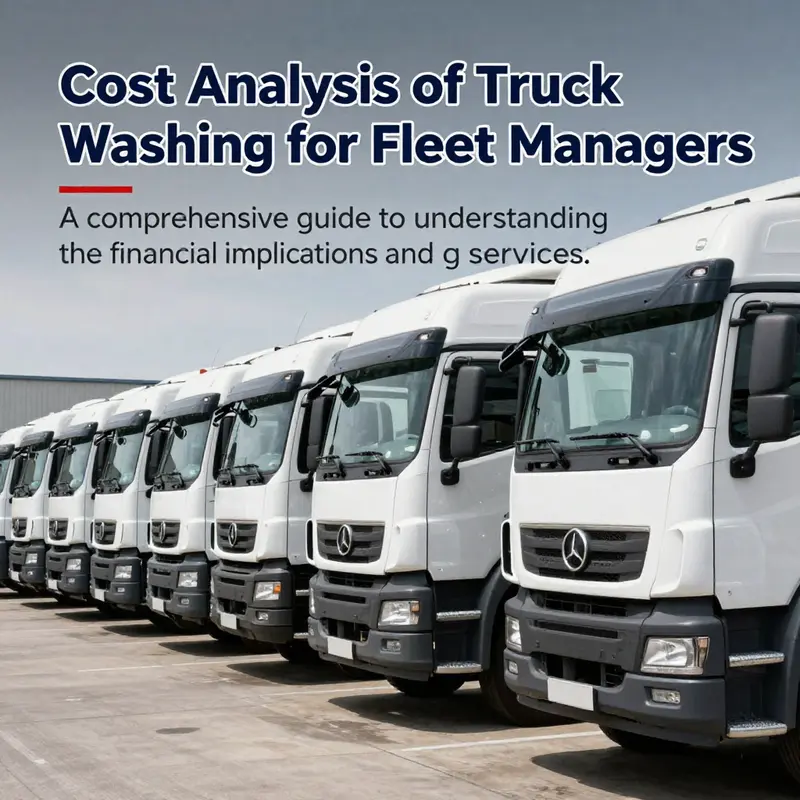
Maintaining a fleet of trucks involves not only operational efficiency but also ensuring vehicles are presentable and free from contaminants. For fleet managers in logistics, trucking, or construction, understanding the costs of truck washing is essential for budgeting and maintenance planning. This guide examines the different factors influencing washing costs, analyzes regional variations, and explores the array of services available to help informed decision-making. Each chapter contributes to a holistic understanding of financial planning for truck washing, enabling fleet managers to make strategic choices.
Decoding Truck-Wash Pricing: How Size, Location, and Service Packages Set the Bill

Truck wash pricing is usually not a single price but a bundle of choices that together determine the final bill. The main drivers are vehicle size and complexity, location and delivery mode, and the wash package you select. Understanding these factors helps fleets forecast costs, compare bids, and avoid sticker shock. Size and complexity affect labor time, water use, and chemical consumption, so larger or multi axle trucks typically carry higher base pricing even if the exterior looks similar to a smaller vehicle. Location adds another layer because urban operations incur higher overhead, while rural sites may offer savings. Mobile on site service often commands a premium for the convenience of uptime, travel, and equipment transport. Wash package components matter a lot. A basic exterior rinse is the cheapest entry point, but most fleets add wheel and undercarriage cleaning, protective sealants, and sometimes interior detailing. Each added element increases direct costs and total job time, but can reduce future maintenance and improve vehicle longevity. Frequency also changes the math: regular or contracted washes tend to lower the per wash price through route optimization and steady demand, while one off cleans usually cost more on a per wash basis. Other factors like seasonality, weather, and access limitations can push quotes higher or lower. Regulations around water use and chemical discharge in some markets also create compliance costs that may be reflected in pricing. The best approach is to request an itemized quote that breaks out size or complexity, location or mobile versus facility based, and each wash package component, plus any travel, fuel, or emergency surge fees. With transparent bids, fleets can compare apples to apples and tune their washing plan for uptime, appearance, and total cost of ownership. Finally, remember that price is a balance between convenience and thoroughness, and the most cost effective program aligns pricing with the fleet operation’s maintenance goals and downtime targets.
What It Really Costs to Wash a Truck: A Regional Palette of Prices, Packages, and Practical Realities

To answer the question of how much it costs to wash a truck, one must move beyond the familiar headline price and see the broader landscape. The numbers that show up in a basic exterior wash—often quoted as a simple benchmark—do not stand alone. They travel with the vehicle, the condition of the truck, the time of year, and the local economics of the service market. A reader who starts with a neat figure like thirty or forty dollars may be surprised to discover a much wider range when they cross borders or compare urban centers with rural backwaters. The true story is less a single price tag than a spectrum of options that reflect supply, demand, and the practical realities of cleaning heavy equipment in diverse environments. In this chapter we explore that spectrum with a focus on how regional differences reshape the cost of washing a truck, while keeping the thread of what the price means for fleets and individual operators alike. The aim is less to prescribe a universal price and more to illuminate the factors that create real-world variability so that managers, drivers, and small-business owners can budget with clarity and negotiate from a position of understanding rather than assumption.
At a glance, the most common starting point for any discussion of washing a truck is the basic exterior wash. This is the service you see offered as the entry point in most shops, stated as a simple cleanse of the outer surfaces, wheels, and seals. Yet even this ostensibly simple service can vary widely in price. In many markets a basic exterior wash can hover around the lower end of the spectrum, but in other places the same service can carry a noticeably higher price tag. The variability is not purely a matter of generosity on the part of the provider; it folds in the economics of labor, overhead, and the cost of water and waste management. In North American contexts the initial price can crest or dip depending on region, facility type, and how the wash package is structured. When a truck moves from one city to another, especially across national or provincial borders, the cost math shifts, capturing local wages, fuel for equipment, and even the availability of skilled personnel who can operate complex wash systems or mobile rigs with a reliable schedule.
Across the broader Canadian landscape, the price dynamics echo a blend of proximity to dense markets and the costs that come with service delivery at scale. A basic exterior wash in a major Canadian metropolitan area may carry a higher baseline than a rural counterpart; the same service in a smaller town may be more affordable simply because the cost of doing business there is lower and demand is steadier. In North York, Ontario, for example, the range for a basic exterior truck wash stretches widely—from a moderate fifty dollars to a comfortably elevated one hundred fifty dollars. These figures are not outliers but reflections of a market where service providers balance competitive pricing with the realities of urban overhead, including labor competition, real estate costs, and scheduling demand in a region where fleets operate at various hours. The result is a price band that rewards efficiency and quality but also signals the premium attached to high density, high use markets where fleets require uptime and predictable service windows. The regional nuance matters because it sets expectations for what a customer can reasonably negotiate in a given locale and what a shop must consider when allocating staff to a truck wash job that might span several hours depending on the truck’s configuration and state.
Canada broadens the conversation into another important layer: the modality of service delivery. Mobile truck wash services are a distinct variation within the same country, and they illustrate how mode choices influence price. In Canada, a mobile wash can range widely—from fifty dollars to as much as two hundred fifty dollars per vehicle. The spread is driven by the same core variables that govern stationary service, but with the added complexities of travel time, equipment transport, on-site water supply, and the degree of depth the cleaning crew can achieve away from a fixed facility. A mobile crew may offer a deeper clean in the field, including undercarriage rinses, heavy-duty tire dressing, or interior touch-ups when a customer requests them, and these add-ons push the price upward. The higher end of mobile service pricing often corresponds to clients with specialized needs—older, heavily soiled equipment or trucks that require a more meticulous approach due to fleet standards or regulatory expectations. The admonition here is practical: when a mobile wash is proposed, the quote likely includes a premium for logistics as well as the actual wash, and customers should parse whether the premium covers travel time, crew composition, or guaranteed same-day scheduling.
Across the border into the United States, the regional calculus shifts again, driven by a similar logic but expressed through a different economic lens. In urban centers such as Los Angeles or New York City, where labor costs, real estate, and congestion are all high, exterior washes for trucks can land in the upper tier of pricing, with estimates hovering around two hundred dollars to two hundred fifty dollars for a standard exterior wash. The reason is straightforward: the overheads are steep, and the same customer is often seeking a fast, predictable turnaround in a market where space is at a premium and demand for fleet services runs hot. Conversely, in rural or less densely populated areas, prices for a standard exterior wash frequently start lower, often around fifty dollars to one hundred dollars. In these markets the demand curve and the economics of service delivery align to produce more affordable options while still offering the core benefits of a reliable wash—appearance, vehicle longevity, and fleet readiness. The regional spread in the United States mirrors the Canadian pattern: the price is a signal of the local cost structure rather than a simple market preference. It is a reminder that a price tag on a wash is also a measure of the local ecosystem in which the service provider operates.
Seasonality adds another layer of texture to the regional price map. In peak seasons, particularly during summer when fleets ramp up activity, demand for washes rises. That uptick in demand tends to push prices upward or encourage providers to securitize bundled services that deliver value to large operators who need regular maintenance windows. Off-season periods, in contrast, can unlock opportunities for discounts or bundled offerings as shops attempt to fill capacity and keep their teams productive. This seasonal dance is not merely about weather; it is a reflection of fleet management calendars, maintenance cycles, and regulatory or customer-driven expectations that shape when and how often trucks require washing. The practical implication for a fleet operator is simple: if the fleet must wash during a high-demand window, budgeting for potential premium pricing is prudent; if a window is flexible, bundling washing with other maintenance services can unlock savings that would otherwise be invisible in a standalone price quote.
Size matters in a concrete way, especially for trucks that carry more mass, longer wheelbases, or multiple axles. The same base exterior wash that is adequate for a standard pickup becomes proportionally more expensive for a heavy-duty or large-volume truck. The cost deltas in these cases are not arbitrary or punitive. They reflect the additional labor, longer washing cycles, higher water usage, and more intensive drying or detailing required to leave a large vehicle in a presentable state. For fleets operating long-haul equipment or construction vehicles, the calculus includes the practicality of downtime, the impact of clean trucks on resale value, and the crew’s ability to complete work within the scheduled maintenance window. In other words, size is a multiplier in the pricing equation, a reminder that the sticker price of a wash is only the first figure you should read. The second and more revealing figure is the total time, effort, and value added by the wash package being offered.
Another critical factor is the level of cleaning detail attached to the wash package. A basic exterior wash may include soap, rinse, and a light towel-dry, while more comprehensive packages add interior wipe-downs, wheel cleaning, tire dressing, undercarriage rinsing, and even specialized steps to remove grease, tar, or road grime. The difference between a basic exterior wash and a more detailed package is not simply a matter of fancy add-ons; it is a fundamental shift in the service’s scope and the crew’s preparation, equipment usage, and follow-through. As the scope grows, so does the price. A deeper clean, particularly for fleets that must present a uniform appearance across thousands of vehicles, can justify higher price points because the value delivered extends beyond cosmetic improvement to improvements in maintenance life, corrosion protection, and, in some cases, regulatory compliance where specific cleaning standards are required.
If one were to distill the core drivers of price into a coherent framework, several factors stand out as recurring determinants: local labor rates and market conditions, the chosen service modality (on-site mobile versus fixed facility), the size and condition of the truck, the depth of cleaning specified, and the seasonal rhythm of demand. Each of these elements can tilt the final invoice in meaningful ways. For fleet managers, the practical upshot is to map pricing to the organization’s operational realities. If a fleet operates in a market where labor costs are high but the fleet is small and infrequently washed, a per-vehicle price may suffice as a budgeting anchor. If, however, the fleet runs in a market with steep wages and a requirement for consistent fleet-wide presentation, a bundled program with scheduled washes and standardized packages may deliver better long-run value. It is in this alignment of needs and offers that the true price of washing a truck emerges as not simply a number but a planning instrument that informs scheduling, maintenance, and even procurement decisions in the broader fleet-management playbook.
A useful way to view the economics is to consider the contrast between fleet-scale washing and individual truck cleaning. When fleets move toward standardized, repeatable wash programs, shops often respond with tiered pricing, service-level guarantees, and bundled offerings that include periodic maintenance checks or water recycling assurances. In those cases the incremental cost of returning vehicles to a uniform standard can be justified by the savings in downtime, the consistency of results, and the potential for longer-term asset preservation. For a single owner-operator or a small company with a handful of trucks, the calculus may skew toward flexibility, static pricing, and the ability to tailor a wash to a specific need or a tight schedule. The value here is the assurance of predictability and the ability to optimize the calendar so that a clean truck is one less obstacle to meeting delivery windows, maintaining client appearances, or preserving the truck’s finish in challenging climates. In both cases, the price is an instrument that translates region, scale, and intent into a practical plan for keeping a vehicle clean and road-ready.
The research results we cited paint a clear map of what customers can expect when they compare regional costs. In the North York area of Ontario, the basic exterior wash can be notably more expensive than the simplest national baseline, reflecting the market’s mix of urban demand and operational costs. Across Canada, mobile services demonstrate a wider price ceiling when depth of cleaning extends beyond the exterior, and the choice of mobile versus fixed-site service influences the overall value a customer receives. In the United States, the urban-rural dichotomy echoes the same economic forces, with urban centers delivering higher price ranges driven by the cost structure of city markets, while rural areas offer more affordable basic options. Seasonal fluctuations add a further dimension, nudging prices up during peak fleets hours and down when activity cools off. The upshot for readers focused on budgeting is straightforward: a regional price tag is a signal about the underlying cost structure, and understanding that structure helps in negotiating, choosing packages, and predicting annual wash costs across a fleet.
For operators who want to translate these insights into actionable cost-management strategies, there are practical steps to consider. First, when evaluating different markets, request a detailed quote that itemizes the base exterior wash, any added depth cleaning, and the per-vehicle travel or mobilization fee if a mobile service is involved. A well-structured quote should also reveal whether the price includes water disposal fees or any environmental compliance charges, which are common in areas with strict wastewater regulations. Second, assess the value of a bundled program for fleets that operate on tight maintenance windows. Bundles can combine exterior washing with wheel cleaning, undercarriage rinsing, and periodic interior detailing, offering predictable monthly or quarterly spend and reducing the administrative burden of scheduling and invoicing. Third, factor in the cost of downtime versus the cost of a do-it-yourself approach. In some cases, a fleet may save money by washing vehicles in-house, provided the operational capacity exists to maintain consistency and quality without disrupting service delivery. The trade-off is not only the price of supplies but the opportunity cost of a vehicle tied to a wash bay for a period that could otherwise be spent on hauling or maintenance tasks. By calculating these trade-offs, a fleet can decide whether to outsource washes to a regional provider or to build an in-house capability that leverages the local cost structure in a way that maximizes uptime and asset visibility.
In articulating these variations, it is essential to ground the discussion in credible industry images of what a wash can achieve. A basic exterior wash, at its simplest, yields a clean surface, removal of visible grime, and a refreshed appearance. That baseline is valuable, especially for trucks that rely on visibility in the field or demand a neat presentation for client-facing events. More detailed wash packages create tangible long-term benefits by reducing corrosion risks, improving component longevity, and facilitating better air and water filtration systems by maintaining cleaner surfaces. Some operators extend these benefits to interior surfaces, by offering dashboards, windows, and cab interiors a polish that keeps drivers comfortable and attentive. The cost of these enhancements should be weighed against the expected gains in vehicle appearance and longevity, as well as the potential impact on driver morale and client perceptions of fleet professionalism.
The regional price landscape and the factors driving it do more than set a price floor or ceiling. They shape expectations about what constitutes a fair exchange when a truck needs cleaning. They also influence decision-making around service delivery models, such as the choice between a mobile unit that travels to the vehicle versus bringing the vehicle to a fixed facility. Providers respond to these preferences with a mix of scheduling flexibility, package customization, and, where feasible, technology-enabled efficiency that reduces per-vehicle costs without sacrificing quality. For the end user, the result is a spectrum in which a single service can be purchased in multiple forms—each with a distinct price point, timeline, and value proposition. The challenge then becomes choosing the option that aligns with operational goals: is speed the priority, or is consistency and depth of cleaning the priority? Is there a premium attached to convenience, or is there a premium attached to thoroughness? And how do these choices affect the fleet’s overall lifecycle costs, including asset depreciation, downtime, and the reliability of delivery schedules?
To make this panorama more navigable without losing its nuance, it helps to keep the practical implications in view. When you compare a basic exterior wash across regions, you are not just comparing prices; you are comparing the readiness of your fleet to perform. A higher local price can be justified by faster service and higher-quality results, enabling fleets to stay on schedule and maintain professional appearances that matter to customers and partners. A lower price, conversely, can free up cash flow, but you should verify that the level of cleaning, the speed of service, and the reliability of the provider meet your minimum standards before committing to a long-term agreement. In both cases, the deciding factors often hinge on the specific needs of the fleet—its size, its routes, and the industry vertical in which it operates. A food-grade tanker fleet, for example, may require particular cleaning standards and documentation; a dry van fleet may prioritize speed and the speed with which exterior finishes are restored and protected. Each scenario can tilt the value equation in favor of one pricing model over another, and those choices should be made within the context of overall operational efficiency and asset preservation.
As this discussion closes in on practical budgeting and decision-making, it is important to weave in the broader narrative about how price communicates value. The numbers that market shows for washing a truck are less a verdict about the vehicle’s cleanliness and more a reflection of regional economics, service scope, and the operational tempo of fleets that depend on timely, reliable cleaning. The real cost to wash a truck, then, is not only the dollar amount of the invoice but the broader impact on uptime, appearance, maintenance cycles, and even driver morale. Those who master this pricing map can build wash programs that deliver stable, predictable outcomes—without paying a premium for services that do not align with their needs. The traveler through these markets learns to read the price not as a single figure but as a guide to the quality, reliability, and value embedded in a truck wash assignment. In the end, the question of how much it costs to wash a truck becomes a question of how much value a fleet is willing to invest in keeping its equipment ready for the road and its image ready for business.
For readers who want to explore regional dynamics beyond the narrative here, a broader, up-to-date comparison provides useful context as markets evolve. For further information and a detailed, up-to-date comparison of regional truck wash costs, see the Regional Truck Wash Cost Comparison 2026. This resource can help calibrate expectations against the latest regional data and help fleets benchmark their own wash programs against the latest market realities. Additionally, operators who want to dig deeper into how to optimize wash operations within an organization can consult industry-focused guidance on facility management for truck-wash businesses, which discusses the operational imperatives, scheduling, and staffing considerations that often determine how cost-effective a wash program can be over time. The internal resource linked here can help managers align their washing decisions with broader fleet-management goals and operational efficiencies: facility-management for truck-wash businesses.
In closing, the price you see for washing a truck is not a stand-alone datum. It is a window into a region’s labor market, a truck’s size and condition, the depth of cleaning sought, the service delivery model chosen, and the seasonal rhythm of fleet activity. The careful reader can use this window to size a budget, choose a package that matches operational needs, and negotiate with confidence. The regional differences highlighted here are not barriers but signals about where value lies: in the efficiency of the wash, in the predictability of scheduling, and in the overall maintenance of the vehicles that move goods, serve communities, and keep supply chains moving. This understanding helps transform a routine maintenance task into a strategic component of fleet reliability, regulatory compliance, and client-facing professionalism. For those who manage fleets, the numbers behind the wash are not merely costs to be minimized. They are the underpinnings of uptime, asset stewardship, and the daily discipline of keeping wheels turning on a busy road network.
The Price of Clean: A Deep, Fleet-Sized Look at What It Really Costs to Wash a Truck

When a fleet or an owner-operator asks how much it costs to wash a truck, the answer is never a single, neat number. It is a spectrum shaped by service type, truck size, dirt level, and location. Washing a vehicle is more than a cosmetic act; it’s a workflow that blends labor, materials, and logistics.
In this chapter, we move beyond the sticker price and trace how each variable alters the bottom line. We start with the basics, then expand into how fleets justify premium detailing, subscription plans, and the strategic value of regular washing. The goal is not just to guess a price but to understand the economics that drive it, so operators can budget accurately, compare offers intelligently, and choose the option that balances appearance, maintenance, and cost over the life of the fleet.
At the core, there are basic services and premium packages, and the line between them is defined by what is included and how much time and equipment the job requires. A standard mobile truck wash is designed to address the essential needs of many operators: an exterior clean, window clarity, and sometimes wheel cleanliness. The price range for these basic services, when delivered by a mobile provider, tends to be broad. Within typical market conditions, a basic exterior wash combined with windows can be offered for around fifty to two hundred fifty dollars per vehicle. This range reflects factors such as truck size, dirt level, and travel distance.
One of the simplest ways to view the cost structure is to separate it into what you get, and what influences the price you pay. The bare minimum—an exterior wash, basic window cleaning, and perhaps occasional wheel cleaning—addresses cosmetic concerns and preventive upkeep. In this simplified package, the job is shorter, the materials are more basic, and the labor intensity is lower. The truck’s size matters a lot here. A small delivery van cleans faster than a full-sized semi, so it consumes less labor time and fewer resources. Dirt level matters as well. Light dust and road grime allow a quick, routine cleaning; heavy soils, caked mud, or tar require more time, stronger cleaners, and sometimes scrubbing, all of which raise the cost.
Geography is another powerful lever. Urban settings push prices higher because overhead costs rise and drive time between stops can be longer. Rural or suburban areas often offer more favorable pricing, not because the service is inferior, but because the operational costs per job stay lower. The service depth, sometimes called the level of detail, also sculpts the final price: interior cleaning, upholstery care, tire dressing, or engine-bay detailing moves you into premium territory where labor hours, materials, and equipment are more heavily invested.
Beyond the basics, premium packages are a common choice for fleets that rely on a consistently clean, professional appearance. These packages often bundle interior vacuuming, dashboard cleaning, upholstery protection, tire dressing, and undercarriage cleaning. The value proposition for fleets is not just looks. A clean interior can improve driver comfort and safety, while a clean undercarriage protects components from corrosive road grime. In many fleets, premium detailing is viewed as a preventive maintenance step that reduces long-term repair costs by limiting wear and exposure to salt, mud, and grime.
A fleet’s decision to upgrade from a basic exterior wash to a premium package is usually driven by usage patterns and maintenance philosophy. For a single truck owner who values appearance for customer-facing routes, premium services may be used seasonally or after long hauls. For fleet operators, premium detailing is a strategic tool for branding, resale value, and meeting certain insurance or compliance expectations that require a clean, well-maintained vehicle. The price gap between a basic wash and a premium package is often justified by the incremental benefits in appearance, comfort, protection, and uptime.
Another factor that often goes unmentioned is the availability of subscription models. Some providers offer fleet or volume-based subscriptions, where regular washes are scheduled on a predictable cadence and priced at a discount relative to ad hoc pricing. Subscriptions can be powerful for businesses with multiple trucks or scheduled maintenance, because they convert fluctuating costs into predictable operating expenses and help avoid last-minute downtime.
With any pricing discussion, a comparative mindset matters. Prices alone tell only part of the story. The services included, the reliability of the provider, and the quality of results all determine the value you receive. When quotes are presented, request a detailed breakdown: exterior wash time, water usage, cleaning agents, window treatment, wheel cleaning, interior service, upholstery care, carpet treatment, undercarriage cleaning, and any add-ons. This granularity helps avoid surprises on the final invoice and ensures alignment with what is actually delivered. If you manage a small fleet, asking for bundled rates or a subscription option can yield meaningful savings over time. The math becomes clearer when you see the recurring value of regular maintenance translated into predictable costs and a consistent appearance across the fleet.
It is also worth considering the broader ecosystem surrounding truck washing. Managing wash operations effectively involves workflows, allocation of bays, maintenance of equipment, and coordination with other fleet services such as lubrication and tire care. When a fleet manager integrates washing into a broader facility management strategy, the result can be lower downtime and higher throughput. For teams exploring how this broader approach works in practice, there are practical perspectives on coordinating wash operations with other maintenance activities.
Ultimately, the numbers remain a moving target, shifting with what the market will bear and how operators structure their service offerings. It is not unusual to see a basic exterior wash anchor the price below two hundred dollars in some regions, while similar trucks in other markets push toward the two-hundred-and-fifty-dollar mark when interior work and undercarriage cleaning are added. The price ceiling is dictated by the operator’s willingness to deploy more staff and materials, while the price floor reflects minimal labor and mostly exterior work. The most reliable way to understand what a wash will cost is to request a detailed quote that itemizes components and time.
Looking ahead, regional differences matter. Urban and coastal areas tend to command higher prices due to labor, access, and real estate costs, while rural areas often offer more competitive per-wash pricing with a narrower scope of services. These dynamics influence not only the price but the speed and quality of the service, which in turn affects a fleet’s maintenance schedule and uptime.
In sum, understanding how much it costs to wash a truck means looking beyond a single price tag. The cost is shaped by service depth, vehicle size, soil condition, travel logistics, and local market conditions. Fleets benefit from weighing the incremental value of premium detailing against the immediate price, and from exploring subscription options that convert variable expenses into predictable costs. The right choice aligns with maintenance philosophy, branding standards, and operational tempo. When these elements converge, a wash becomes more than a cosmetic expense; it becomes an intentional investment in vehicle longevity, driver comfort, and professional appearance that supports reliable operations.
Final thoughts
In summary, understanding the costs associated with washing trucks is a crucial component for effective fleet management. The factors influencing pricing, regional variations, and the services offered can significantly affect budget allocations and strategic planning for maintenance. By staying informed on these elements, fleet managers can optimize their vehicle upkeep while managing costs efficiently. Analyzing the cost-effectiveness of washing services not only preserves the fleet’s image but also extends the life of the vehicles, thereby enhancing overall operational efficiency.