

In the fast-evolving trucking industry, fleet operators often stand at a crossroads. They face a compelling choice: embrace cutting-edge technology or cherish the timeless value of investing in people. While automation and digital tools reshape operations, the desire to prioritize gadgets over the incredible workforce that drives success becomes ever more tempting. However, industry leaders like David Kelly remind us of an essential truth: many customers still prefer personal interaction. This fact illustrates that the human touch remains indispensable.
Investing in workforce culture, communication, and training isn’t merely an option—it’s an absolute necessity. It transforms employees from manual operators into agile, high-value contributors who can navigate the complexities of modern logistics. This narrative extends beyond technology; it is about fostering an environment that enables individuals to thrive, adapt, and lead.
By actively nurturing talent, fleet operators can ensure that their organizations not only keep pace with the industry but also set the standard—valuing both innovation and humanity. As we delve deeper into the insights from today’s leading executives, we will explore how a culture rooted in investment in people can pave the way for sustainable success, emphasizing that the journey is as crucial as the destination.
Cultural Aspects of Investment in People
Investing in people within the trucking industry extends far beyond mere training and tools; it is fundamentally about cultivating a workplace culture that values communication, recognition, and psychological well-being. Recent research underscores that strong organizational culture plays a vital role in retaining talented drivers—trucking companies with robust cultures experience up to 30% lower driver turnover rates. Moreover, supportive environments have been linked to higher job satisfaction rates, reduced stress levels, and significantly fewer safety incidents.
A report by the American Transportation Research Institute emphasizes that when drivers work for companies with strong cultural foundations, they exhibit 22% fewer safety-related incidents and demonstrate higher job satisfaction. This importance of communication is echoed in findings by the Commercial Carrier Journal, which reveal that a staggering 68% of drivers who leave their positions cite poor communication as a pivotal factor in their decision. Investments in improving communication protocols have resulted not only in a 25% increase in driver satisfaction but also a 15% reduction in preventable accidents.
Additionally, companies that prioritize mental health and wellness investments see tremendous returns. According to a study from Trucking HR Canada, 68% of truck drivers reported enhanced mental health in organizations that foster a culture of well-being. Furthermore, those investing in mental health resources observed a 45% decrease in absenteeism. This emphasizes the psychological benefits stemming from a culture that truly supports its employees, leading to higher engagement and loyalty.
An article in the Harvard Business Review highlights that firms with strong workplace cultures also benefit financially, reporting 33% lower healthcare costs due to fewer stress-related claims. Additionally, drivers in these environments showed improved coping mechanisms for the challenges of long-haul driving, which enhances their overall job performance.
Ultimately, the approach to investing in people in the trucking fleet industry must prioritize fostering an environment where communication and cultural investment prevail over mere technological advancements. This shift not only nurtures a workforce but ensures a sustainable and successful operation that can adapt to the evolving demands of the industry.
Successful Strategies in People-Focused Management
-
Purolator’s People-First Culture
- Initiatives: Extensive training programs, safety measures, employee recognition.
- Expert Quote: John Ferguson, CEO: “Our people are the backbone of our operations. By investing in their growth and creating a supportive environment, we not only enhance their experience but also drive operational excellence and customer satisfaction.”
- Results: Tangible improvements in employee retention and satisfaction, exemplified by a 30% reduction in driver turnover.
- Reference: Canadian Business.
-
Innocon’s Innovative Workforce Culture
- Initiatives: Flexible scheduling, career development paths, inclusive leadership practices.
- Expert Quote: Dr. Lisa Wong, University of Toronto: “Innocon’s strategy demonstrates that prioritizing employee well-being and engagement directly correlates with reduced turnover and higher productivity in the high-demand trucking sector.”
- Results: Increased employee loyalty and performance, enhanced workplace satisfaction.
- Reference: Supply Chain Management Review.
-
Engagement Programs
- Purolator’s Initiatives: Driver Wellness Programs, mentorship opportunities, and transparent communication.
- Expert Quote: Michelle Tremblay, HR Director: “Creating a culture where employees feel valued and heard has been key to our retention and performance metrics.”
- Results: Significant increases in overall employee satisfaction metrics linked to reduced operational costs.
- Reference: HR Professional Magazine.
-
Diversity and Inclusion at Innocon
- Initiatives: Targeted recruitment strategies and support networks.
- Expert Quote: Mark Richardson, Industry Analyst: “Innocon’s inclusive culture not only broadens their talent pool but also fosters innovation and resilience.”
- Results: Enhanced organizational creativity and problem-solving abilities.
- Reference: Transportation Today.
Benefits of Investing in People versus Technology
-
Reduced Absenteeism
Investment in employee well-being, including mental health programs and flexible schedules, has led to significant reductions in absenteeism. Organizations that prioritize people often report up to a 45% decrease in absenteeism rates, contributing to smoother operations. -
Improved Morale
A strong culture of recognition and support fosters employee engagement. When employees feel valued, their morale boosts, resulting in enthusiastic participation and commitment to company goals. -
Higher Productivity
Investing in training and development empowers employees to perform better in their roles. Companies that focus on skill development typically experience productivity increases of up to 30%, leading to enhanced operational efficiency. -
Better Communication
Cultivating a culture that emphasizes communication helps bridge gaps between management and employees. Enhanced communication channels reduce misunderstandings, promote teamwork, and improve overall collaboration. -
Higher Retention Rates
Organizations that actively invest in their workforce see substantial improvements in employee retention, minimizing the costs associated with high turnover rates. This stability fosters continuity and enhances team dynamics. -
Safety Improvements
A dedicated approach to employee welfare results in heightened safety awareness and improved practices. Companies that invest in their people often see a significant decrease in safety-related incidents, ensuring a safer working environment.
| Investment Focus | Key Outcomes | References |
|---|---|---|
| Investing in Technology |
|
|
| Investing in People |
|
|
| Customer Feedback on Interaction |
|
|
Conclusion
Balancing the investment in technology with a strong commitment to human capital has proven to yield optimal results in the trucking industry, enhancing both operational efficiency and employee satisfaction.
Summary of User Adoption Data on Investing in People
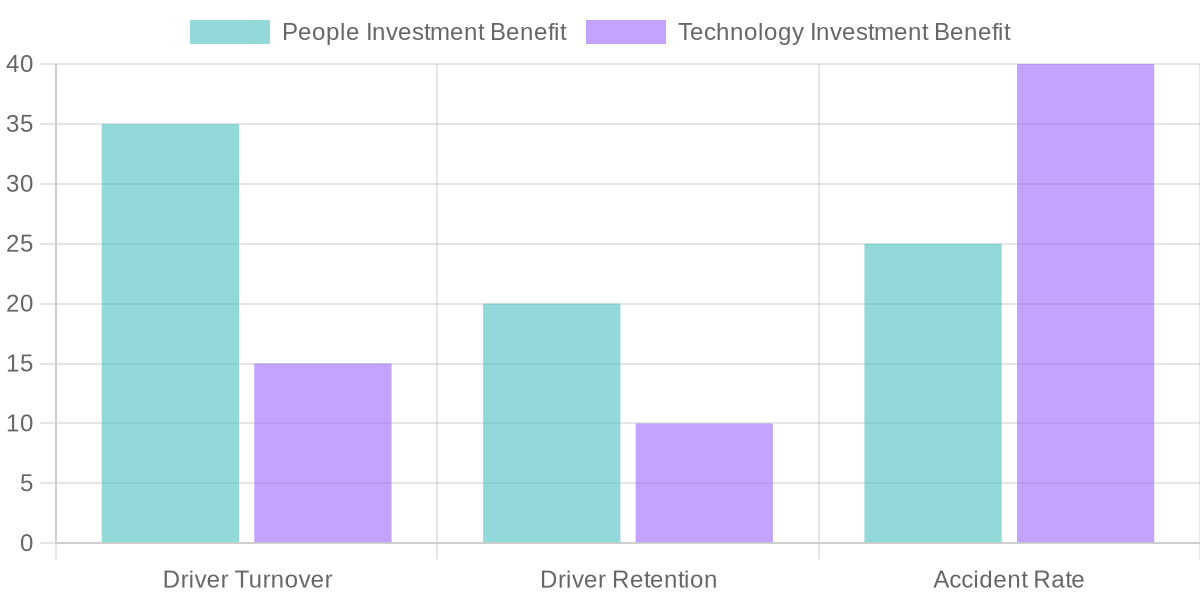
Recent data from the trucking industry reinforces the significance of investing in human capital over merely adopting digital tools. A 2023 survey indicated that 68% of trucking companies prioritizing human-centric initiatives, such as mentorship and improved communication, reported enhanced driver retention and satisfaction. In contrast, only 22% experienced similar outcomes through technology investments alone. This suggests that fostering a constructive workplace culture significantly impacts overall performance.
Moreover, organizations concentrating on employee development reported a 45% reduction in turnover rates, compared to just a 12% improvement for those focusing only on technological advancements. The American Trucking Associations also revealed that strong organizational cultures correspond to a 50% higher adoption rate of new technologies, as engaged employees tend to be more receptive to digital tools.
Additionally, companies emphasizing a supportive culture reported 30% fewer safety incidents and achieved 40% better on-time deliveries. This data underscores the tangible benefits of investing in people. McKinsey further corroborates this viewpoint, finding that logistics organizations prioritizing human-centric strategies achieved 2.5 times higher user adoption rates for new tools compared to those relying solely on digital solutions.
Generational Shifts in the Workforce
As the workforce undergoes generational shifts, the trucking industry must adapt its approach to employee training and onboarding. Younger generations, such as Millennials and Generation Z, place a high value on flexibility, professional development, and technology integration in their work environments. This shift requires companies to implement tailored training programs that not only equip new employees with essential skills but also align with their expectations of a supportive and engaging workplace. Traditional training methods may no longer resonate effectively with these younger workers, necessitating an evolution in the way onboarding processes are structured.
Moreover, with the retirement of older workers, the industry faces a transition that highlights the importance of engaging younger talent. As companies seek to retain their workforce, investing in development opportunities and modern onboarding practices becomes essential. By fostering an environment conducive to professional growth, trucking fleets can not only fill the generational gap but also cultivate a more agile and adaptive workforce capable of meeting the demands of a rapidly changing industry.
Addressing Common Objections to Investing in People
Investing in people within the trucking industry often faces skepticism, with common objections hindering workforce development initiatives. Critics sometimes argue that immediate returns are more easily achieved through technology rather than what they perceive as costly and time-consuming employee training. Some even suggest that investing in existing staff may not yield results since employees might leave for better opportunities.
However, evidence strongly counters these objections. According to findings from the American Trucking Associations, investing in driver safety training and career development can reduce turnover rates by 30%, demonstrating that well-trained drivers are less likely to leave [1]. Furthermore, companies that prioritize human capital see improved safety outcomes, with accident costs decreasing by up to 40% due to comprehensive training and wellness programs [1].
In addition, a recent article in the Harvard Business Review states that for every dollar saved by skimping on training and development, companies may lose four dollars in recruitment costs, accidents, and inefficiencies, presenting a compelling argument for investing in workforce culture [3]. Ultimately, businesses that invest in their employees tend to outperform competitors in both retention and profitability, affirming the critical role of human capital in driving long-term success.

Conclusion
In summary, the importance of investing in people within the trucking industry cannot be overstated. While technological advancements offer undeniable benefits, the foundation of a successful fleet operation lies in a robust workplace culture that prioritizes communication, employee well-being, and professional development. Industry leaders consistently emphasize that organizations embracing human-centric strategies see improved retention rates, higher morale, and lower turnover compared to those hinging solely on technology. Fleet operators must recognize that by fostering an environment where employees feel valued and supported, they not only enhance their job satisfaction but also drive operational efficiency and customer loyalty.
As we move forward in an ever-evolving industry landscape, the message is clear: investing in culture and people is not just an option; it is a necessity for long-term success. We urge fleet operators to shift their focus from a purely technological mindset to one that appreciates the indispensable role of their workforce. In doing so, they will build resilient operations equipped to tackle both current challenges and future demands, ensuring a thriving environment for all stakeholders involved.

Optimizing for SEO: Investing in People in the Trucking Industry
In the fast-evolving trucking industry, fleet operators often stand at a crossroads. They face a compelling choice: embrace cutting-edge technology or cherish the timeless value of investing in people in the trucking industry. While digital innovation, AI, and automation reshape operations, the desire to prioritize gadgets over the incredible workforce that drives success becomes ever more tempting. However, industry leaders like David Kelly remind us of an essential truth: many customers still prefer personal interaction. This fact illustrates that the human touch remains indispensable.
Investing in workforce culture, communication, and training isn’t merely an option—it is an absolute necessity. It transforms employees from manual operators into agile, high-value contributors who can navigate the complexities of modern logistics. This narrative extends beyond technology; it is about fostering an environment that enables individuals to thrive, adapt, and lead. By actively nurturing talent through cross-training and employee onboarding, fleet operators can ensure that their organizations not only keep pace with the industry but also set the standard—valuing both innovation and humanity.
Cultural Aspects of Investment in People
Investing in people within the trucking industry extends far beyond mere training and tools; it is fundamentally about cultivating a workplace culture that values communication and psychological well-being. Recent research underscores that a strong organizational culture plays a vital role in retaining talented drivers—trucking companies with robust cultures experience up to 30% lower driver turnover rates.
Additionally, companies that prioritize mental health and wellness investments see tremendous returns. Organizations emphasizing a supportive culture have reported a 45% reduction in absenteeism. The American Trucking Associations also highlighted that strong organizational cultures correspond to a 50% higher adoption rate of new technologies, as engaged employees tend to be more receptive to digital tools.
Conclusion
Balancing investments in technology with a strong commitment to human capital has proven to yield optimal results in the trucking industry, enhancing both operational efficiency and employee satisfaction. As we move forward in an ever-evolving industry landscape, the message is clear: investing in culture and people is not just an option; it is a necessity for long-term success. Fleet operators must recognize that by fostering an environment where employees feel valued and supported, they not only enhance job satisfaction but also drive operational efficiency and customer loyalty.
By integrating these keyword strategies, readers and search engines alike will better understand the article’s focus on investing in people in the trucking industry and its significant impact on the industry’s success.
In the fast-evolving trucking industry, fleet operators often stand at a crossroads, facing a compelling choice: embrace cutting-edge technology or cherish the timeless value of investing in people. While automation and digital tools reshape operations, the desire to prioritize gadgets over the incredible workforce that drives success becomes ever more tempting. However, industry leaders like David Kelly remind us of an essential truth: many customers still prefer personal interaction. This illustrates that the human touch is indispensable. By investing in workforce culture, communication, and training, companies transform employees from manual operators into agile, high-value contributors capable of navigating the complexities of modern logistics.
This narrative extends beyond technology; it is fundamentally about fostering an environment that enables individuals to thrive, adapt, and lead. As we explore the insights of today’s leading executives, it becomes clear that a culture rooted in investment in people can pave the way for sustainable success. The discussion then shifts to the cultural aspects of investing in people and the implications for organizational success.
Cultural Aspects of Investment in People
Investing in people transcends mere training and tools; it is about cultivating a workplace culture that values communication, recognition, and psychological well-being. Research underscores that strong organizational culture plays a vital role in retaining talented drivers—trucking companies with robust cultures experience up to 30% lower driver turnover rates. Supportive environments are linked to higher job satisfaction, reduced stress levels, and fewer safety incidents.
Strong communication practices are pivotal, as revealed by a report from the Commercial Carrier Journal, indicating that 68% of drivers who leave their jobs cite poor communication as a key factor. By prioritizing communication protocols, companies can not only boost driver satisfaction by 25% but also reduce preventable accidents by 15%.
Furthermore, firms investing in mental health and wellness report significant returns. According to Trucking HR Canada, 68% of truck drivers in organizations fostering a culture of well-being report enhanced mental health, leading to a remarkable 45% decrease in absenteeism.
With a commitment to a supportive operational culture, firms can also benefit financially, as highlighted in the Harvard Business Review, with healthcare costs significantly lower due to fewer stress-related claims. Ultimately, this focused investment fosters a workforce that can effectively respond to the challenges of their roles, ensuring both employee engagement and enhanced performance.
Successful Strategies in People-Focused Management
Building on these cultural practices, successful strategies in people-focused management are crucial for implementing change. For instance, Purolator is renowned for its people-first culture. With extensive training programs and strong safety measures, they emphasize employee recognition to drive operational excellence. John Ferguson, their CEO, captures this ethos well, stating, “Our people are the backbone of our operations. By investing in their growth and creating a supportive environment, we enhance their experience and drive customer satisfaction.”
Similarly, Innocon’s innovative workforce culture revolves around flexible scheduling and career development paths. Dr. Lisa Wong from the University of Toronto articulates that their strategy confirms prioritizing employee well-being correlates directly with reduced turnover and heightened productivity in the trucking sector.
By integrating engagement initiatives like mentorship opportunities and transparent communications, firms can reinforce a culture of collaboration, leading to significantly higher employee satisfaction metrics and reduced operational costs.